Mise: The Smart Meal Prep Tool That Gets Every Dish to the Table at the Same Time

Mise is a free meal prep tool that schedules multiple dishes backwards from your target dinner time.
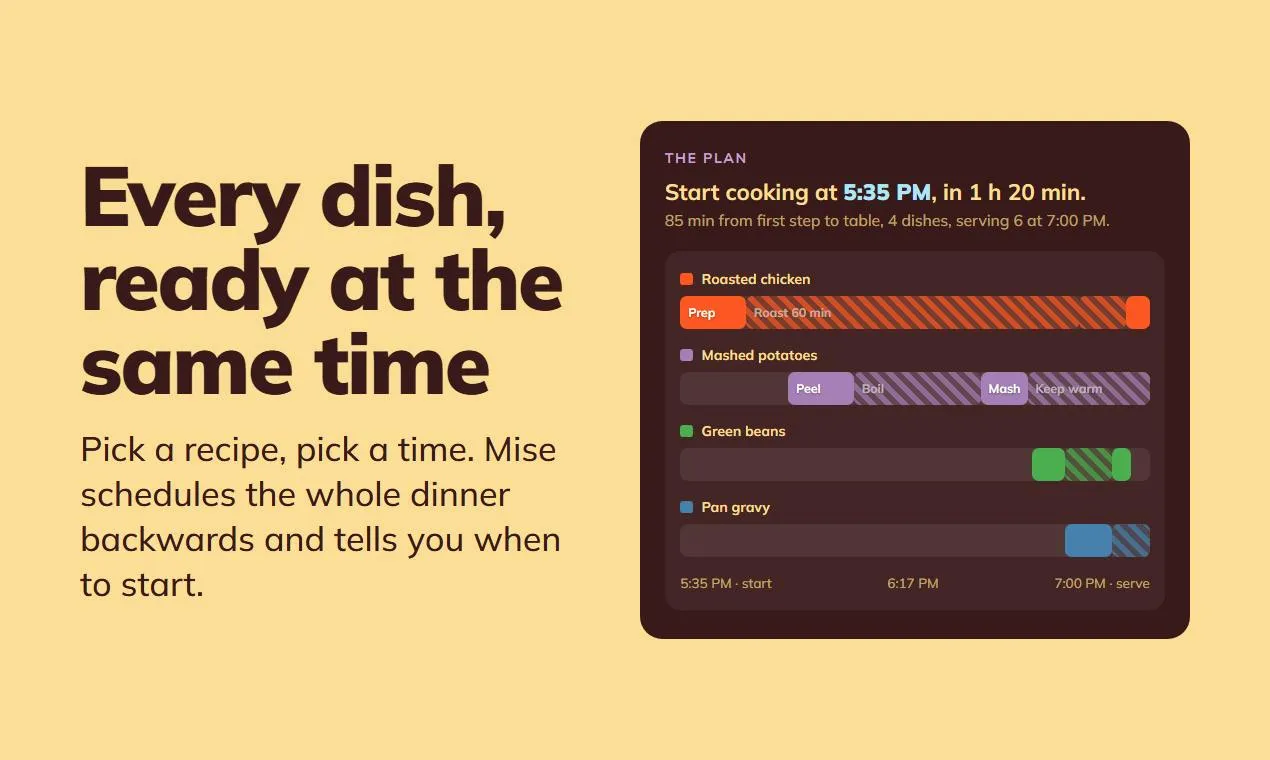
Mise is a meal prep planning tool designed to get multiple dishes on the table at the same time, debuting at #10 on Product Hunt. Its core idea is "backwards scheduling": users set a target dinner time, and the system automatically works backwards to calculate each dish's start time and sequence, generating a unified start time, an interleaved running order, a consolidated shopping list, and a real-time cooking guide. Free and login-free, it focuses entirely on the single problem of synchronizing multiple dishes — a prime example of AI solving concrete, everyday pain points.
A Overlooked Pain Point in Cooking
The vast majority of recipes only teach you how to make one dish at a time — but a real meal almost always involves several. When you're juggling a main course, side dishes, and soup simultaneously, the hardest part is never the recipe itself. It's timing coordination — getting everything ready, hot, and on the table at the exact same moment.
That's precisely the problem Mise, a new product on Product Hunt, is trying to solve. It ranked #10 on the day's leaderboard with 83 upvotes — not a staggering number, but the product targets a scenario that almost every home cook has faced and that very few tools have seriously addressed.
Mise's Core Idea: Schedule Backwards from Dinner Time
Mise's product logic is refreshingly clear. It's not another recipe library — it's a multi-dish meal prep coordinator. Its approach can be summed up as "backwards scheduling": you set a target time to eat, and Mise works backwards from that endpoint to calculate when each dish needs to start and in what order.
According to its official description, the system generates:
- A single unified start time — telling you exactly when to begin
- A running order — a sequenced schedule for interleaving multiple dishes
- A consolidated shopping list — all ingredients across every dish, merged and deduplicated
- A cooking mode — a real-time guided interface to follow while you cook
In other words, Mise transforms the experience of coordinating multiple dishes — something that normally requires experience and mental math — into an executable checklist covering ingredients, steps, and reminders. For dinner parties and holiday meals with many courses, this capability is far more practical than any single recipe.
Why "Finishing Everything at Once" Is So Hard
Anyone who's cooked a multi-dish meal knows the challenge: the stew needs an hour's head start, the greens go in last, the oven roast has a fixed cook time, and you only have two hands and limited burners. The traditional approach requires a cook to mentally maintain a dynamic schedule — and the slightest lapse leads to situations like "the main is done but the side dish hasn't even started" or "the soup went cold ages ago." Mise's value lies in making this hidden time management visible and automatic.
The name "Mise" comes from the French culinary term mise en place (literally "everything in its place") — referring to the professional chef's practice of preparing all ingredients, tools, and seasonings before cooking begins. It's a fundamental discipline in restaurant kitchens: head chefs complete their cutting, measuring, and preheating hours before service, ensuring smooth execution during the rush. Using this term as the product name signals Mise's design philosophy: helping home cooks plan and coordinate ahead of time, like a professional kitchen, rather than figuring things out on the fly.
Low-Friction Design for Everyday Users
Mise takes a notably restrained approach to the usage barrier. The product is free and requires no login — lowering the cost of trying it out, so users can access the full scheduling experience without creating an account or paying anything. This "zero friction" strategy is a well-known accelerant for early adoption of utility tools.
Product Hunt categorizes it under three tags: Productivity, Cooking, and Artificial Intelligence. Based on its feature description, AI's role is primarily in automating the schedule generation and intelligently merging ingredient lists. While the team hasn't shared detailed technical specifics, this kind of "automate complex coordination" use case is a textbook example of AI gradually working its way into everyday life.
"Backwards scheduling" is a classic methodology in project management, commonly used in engineering and event planning: you lock in the final deadline, then work forward to identify the start points and dependencies of each preceding phase. Applying this to the kitchen is completely natural — dinnertime is a non-negotiable endpoint, while cooking steps like braising time, oven preheating, and dough proofing all have relatively fixed durations that are easy to auto-calculate backwards from. It's essentially the same problem as Gantt chart scheduling — just with "heat and timing" replacing "task dependencies."
A Small, Focused Tool
Mise was built by Andrew Tye and remains a tightly focused single-purpose product. It doesn't try to become a sprawling recipe community or a full meal-planning platform — it zeroes in on one specific problem: getting multiple dishes done at the same time. That focus is both its strength and potentially its ceiling. For someone cooking just one dish, Mise offers limited value; but for home cooks who regularly prepare multi-course meals, it fills a real and previously underserved gap.
From a product positioning standpoint, Mise represents a trend worth watching: using AI in concrete, tangible everyday scenarios rather than building vague "intelligent assistants." Solving a specific problem like "how do I time these five dishes tonight" is often a far more effective way to win users than grand, sweeping visions.
Summary
Mise takes a simple but clever approach — scheduling backwards from your target dinner time — to solve the classic challenge of synchronizing multiple dishes. It's free, requires no login, and is quick to pick up, transforming what was once experience-dependent kitchen time management into an actionable checklist. For anyone who loves hosting multi-course dinners at home, it's well worth trying. That said, as a newly launched product, the real-world accuracy of its scheduling and the breadth of its ingredient database still await validation in actual home kitchens.
Related articles

LLM Application Development: A High-Paying Career Guide for Ordinary People
LLM application development offers fresh graduates up to 35K/month, with SP offers reaching 600K. This article explains the core skills, how to break in, and how ordinary people can seize AI opportunities through learning by doing.

Say Goodbye to AI Influencer Faces: A Complete Guide to Creating Visual Assets for AI Comic Dramas from Scratch
Bilibili creator shares a full workflow for zero-basics AI comic drama visual assets: use Doubao Work skills with script-first, visual references, and real-person texture to escape AI influencer faces, then lock character and scene consistency with asset sheet layouts, weapon detail images, scene nine-grids, and cinematic color palettes.

The AI Production Pipeline Behind Great Videos: From Research to Agent Validation
AI video production isn't just a model race. This article breaks down a transferable four-step pipeline: researching professional workflows, organizing a skill checklist, configuring agents, and experimental validation—and explains how general-purpose LLMs like DeepSeek can replace paid tools to run the entire process.