Modeling Fast Human Reactions from High-Frequency Interaction Data: An Analysis of EMBER and ORBIT

The study uses millisecond-level CS2 telemetry to build the Ego-Knowledge framework and trains EMBER and ORBIT models to recognize fast fight-or-flight reactions, surpassing LLMs in accuracy.
This study explores whether fast human reactions can be modeled from high-frequency digital interaction data. Using millisecond-level *Counter-Strike 2* telemetry, the authors propose an "Ego-Knowledge" framework to generate 60–120 ms "fight-or-flight" labels from visibility and damage-trigger events, and train the gradient boosting model EMBER and the Transformer model ORBIT. On the validation set, EMBER and ORBIT achieve accuracies of 73.5% and 71.2%, significantly outperforming the majority-class baseline (51.5%) and the strongest LLM baseline (62.7%), with orders of magnitude lower inference cost. Adding a short post-trigger window turns the task into early reaction recognition, with accuracy rising monotonically to 85.15%. The authors stress that the neuroscience interpretation is hypothesis-generating, and physiological validation and the limitations of reverse inference remain open questions.
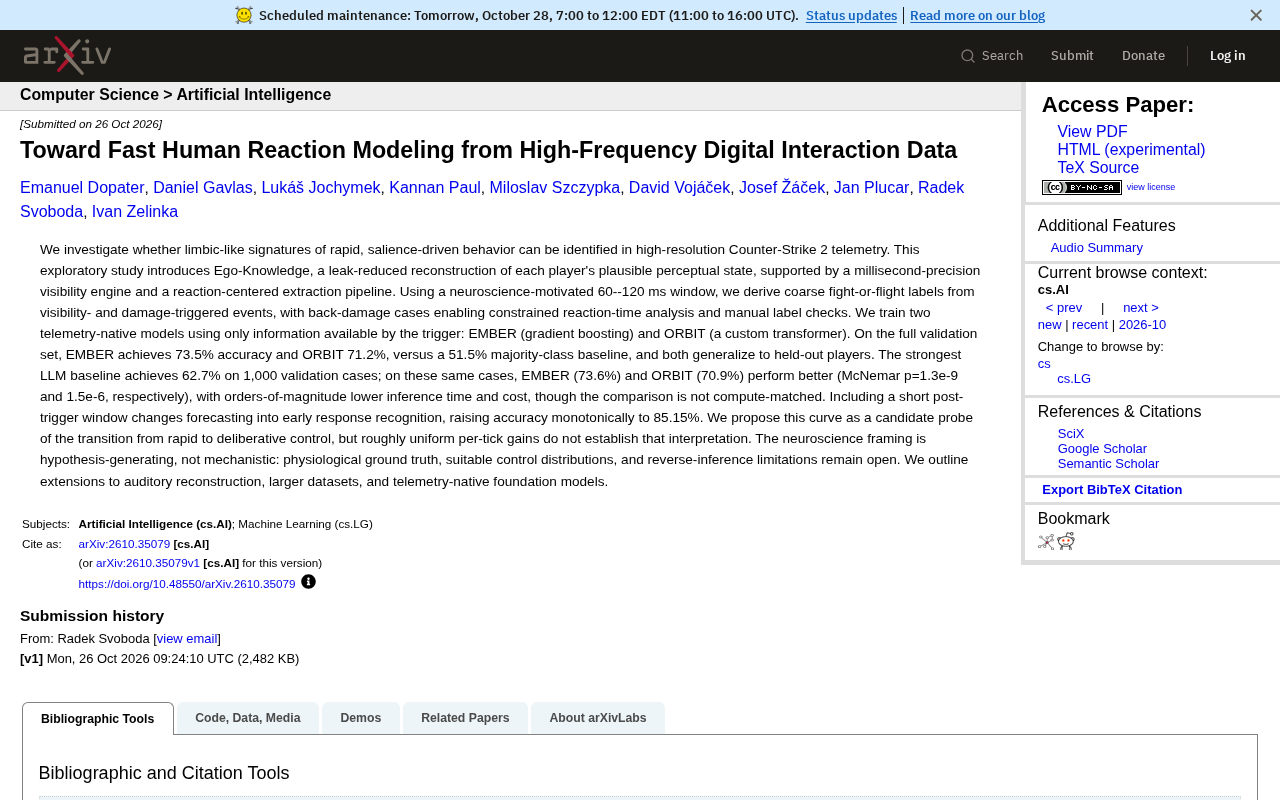
Can humans' fast reactions under high-pressure situations—such as an instant dodge or counterattack in an esports match—be modeled or even predicted from high-frequency digital interaction data? A recent exploratory study offers a preliminary answer. Researchers used millisecond-level telemetry data from Counter-Strike 2 to build an "Ego-Knowledge" framework and trained two telemetry-native models, attempting to identify fight-or-flight-like fast behavioral signatures from visibility and damage-trigger events.
Research Background and Core Questions
Traditional reaction-time research mostly relies on controlled experiments in laboratory settings, with limited ecological validity. High-frequency digital interaction data—especially telemetry records from competitive games—provides a nearly continuous stream of behavior containing rich perception-action coupling information. The core question the researchers posed is: can limbic-like fast, salience-driven behavioral signatures be identified in these data?
To this end, they introduced the concept of "Ego-Knowledge," referring to a low-leakage reconstruction of each player's possible perceptual state. This relies on a millisecond-precision visibility engine and a reaction-centered extraction pipeline, ensuring the label generation process stays as close as possible to real perceptual events.
The limbic system is a set of neural structures in the brain closely associated with emotion, motivation, and survival behaviors, including the amygdala, hippocampus, hypothalamus, and others. The amygdala plays a key role in threat detection and the "fight-or-flight" response: when an individual perceives a salient threat, the amygdala can bypass higher-order cortex and trigger immediate physiological and behavioral responses through fast subcortical pathways, a process typically completed within tens to just over a hundred milliseconds. The researchers' "limbic-like" features refer to fast, salience-driven behavioral patterns with low conscious involvement exhibited in the data, rather than direct measurement of limbic system activity.
Methods: From Fight-or-Flight Labels to Telemetry-Native Models
The study adopted a neuroscience-motivated 60–120 millisecond time window to derive coarse "fight-or-flight" labels from visibility and damage-trigger events. Cases of damage to the back allowed for restricted reaction-time analysis, supplemented by manual label checks. Based on these labels, the team trained two telemetry-native models that use only information available at the trigger moment:
- EMBER: a gradient boosting model
- ORBIT: a custom Transformer model
Neither relies on any future information or hindsight data, ensuring the causality of predictions.
Gradient boosting is a class of ensemble learning methods that trains weak learners (usually decision trees) round by round, with each round fitting the residuals of the previous round, and finally combining them in a weighted manner into a strong model. Its advantages lie in automatically capturing nonlinear interactions among features, being especially efficient for tabular telemetry data, and offering fast inference and relatively good interpretability. Transformer, on the other hand, is based on the self-attention mechanism and can model dependencies between any positions in a sequence, making it suitable for processing high-frequency interaction event streams. The comparison between the two in this study reflects the different trade-offs between traditional machine learning and deep sequence models in millisecond-level behavior modeling.
The McNemar test is a statistical test for paired binary data that compares the distribution of disagreements in predictions between two models on the same batch of samples to determine whether the difference in their accuracy is significant. In this study, the p-values were far below 0.05, indicating that the results showing EMBER and ORBIT outperforming the LLM baseline are unlikely to be caused by random fluctuation, enhancing the statistical credibility of the conclusions.
Main Results: Significantly Outperforming Baselines and LLMs
On the full validation set, EMBER achieved 73.5% accuracy and ORBIT 71.2%, while the majority-class baseline was only 51.5%. Both models generalized to unseen players. More strikingly, in comparison with large language models (LLMs): on 1,000 validation cases, the strongest LLM baseline achieved 62.7% accuracy, while EMBER (73.6%) and ORBIT (70.9%) performed better, with McNemar test p-values of 1.3e-9 and 1.5e-6, respectively, indicating statistical significance. At the same time, the inference time and cost of these two models are orders of magnitude lower than those of LLMs—although the authors cautiously note that the comparison was not compute-matched.
From Prediction to Recognition: Introducing a Post-Trigger Window
When a short time window after the trigger moment is added, the task shifts from "prediction" to "early reaction recognition," and accuracy rises monotonically to 85.15%. The researchers propose that this curve of accuracy changing with window length can serve as a candidate probe for the transition from fast control to deliberative control. But they also acknowledge that the per-tick gains are roughly uniform and cannot confirm this interpretation.
Open Questions and Future Directions
The authors emphasize that the neuroscience framework is hypothesis-generating rather than mechanistic. Physiological ground truth, appropriate control distributions, and the limitations of reverse inference remain unsolved challenges. Future work will extend to auditory reconstruction, larger-scale datasets, and telemetry-native foundation models.
This study demonstrates the potential of high-frequency interaction data for modeling fast human reactions and provides a new tool for cross-disciplinary research between cognitive science and game data. Although mechanistic understanding is still out of reach, the performance of EMBER and ORBIT lays a reproducible benchmark for subsequent exploration.
One-line Summary
This study uses millisecond-level CS2 telemetry data to build an Ego-Knowledge framework and trains EMBER and ORBIT models to recognize fast fight-or-flight reactions, achieving accuracy beyond LLMs.
Paragraph Summary
This study explores whether fast human reactions can be modeled from high-frequency digital interaction data. Using millisecond-level Counter-Strike 2 telemetry, the authors propose an "Ego-Knowledge" framework that generates "fight-or-flight" labels in 60–120 ms windows from visibility and damage-trigger events, and train the gradient boosting model EMBER and the Transformer model ORBIT. On the validation set, EMBER and ORBIT achieve accuracies of 73.5% and 71.2%, respectively, significantly outperforming the majority-class baseline (51.5%) and the strongest LLM baseline (62.7%), while requiring orders of magnitude lower inference cost. After introducing a short post-trigger window, the task becomes early reaction recognition, with accuracy rising monotonically to 85.15%. The authors emphasize that the neuroscience interpretation is hypothesis-generating, and physiological validation and the limitations of reverse inference remain open questions.
Related articles

RAG Interview Essentials: Breaking Down the Full Offline Indexing and Online Retrieval Pipeline
A complete breakdown of the RAG retrieval-augmented generation workflow: offline document loading, chunking, vectorization, and indexing; online query rewriting, vector retrieval, reranking, and generation, plus core interview points and system optimization directions.

AI Large Models for Absolute Beginners: Principles and API Calling in Practice
From AI's evolution to large model training principles and core concepts like Token, Temperature, and Top-P, this article explains system prompts, Function Call, RAG, and memory with hands-on examples and four API call scenarios—ideal for beginners.

Will GitHub Die? Open Source Maintainer Burnout and the Collaboration Crisis in the AI Era
Lex Fridman podcast discussion on open source maintainer burnout and GitHub's predicament: massive pull requests overwhelm core maintainers, and AI worsens code bloat. Using math journal peer review and Poincaré conjecture verification as analogies, the article analyzes why verification in knowledge production must be deliberately slow, and how open source communities can avoid the failure mode of maintainers exiting.