MuJoCo Parallel Training: Single World with Multiple Robots vs. Independent Environments

Single-world multi-robot vs. independent environment parallelism are different levels of parallelism; GPU acceleration should use batched independent environments, not a shared world.
The article clarifies the confusion between "single world with multiple robots" and "one robot per environment" in RL training. The core difference lies in environment isolation and sample correlation: a shared world suits multi-agent interaction and visualization but introduces physical interference; independent environment parallelism is the standard efficient paradigm for single-agent RL. GPU acceleration (e.g., MJX, Isaac Gym) essentially batch-simulates many independent environments, so after migrating from CPU to GPU, keep the "one environment, one robot" structure and only use a shared world when multi-agent interaction or demos are needed.
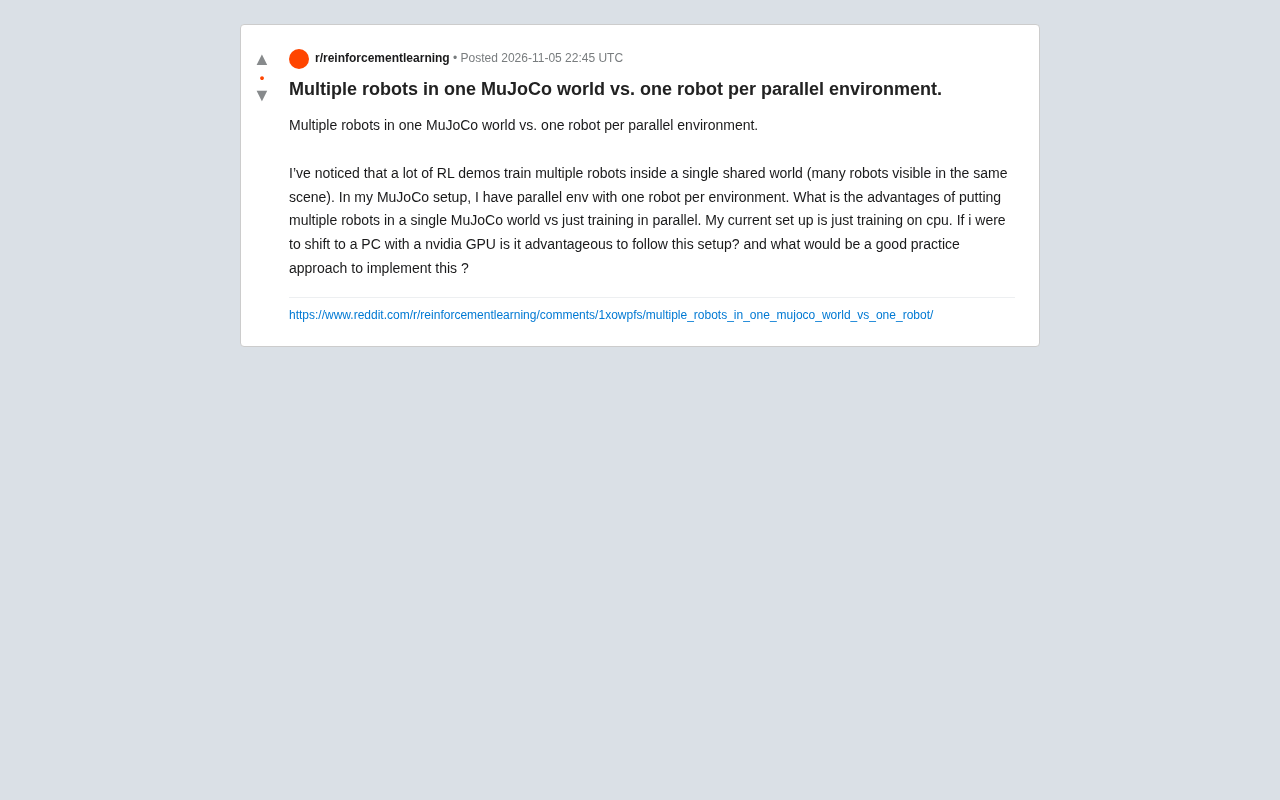
In reinforcement learning (RL) demos, it's common to see a scene with multiple robots running simultaneously—they share the same physics world and can see each other. But in many people's actual setups, such as the MuJoCo environment used by the person asking the question, each parallel environment contains only one robot. What exactly is the difference between these two approaches? And when training migrates from CPU to a PC with an NVIDIA GPU, how should one choose?
The Essential Difference Between the Two Parallel Paradigms
The questioner's confusion is typical: they've seen many RL demos training multiple robots in a shared world, while their own MuJoCo setup uses parallel envs with "one robot per environment." Both are called "parallel," but the parallelism occurs at different levels.
Single world with multiple robots: All robots share the same physics simulator instance, and physics stepping is synchronized. Robots may interact with each other (collisions, occlusion, sensor interference, etc.), depending on whether they are physically close.
Independent environment parallelism: Each environment has its own physics world and robot copy, and environments are completely isolated from each other. Parallelism is typically achieved through multiprocessing (e.g., vectorized environments on CPU) or batched simulation on GPU.
The core difference between the two lies in environment isolation and sample correlation. Independent environments naturally provide independent experience streams, while a shared world may introduce implicit coupling between robots.
Vectorized Environment is a key concept for understanding independent environment parallelism. In standard RL interfaces (such as OpenAI Gym), one environment instance corresponds to one step() and reset() call. A vectorized environment wraps multiple such instances into a batched interface, presenting externally as a single "environment" but internally advancing N independent copies in parallel, returning a batch of observations, rewards, and done flags each time. There are two main implementation approaches: on CPU through multiprocessing (e.g., SubprocVecEnv) or thread parallelism, and on GPU through hardware-accelerated batched simulation (e.g., Isaac Gym, MJX) that steps thousands of environments simultaneously on a single card. The value of vectorized environments is that they make sampling throughput grow linearly with the number of parallel instances while maintaining the physical isolation of each copy, thereby providing low-variance, independent and identically distributed batch experience for policy gradient methods. This is also the standard configuration of modern RL training frameworks (such as Stable-Baselines3, RLlib).
Advantages and Use Cases of Single World with Multiple Robots
Putting multiple robots into one world isn't just for making demos look good. It has several practical advantages:
- Rendering and visualization efficiency: Rendering multiple robots in one scene saves more resources than opening multiple windows, especially suitable for recording demo videos or debugging observations.
- Facilitating interactive learning: If the task itself involves multi-agent cooperation, competition, or avoidance, a shared world is necessary. Interactions between robots are part of the learning signal.
- Amortizing physics engine overhead: In some implementations, multiple robots within one world can share low-level computations such as collision detection and constraint solving, theoretically making the per-robot overhead potentially lower than in completely independent worlds.
But the costs are also obvious: robots may produce unexpected physical interference, increasing environment non-stationarity; if they are too close, collisions and contacts will pollute the learning signal.
Advantages of Independent Environment Parallelism
The questioner's current approach of "one robot per environment" is actually the more common and correct approach in standard single-agent RL:
- Experience independence: Each environment samples independently, resulting in lower variance in gradient estimates and more stable training.
- Easy to vectorize: Can be efficiently scaled with CPU multiprocessing or GPU batched simulation.
- Avoiding interference: No accidental collisions or sensor pollution between robots, and task definitions are clear.
For single-robot tasks (such as locomotion, manipulation), independent environment parallelism is the cleaner choice. Multiple robots in a shared world are often for visualization or specific multi-agent tasks, rather than performance optimization for single-agent training.
Sample correlation is a core issue in RL training stability. In a single-world multi-robot setup, robots share the same physics timeline, their observations and actions are highly synchronized in time, and they may become coupled due to physical interactions (such as collisions). This leads to implicit correlation between batch experiences, breaking the assumption of "sample independence" in stochastic gradient estimation, potentially increasing variance and slowing convergence. In contrast, in independent environment parallelism, each environment has its own random initial state and dynamics noise, and the sampled trajectories are mutually independent, making gradient estimates closer to the true expectation. Additionally, independent environments facilitate domain randomization: each environment can sample different physical parameters (mass, friction coefficients, etc.), thereby improving the policy's generalization ability. This "environment-level" diversity is difficult for a single world with multiple robots to provide.
Considerations After Migrating to GPU
The questioner currently trains on CPU and wants to know whether they should switch to a single world with multiple robots after moving to an NVIDIA GPU. Here we need to distinguish two concepts: GPU-accelerated physics simulation and single world with multiple robots are not the same thing.
Platforms like MuJoCo's GPU backend (such as MJX) or Isaac Gym have their advantage in batch-simulating large numbers of independent environments on GPU, not in cramming multiple robots into one world. In fact, the typical paradigm of Isaac Gym is thousands of independent environments in parallel, each with one robot, stepped in batches through GPU tensor operations.
Therefore, after migrating to GPU, the more reasonable approach is to continue using "independent environment parallelism" but leverage GPU batched simulation to greatly increase throughput. Single world with multiple robots is not a necessary requirement for GPU acceleration; on the contrary, it may add unnecessary computation and complexity due to inter-robot interactions.
MJX is the GPU-accelerated version of MuJoCo, implemented based on JAX, expressing physics simulation as differentiable, batchable functions. Unlike traditional MuJoCo single-instance CPU stepping, MJX uses JAX's vmap and pmap primitives to simulate hundreds or thousands of independent environments simultaneously on GPU, each with different initial states and parameters. Its typical usage is: define a single-environment simulation function, then vectorize it with jax.vmap, and compile it into a GPU kernel through jax.jit. This way, a single step call can advance the entire batch of environments, with throughput far exceeding CPU multiprocessing. It should be noted that MJX's support for contact-rich scenarios (such as frequent collisions between multiple robots) is still being improved, and the differentiable feature is mainly used for system identification and trajectory optimization, rather than directly replacing the standard RL training loop. For single-robot locomotion tasks, the standard MJX paradigm is exactly "batched independent environments," not a single world with multiple robots.
Practical Recommendations
If the goal is to train a single-robot policy, it is recommended to:
- Maintain independent environment parallelism, whether through CPU multiprocessing or GPU batched simulation.
- If using GPU simulation (such as MJX, Isaac Gym), prioritize the batched independent environment paradigm to fully utilize GPU parallel capabilities.
- Only consider a single world with multiple robots when multi-agent interaction or visualization demos are needed.
- Pay attention to the balance between the number of environments and batch size, avoiding GPU memory overflow or excessive CPU processes causing scheduling overhead.
For the questioner's situation, after migrating from CPU to GPU, the most direct benefit is being able to run more parallel environments and collect samples faster, rather than changing the basic structure of "one environment, one robot." Unless the task itself requires interaction between robots, there is no need to switch to a single world with multiple robots for the sake of GPU.
Conclusion
Single world with multiple robots and independent environment parallelism solve different problems: the former is suitable for multi-agent interaction and visualization, while the latter is the standard efficient paradigm for single-agent RL training. The core of GPU acceleration is batch-simulating independent environments, not cramming robots into the same world. Understanding this will help avoid pitfalls when upgrading hardware.
One-line Summary
Single world with multiple robots and independent environment parallelism are different levels of parallelism; GPU acceleration should continue using batched independent environments rather than a shared world.
Paragraph Summary
The article clarifies the confusion between two parallel paradigms in reinforcement learning training: "single world with multiple robots" and "one robot per environment." The core difference lies in environment isolation and sample correlation: a shared world is suitable for multi-agent interaction and visualization but introduces unexpected physical interference; independent environment parallelism is the standard efficient paradigm for single-agent RL, offering independent experience streams, low-variance gradients, and easy vectorization. The article further points out that the essence of GPU acceleration (such as MJX, Isaac Gym) is batch-simulating large numbers of independent environments, not cramming multiple robots into the same world. Therefore, after migrating from CPU to GPU, one should maintain the "one environment, one robot" structure and use GPU batched simulation to increase throughput, only considering a single world with multiple robots when the task requires multi-agent interaction or demos.
Related articles
 Tech Frontiers
Sherlock: An Open-Source Tool for Tracking Usernames Across Social Networks
Sherlock is an open-source Python tool that tracks social accounts across networks by username. This article covers its core features, why developers love it, typical use cases, and privacy compliance considerations.
 Tech Frontiers
GitHub Daily·Nov 07: Agent-Ready and Context Compression
GitHub Trending Nov 07: meta's agent-ready design system astryx, billion-context's 5x context compression, sherlock nearing 100k stars, plus local-first localthings and bare-metal GPU orchestration nvke.
 Tech Frontiers
Buoyant Open-Sources Kinference: An Inference Control Plane for vLLM on K8s
Buoyant open-sources Kinference, an inference control plane for vLLM on Kubernetes, with declarative routing, KV-cache-aware load balancing, and per-tenant metrics—claiming 95% lower median TTFT in official benchmarks.