Muse Launches Chrome Extension: 200,000 Users Already on Board, Access AI Directly from the Sidebar
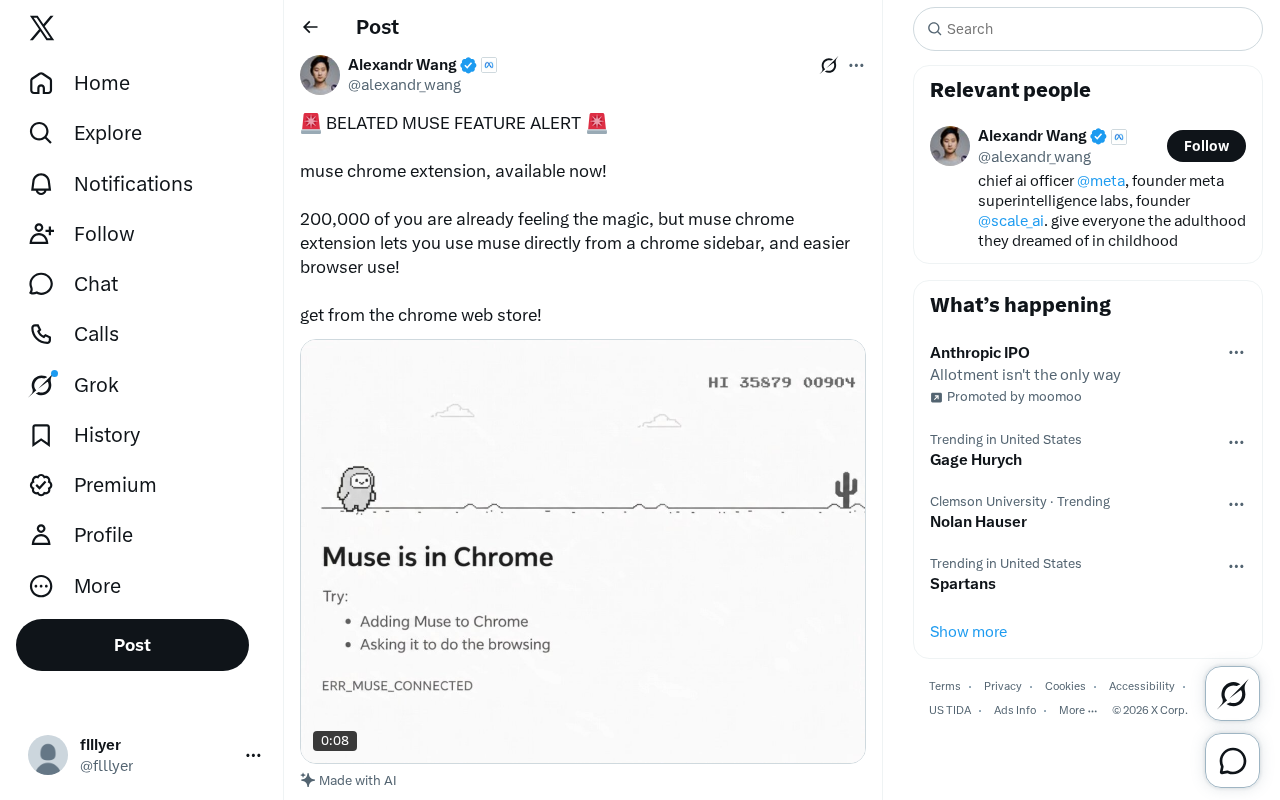
Muse launches a Chrome sidebar extension, with 200,000 users already on board.
AI tool Muse has officially launched a Chrome browser extension that embeds its core features into the browser sidebar, letting users invoke AI for questions, summaries, or content generation at any time while browsing without switching tabs. The company says 200,000 users are already using it and that it delivers a more convenient browsing experience. The article argues this format lowers the cost and psychological barrier of invoking AI and reflects how browsers are becoming a key battleground for AI assistant entry points. However, details such as the feature list, webpage reading scope, and free-tier limits have not been disclosed, and whether the sidebar becomes a standard AI entry point remains to be seen.
AI tool Muse has officially launched a Chrome browser extension that lets users access all of Muse's features directly from the sidebar without leaving their current page. According to the company, 200,000 users are already using the extension, which it says delivers a "more convenient browsing experience."
From Standalone Tool to Browser Sidebar: Muse's Lightweight Approach
Muse previously offered its services primarily as a standalone app or web page, requiring users to switch tabs or open a new window to use it. The new Chrome extension embeds Muse's core capabilities into the browser sidebar, letting users summon Muse at any time while browsing any webpage to ask questions, summarize content, or generate text.
In its tweet, the company described the change as a "late feature reminder" and emphasized that the extension is now available in the Chrome Web Store. From a product standpoint, the sidebar format lowers both the psychological barrier and the operational cost of invoking AI—especially well suited to scenarios that require frequent switching between web content and AI assistance.
The Signal Behind 200,000 Users: The Battle for the Browser Entry Point
The company noted that "200,000 of you are already feeling the magic," meaning 200,000 users are already using the extension. While this number can't compare with the user scale of leading AI products, for a vertical AI tool it demonstrates that the browser sidebar format meets real demand.
Browsers are becoming a key entry point for AI assistants. Embedding AI capabilities directly into users' everyday browsing paths—rather than requiring them to actively visit a standalone site—is an effective way to boost usage frequency and retention. Muse's decision to launch an extension now is a response to this trend.
The browser extension sidebar (Side Panel) is an official UI capability that Chrome introduced with Manifest V3 in 2022, allowing extensions to display a persistent independent panel on the right side of the browser window alongside the current webpage without obscuring the main content. Compared with earlier popups or injected overlays, the sidebar offers greater persistence—panel state can be preserved when users switch tabs—making it better suited to carrying conversational AI use cases that require continuous context. Manifest V3 also tightened restrictions on background scripts and remote code loading, which means AI extensions must follow clearer permission declarations when reading webpage content and calling cloud models, and users will see specific site-access authorization prompts during installation.
Experience and Limitations: What We Know So Far
According to the official tweet, the extension's core selling points are "use muse directly from a chrome sidebar" and "easier browser use." However, the tweet did not disclose details such as the extension's specific feature list, whether it supports reading content from all webpages, or whether there are free-tier limits.
Users interested in trying it can search for "muse chrome extension" in the Chrome Web Store to install it. Given that the company says 200,000 users are already using it, the extension's stability and basic experience should have been validated at a certain scale.
Whether a browser AI sidebar can "read" the current webpage depends on the type of permissions the extension requests. Typically, activeTab or host permissions are required to obtain page DOM content in order to enable summarization, Q&A, and other features; however, limited by the same-origin policy and sandboxing mechanisms, extensions generally cannot read content inside cross-origin iframes, and often cannot handle PDFs, Canvas-rendered content, or DRM-protected pages. In addition, the Chrome Web Store has explicit privacy policy disclosure requirements for extensions involving user data, and when page content is uploaded to the cloud, the data's purpose must be explained on the store page. These technical and compliance constraints are precisely the key factors that the official tweet did not elaborate on but that actually define the boundaries of the experience.
Conclusion
The launch of the Muse Chrome extension is another example of AI tools moving toward users' existing workflows. Whether the sidebar format can become a standard entry point for AI assistants remains to be seen through user retention and feature iteration, but a base of 200,000 users at least suggests this path is worth trying.
One-line Summary
Muse launches a Chrome sidebar extension, with the company reporting 200,000 users already on board.
Paragraph Summary
AI tool Muse has officially launched a Chrome browser extension that embeds its core features into the browser sidebar, letting users invoke AI for questions, summaries, or content generation at any time while browsing without switching tabs. The company says 200,000 users are already using the extension and that it delivers a more convenient browsing experience. The article argues that this format lowers the operational cost and psychological barrier of invoking AI, and reflects how browsers are becoming an important battleground for AI assistant entry points. However, the company has not yet disclosed details such as the extension's specific feature list, the scope of webpage reading, or free-tier limits, and whether the sidebar can become a standard entry point for AI assistants will depend on future retention and iteration.
Related articles

AiGO!!!!!×Ai Mujica Episode 12: The AI Industry Metaphor Behind "Forced Open Source"
*AiGO!!!!!×Ai Mujica* Episode 12 "Forced Open Source" packages the open-source vs. closed-source debate as an idol contract dispute, exploring compute shackles, massive penalties, and open-source sustainability.

DeepSeek Super Agent: How a Plugin-Based Harness Is Reshaping AI Agents
DeepSeek's Super Agent is built on DeepSeek Harness's plugin architecture, automating GitHub and Feishu without core changes. We break down its two-layer router-worker design, Frontier Harness Eval cost data, and prototype limits.

Rugu: The Open-Source Memory Plugin That Lets AI Truly Remember You and Even Dream
Rugu is an open-source, free DSH memory plugin that funnels QQ groups, private chats, and desktop into one memory, retrieves before replying, dreams at night to organize, and lets you view, edit, or delete memories.