DeepSeek Super Agent: How a Plugin-Based Harness Is Reshaping AI Agents

DeepSeek Super Agent proves a new agent system can be built with plugins alone, without touching the harness core.
The article uses DeepSeek's newly released Super Agent to show that the more notable story is how it was built: the whole system is just a set of plugins inserted into DeepSeek Harness as patch files, with no fork of the core. Citing CTO opinions and Frontier Harness Eval data, it argues the harness now matters more than the model—similar pass rates under the same model, but cost per successful task can differ severalfold. It then covers DSH's "everything is a plugin" design, Cordis-based spatiotemporal composability, the router-worker architecture with deterministic gate and mandate, and the counterintuitive batching efficiency. It cautions this is a research prototype with a small sample, narrow scope, and unresolved security issues.
DeepSeek's recently released "Super Agent" has sparked considerable discussion in developer communities, with many seeing it as the open-source answer to Claude Code. It lives in a GitHub repository, listens to issues and pull requests, and when team members raise a request, it opens an independent session to complete the work and submit a PR. But what's more noteworthy than the product itself is how DeepSeek built it—the entire system is just a set of plugins inserted into DeepSeek Harness.
Why the Harness Matters More Than the Model
For a long time, industry discussions about AI coding capability focused almost entirely on the model itself. But according to the views of the Instacart CTO and Box CTO on the VentureBeat podcast Beyond the Pilot, the more important variable today is actually the harness. Both technical leaders agree that the center of innovation has shifted from the model layer to the harness layer.
This judgment is backed by data. Frontier Harness Eval ran the same model, Kimi K3, across nine different harnesses and twelve configurations on the same batch of 30 tasks, with the harness as the only variable. Codex came out on top with a 66.7% pass rate, while DeepSeekAd Harness under its creator configuration and Claude Code both scored 63.3%. At the same pass rate, DeepSeek Harness cost about $3.28 per successful task, versus about $18.34 for Claude Code. Across the entire table, the cost gap between the cheapest and most expensive configurations reached roughly 17.5x.
It's worth noting that a sample of 30 tasks means a single task is worth about 3.3 percentage points, so Codex and DeepSeek are actually only one task apart. But the overall direction still holds: the harness is not a simple shell—it changes cost, caching, speed, and success rate while the model stays the same. When evaluating a model, it's best to test it across two or three harnesses; otherwise you may end up attributing harness problems to the model.
What is a harness: In the context of AI coding, a harness refers to the entire engineering system wrapped around a model that drives it to complete tasks, including the agent loop, prompt and context management, tool-calling protocols, permission control, caching strategy, retries and error handling, cost accounting, and more. The same model can perform very differently under different harnesses, because the model can only see the context the harness feeds it and can only act through the tools the harness provides. You can think of the harness as the "operating system" of the model: the model determines the upper bound of single-step capability, while the harness determines whether those capabilities can be stably and cheaply organized into complete tasks. This is also why, when evaluating coding models, you must fix and specify the harness used—otherwise results are hard to compare across the board.
DeepSeek Harness: Everything Is a Plugin
DeepSeek Harness (DSH) was released on August 13 alongside DeepSeek V4 Pro. It uses the MIT license, offers a Web UI and a desktop app, and starts with a single npx command. It isn't tied to DeepSeek's own models and can connect to other providers through OpenAI-compatible endpoints.
Its core philosophy is "everything is a plugin," and it executes on this quite thoroughly. Most agent frameworks consist of a core agent loop, model calls, and tool handling, with plugins attached on the periphery; DSH makes even the router itself, the tool registry, the session log, and even the agent loop into plugins. It builds on the Cordis framework proposed by several researchers in Beijing, whose paper describes it as a "programming paradigm of spatiotemporal composability."
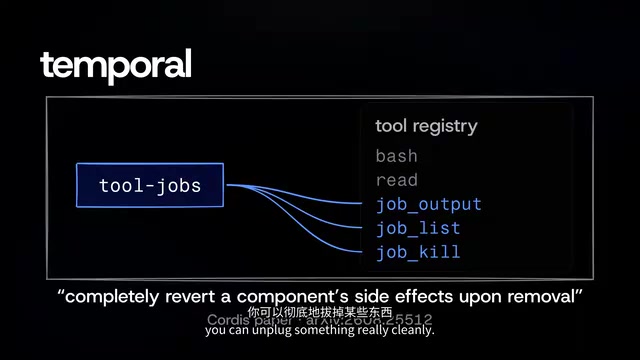
This design involves two concepts. Temporal composability means that when a component is unloaded, everything it did is fully undone—registered tools and event hooks are all rolled back. Spatial composability means that components declare their dependencies, and the runtime automatically activates or deactivates them based on whether those dependencies are present. For agent systems that need to frequently switch models, add tools, and toggle features by permission, this avoids leaving residual code behind with every change.
At runtime, DSH is a plugin tree composed layer by layer at startup: first the bundle (plugin packages and their patches), then home-level patches, and finally the parameters passed on the command line. Each layer can override configuration by plugin ID. The standard, minimal, creator, and other modes in the UI are essentially just different sets of plugins. Creator mode is the endpoint of this philosophy—you can describe a plugin in conversation, and the agent will write, install, and verify that it has taken effect.
Cordis and "spatiotemporal composability": Cordis is a dependency injection and lifecycle management framework for plugin-based systems. Spatial composability means components declaratively describe which services or plugins they depend on, and the framework decides at runtime, based on dependency relationships, whether and when to load them—so the same codebase can take different forms under different plugin combinations. Temporal composability focuses on the symmetry of component lifecycles: when a component is unloaded, the tools, event listeners, timers, and other side effects it registered during runtime are automatically reclaimed by the framework, leaving no residue. For agent systems, this means you can safely switch models, add or remove tools, or change permission modes mid-session without restarting the process or manually cleaning up state. DSH pushes this mechanism down into the agent loop itself, which is the technical prerequisite for its thorough "everything is a plugin" approach.
Super Agent Architecture: Router and Workers
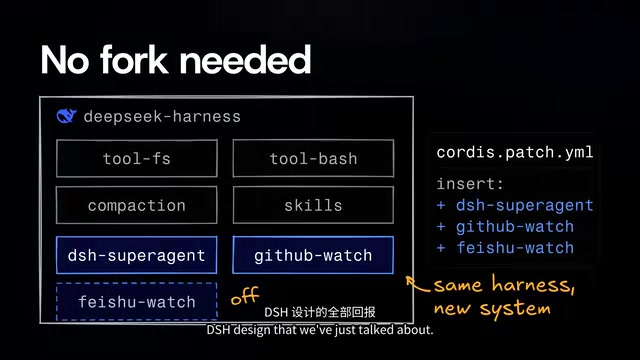
The way Super Agent is integrated is quite telling. Open the repository and almost the entire integration is written in a single file, cordis.patch.yaml: it inserts the core super agent plugin, the GitHub watcher plugin, and the Feishu watcher plugin. There's no forking of the harness, and the core repository doesn't accept external PRs—the way to contribute is to write plugins.
The architecture has two layers. At the top is a long-running router session responsible for all human interaction, maintaining global context, and dispatching tasks; at the bottom are worker agents, each running in an isolated session, not talking directly to people but reporting only to the router. All external input—new issues, comments, chat messages—first passes through a gate implemented in ordinary code rather than a model, which deterministically checks whether the initiator is on the allowlist and whether the agent is actually being invoked. Only after passing does the model judge whether this is real work; if so, it generates a ticket with a mandate, recording the initiator, the rules, and the permitted scope.
There's a noteworthy detail: after a worker takes over a ticket, it subscribes to that conversation, and comments on the PR go directly to the worker, bypassing the router entirely. Experiments showed that turning off this mechanism increased router decision volume by 30%, along with higher token consumption.
Even more counterintuitive is how the router behaves as a bottleneck. In stress tests, when trigger frequency rose from about once per minute to about 40 times per minute and average batch size grew from 1 to 2.8, a single call slowed from about 2.5 seconds to 3.9 seconds, yet thanks to batching, the time per decision actually dropped from 6.4 seconds to 1.6 seconds—the higher the load, the better the efficiency.
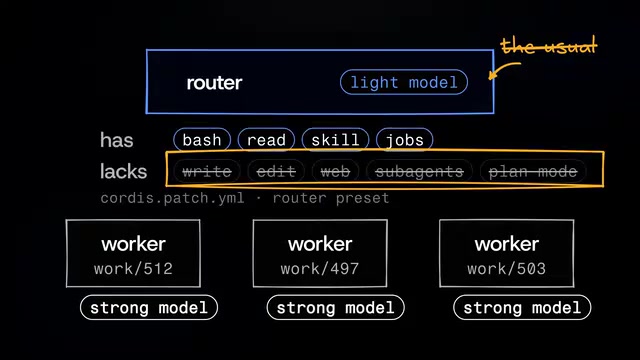
This also overturns the intuition that "the orchestrator must use the strongest model." The router's work is often simpler than imagined—it doesn't even need the bash tool—so a fast, cheap model suffices, while workers can actually use stronger models.
The role of the mandate: A mandate is a structured task credential generated by the router after confirming that an external request constitutes real work. It typically records the initiator's identity, the applicable rule constraints, the permitted repository scope, and the permission boundaries. It crystallizes "who is asking for what under what authorization" into context that worker agents can read, so workers executing in isolated sessions don't need to repeatedly verify with the router, and it makes it easier to trace responsibility when overreach or mistakes occur. From a security perspective, the mandate and the preceding deterministic gate together form two layers of protection: the gate uses ordinary code to filter out obviously invalid or unauthorized input, while the mandate limits the worker's radius of action after the model's judgment, reducing the risk of prompt injection inducing workers to perform out-of-scope operations.
Design Philosophy and Remaining Problems
Super Agent follows one principle: occupy as little human attention as possible and deliver as much value as possible. When starting work nobody asked for, it first enters a record-only, non-executing mode, verifies feasibility on its own, and speaks up only when there are results or a decision is needed.
The limitations are equally clear and should be viewed soberly. DeepSeek explicitly states that this is a research prototype rather than an official product, that the public code and the internal version are not identical, and that some designs described in the article (such as the watchdog session) have not yet made it into the repository. The current integration scope is narrow, covering only a single GitHub repository and Feishu. The benchmarks are based on synthetic workloads and simplified environments, and the 30-task sample is on the small side, so the rankings should only be taken as a rough reference. On security, prompt injection, credential leakage, and cross-device permission issues are officially acknowledged as not yet fully resolved.
As for its relationship to DSH's existing agent teams feature: agent teams coordinates multiple agents within a single task, whereas Super Agent handles multiple independent tasks continuously streaming in from outside over a long period—the two address different problems.
The real significance of Super Agent lies not in the product itself but in what it proves: without touching the harness core, a few patch files and plugins alone are enough to build a rather different kind of agent system. When the harness is evolving this fast, composable plugins are likely a direction more worth watching than a unified coding interface.
Prompt injection and credential leakage: Prompt injection refers to an attacker hiding malicious instructions in content the agent will read (such as issue bodies, PR comments, web pages, or files), inducing the model to deviate from its original task and perform operations the attacker intends. In the scenario of an agent listening to GitHub, any text submitted by an external user can serve as an injection vector. Credential leakage refers to the agent writing sensitive information such as API keys and tokens into logs, commits, or sending them to untrusted endpoints when calling tools or accessing external services. Cross-device permission issues arise when the agent has access beyond a single repository or a single user boundary. Common mitigations include least-privilege tokens, deterministic filtering of external input, execution in isolated environments, and requiring human confirmation for high-risk operations, but none of these can fully eliminate the risk—which is why the official listing of them as unresolved problems is reasonable.
One-line Summary
DeepSeek Super Agent proves that without changing the harness core, plugins alone are enough to build an entirely new agent system.
Paragraph Summary
Using DeepSeek's newly released "Super Agent" as a starting point, the article argues that what's more noteworthy than the product itself is how it was built: the entire system is just a set of plugins inserted into DeepSeek Harness as patch files, without forking the core code. Citing the views of the Instacart and Box CTOs and Frontier Harness Eval data, it shows that the harness has become a more critical variable than the model—under the same model, pass rates are similar, but cost per successful task can differ severalfold. It then introduces DSH's "everything is a plugin" design, its Cordis-based spatiotemporal composability, and Super Agent's two-layer router-worker architecture, deterministic gate, and mandate mechanism, and analyzes the counterintuitive efficiency gains from router batching. Finally, it cautions that this is a research prototype with a small sample, narrow integration scope, and unresolved security issues—but that its composable plugin direction is worth watching.
Related articles

DeepSeek Harness Plugin "Footprints": Turn Your Photo Album into a 3D Earth
DeepSeek Harness plugin "Footprints" projects album photos onto a 3D Earth by GPS location, auto-generates travel storylines, and supports natural language photo search, "that day in years past," and landmark recognition, with a local read-only index for privacy.

Quiver Launcher + Game List: One-Stop Management for PC Ported Games
Learn how the open-source Quiver launcher (localized) and game project list work together: the list discovers PC port and recompilation projects, while the launcher handles installation, version updates, and tag management, with full workflow and manual import options.

Lost DSH Crash Logs? This Open-Source Black Box Makes Every Crash Traceable
DSH WARN logs flash by and vanish on restart? The open-source DSH Runtime Lock black box writes WARN/ERROR to local JSONL in real time, auto-rotates to keep four segments, zero dependencies, no network requests, one-command setup.