Must-Have Claude Code Plugin: How Superpowers Makes AI Plan Before It Codes

Free plugin Superpowers uses a forced planning workflow to make Claude Code think before it codes.
Superpowers is a free, MIT-licensed Claude Code plugin by Prime Radiant with over a million installs and Anthropic certification. Targeting Claude Code's habit of coding without clarifying requirements, it forces a four-step workflow: ask questions to clarify needs, generate a design document, decompose tasks, and test first. Test data shows Claude skipping design docs dropped from 24/24 to 3. The plugin also creates git branches, runs tests, and deletes code written before tests. It runs on your own Claude plan, with one helper agent per task as the biggest cost; optional version reporting can be disabled with one setting; tasks may run for hours, so commit your work first.
Claude Code is undeniably powerful, but it has a habit that drives developers crazy: it starts writing code before it even understands what you want. A free plugin is changing that — Superpowers, which has surpassed one million installs and is officially certified by Anthropic.
The Core Problem: AI Coding's "Act First, Ask Later"
According to test data from Prime Radiant, in a single run, Claude skipped the design document in all 24 out of 24 runs. This means the AI jumps straight into coding without any clear plan, and the result is often developers repeatedly correcting it and starting over from scratch.
This isn't an isolated phenomenon. Many developers using Claude Code have had similar experiences: the AI confidently generates code, but the direction was wrong from the very start. Superpowers was designed specifically for this pain point.
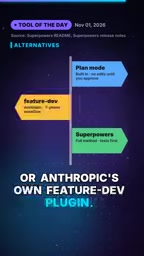
Plan mode is a built-in interaction mode in Claude Code. When enabled, Claude first outputs an execution plan for the user to confirm before modifying code. Its limitation is that the plan is fairly coarse-grained — it usually only lists which files to change and roughly what to do, without forcing clarification of requirement boundaries or solidifying the plan into a trackable design document. So for scenarios where "the requirements themselves are vague" or "changes span multiple modules," plan mode often isn't enough to prevent directional drift — which is exactly why Superpowers needs to introduce additional steps for questioning, design documents, and task decomposition.
Superpowers' Workflow: Four Steps
This plugin was developed by Jesse Vincent's Prime Radiant, uses the MIT license, and is completely free. Its core logic is to force Claude to think things through before acting:
- Ask first: Before writing any code, Claude proactively asks you questions to clarify requirement boundaries
- Write a design document: Based on the Q&A results, it generates a design document to serve as the blueprint for subsequent development
- Decompose tasks: It breaks large work into small tasks, reducing the complexity of each generation
- Test first: Each task starts with a test, then the implementation code is written
After the above update, in the same tests, the number of times Claude skipped the design document dropped from 24 to 3. That's a remarkable improvement, showing that process constraints really can change the AI's behavior patterns.
What else does it touch?
Superpowers isn't just about "making Claude ask a few more questions." It actually operates on your development environment: it creates git branches, runs your test suite, and even deletes code that was written before the tests — that's the iron rule of test-driven development, and the plugin imposes it on the AI.

The core discipline of test-driven development (TDD) is "red—green—refactor": first write a failing test (red), then write just enough implementation to make it pass (green), and finally refactor under the protection of the tests. It requires that implementation code must only appear after the tests exist; any approach of "write implementation first, add tests later" is considered a breach of this discipline. When Superpowers has Claude delete code written before the tests, it's essentially using tooling to enforce this ordering, preventing the AI from turning tests into mere descriptions of existing implementations via "backfilled tests" — which would rob them of their ability to catch defects.
Cost and Privacy: What You Need to Know
Superpowers itself is free, but it runs on your own Claude plan. According to the documentation, one helper agent per task is the most expensive part — if your plan has limited quota, keep this in mind.
On privacy: the plugin has an optional preview feature that reports version information to the developer. However, a single setting turns it off, so privacy-sensitive developers can rest easy.
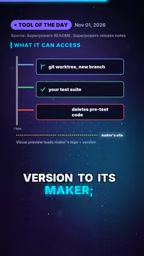
"One helper agent per task" means Superpowers launches a separate Claude session instance for each decomposed subtask to execute and verify it, rather than doing everything in one long context. The benefit is cleaner context with no cross-contamination between tasks; the cost is that each instance must reload context and consume inference tokens, so total consumption grows linearly with the number of tasks. This also explains why the plugin itself is free but the actual cost depends on your Claude plan quota.
When Should You Use It?
The answer is simple: when Claude keeps getting things wrong.
If you're just asking Claude to rename a variable or add a simple function, the built-in plan mode is probably enough. Anthropic also has its own feature dev plugin as an alternative. But if you're dealing with the problem of "AI misunderstanding causing the whole direction to go off track," Superpowers' forced planning workflow is very valuable.
Usage Reminder
The plugin author notes that tasks driven by Superpowers may run for hours. This means you should be sure to commit your current work before starting. This is a very practical reminder — with long runtimes plus automatic branch creation and code deletion, running without version control as a safety net would be dangerous.
For developers chasing efficiency, Superpowers offers a low-cost, high-constraint solution: trade process for quality, and turn AI from "rushing to write code" into "thinking it through first." The million-plus installs themselves show that this pain point is common enough.
Related articles

Skykea Showdown: A Hilarious Variety Show Experience of a Minecraft Airship Building Competition
Skykea Showdown is a Minecraft airship building racing variety show. This article analyzes its two-phase build + hole race format, airship mod lift physics, secret mission design, and team confrontation dynamics—ideal for game content creators.

Did the US Midterms Vote No to AI Data Centers? A Map Reveals the Truth
After the US midterms, media claimed voters rejected AI data centers, but a map shows restrictive votes are concentrated in a few Ohio townships, affecting less than 1% of US towns—the national anti-AI wave is exaggerated.
ApexW Optimizer Benchmark: Matches 8-bit AdamW in Unsloth with Lower Memory Usage
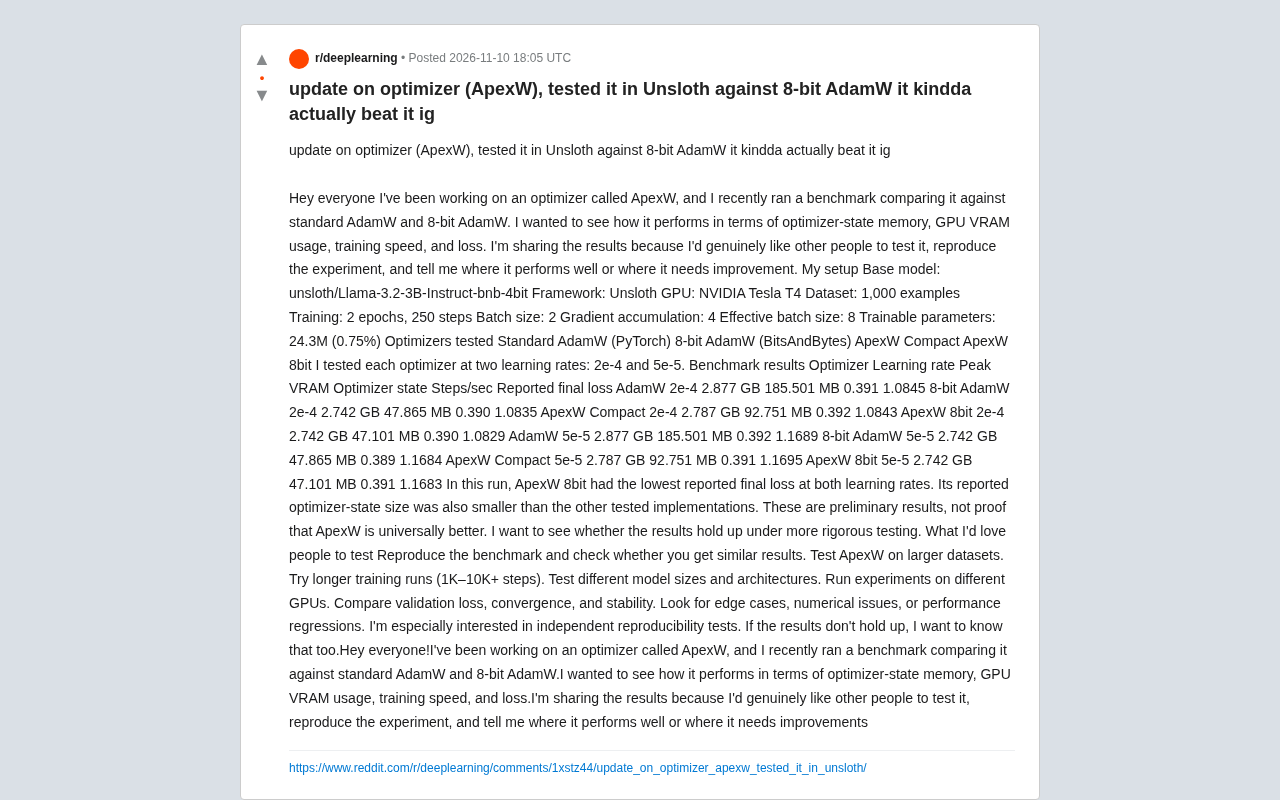
Developer shares benchmark of ApexW optimizer in Unsloth: ApexW 8bit has lower optimizer state memory (47.101 MB) and slightly better final loss than 8-bit AdamW, but similar speed. Needs independent reproduction.