NextLesson: A Free Tool That Turns YouTube Videos and PDFs into Study Flashcards

NextLesson is a free indie tool that turns YouTube videos, PDFs, and notes into Duolingo-style study flashcards.
NextLesson is a free learning tool built by an indie developer and shared on Reddit for early feedback. It automatically converts scattered study materials — YouTube videos, PDFs, and personal notes — into Duolingo-style interactive review cards, targeting the tedious manual step of turning raw content into reviewable resources. Compared to tools like Quizlet and Anki, its differentiators are multi-format input support and a completely free model. The product is still in early stages, and conversion quality, long-term sustainability, and data privacy handling remain key questions to be tested by users.
A Free Tool for Converting Learning Materials
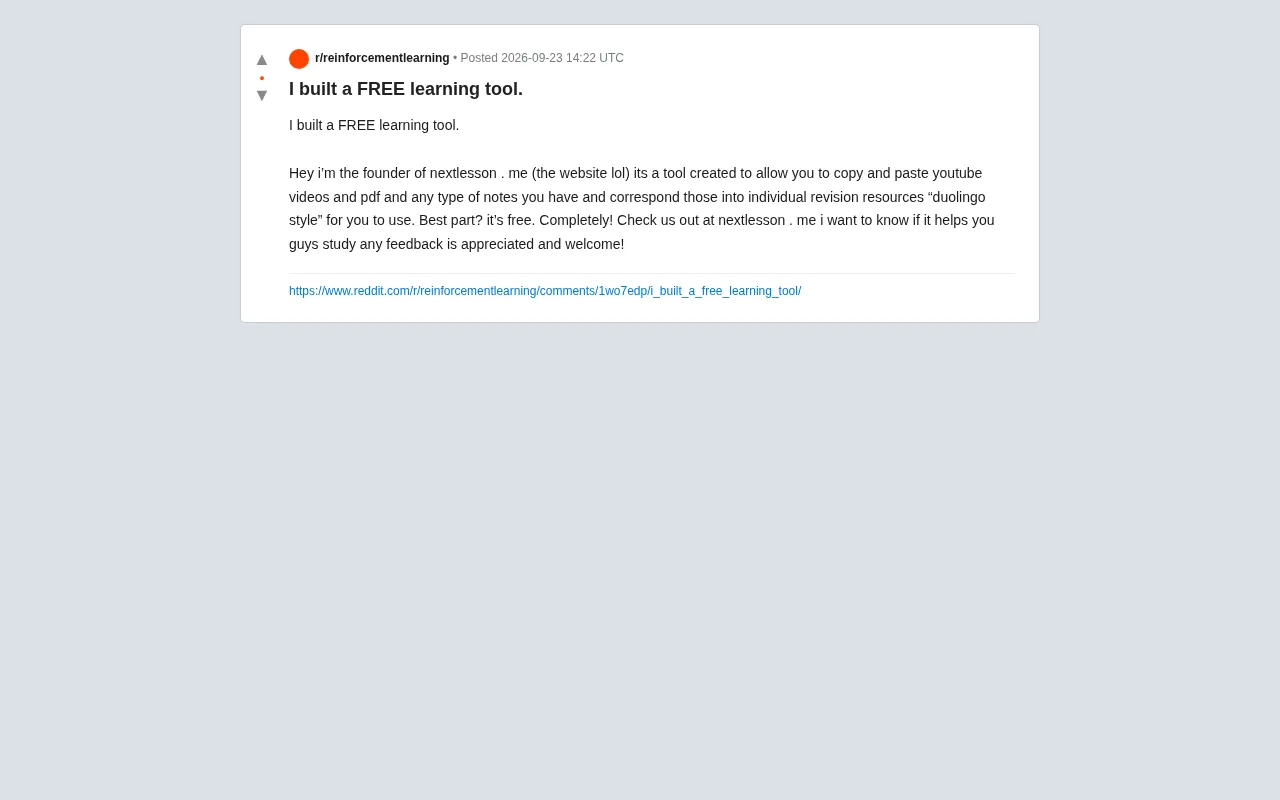
Recently on Reddit, an indie developer shared a learning tool they built called NextLesson (nextlesson.me). The core idea is straightforward: paste in your study materials — YouTube videos, PDF documents, various notes — and the tool automatically converts them into standalone review resources in the form of interactive study cards, similar to Duolingo.
According to the founder's post, the biggest selling point is that it's "completely free." They explicitly stated a desire for feedback from real users to find out whether the tool actually helps people learn more efficiently.
What Problem It Solves
For many students and self-learners, study materials tend to be scattered: a lecture video here, a few pages of PDF handouts there, a pile of hastily written notes. Organizing all of this into a format you can review repeatedly usually means manually extracting content and creating flashcards — a tedious and time-consuming process.
NextLesson aims to fill exactly this gap between raw materials and reviewable resources. It borrows Duolingo's widely popular gamified learning model — reinforcing memory through short, repetitive practice units with immediate feedback. This approach works because it lowers the psychological barrier to each study session and leverages spaced repetition for long-term retention.
If NextLesson can automatically break down content from any source into these kinds of practice units, it could appeal to students preparing for exams, learning a language, or consolidating knowledge.
Spaced Repetition is the core memory science principle underlying tools like this. The basic logic: reviewing material just as it's about to be forgotten lets you achieve the most durable long-term memory with the fewest repetitions. Anki is the best-known implementation of spaced repetition, using an algorithm to dynamically schedule the next review time for each card. Duolingo builds on this with gamified design — streaks, experience points, instant right/wrong feedback — further reducing the psychological cost of staying consistent. NextLesson draws on this same framework of "small units + immediate feedback + repeated reinforcement," with the key difference being that it tries to automate the content creation step rather than requiring users to make cards manually.
A Few Things Worth Noting
From a product positioning standpoint, "content-to-flashcard" tools aren't new — Quizlet, Anki, and various AI-powered quiz generators are already out there. NextLesson's differentiation mainly comes down to two things: support for multiple input formats (video, PDF, notes), and being completely free.
That said, the Reddit post itself is light on details, and several key questions remain unanswered:
- Quality of conversion: The accuracy and coverage of automatically generated questions and cards from videos or PDFs will directly determine the tool's practical value.
- How long will free last: A fully free model is common during early user acquisition, but long-term sustainability — whether it will introduce paid tiers, ads, or data monetization — is worth keeping an eye on.
- Data privacy: How the tool handles user content when personal notes and study materials are uploaded is a factor worth considering.
In the "content-to-flashcard" niche, Quizlet and Anki represent two distinct product philosophies. Quizlet emphasizes cloud-based collaboration and community sharing — users can directly reuse card sets made by others — and has recently introduced AI-assisted generation, though some core features have moved behind a paid subscription. Anki is fully open-source and locally-focused, built around the proven SM-2 spaced repetition algorithm, with a loyal user base especially among medical students and language learners, at the cost of a steeper learning curve. These two tools are the main competitors NextLesson needs to carve out mindshare against, which means if it can genuinely deliver on "multi-format input + completely free + zero manual card creation," there is real room for differentiation.
A Typical Indie Developer Path
This case is actually a classic example of the indie developer "ship fast, iterate" approach: build something functional, release it for free, then head to communities like Reddit for early feedback. The advantage is rapid demand validation and collection of real use cases; the downside is that the product is often still rough around the edges.
For interested users, it's worth treating this as an early-adopter experiment: run your current study materials through it and see whether the generated review cards actually match what you need. If the results are solid, it could save a significant amount of manual organization time. If the generation quality falls short, consider sending specific feedback to the developer to help the product improve.
Summary
NextLesson addresses a real pain point — quickly converting scattered study materials into reviewable interactive content — and leads with "free + Duolingo-style" as its main appeal. It's currently in an early stage, and real-world effectiveness still needs validation from more users. For learners who frequently need to organize online lectures and handouts, it's a low-cost option worth trying.
Related articles

LangChain Retry Middleware Configuration: Practices and Selection Guide
Based on Reddit community discussion, this article analyzes LangChain ModelRetryMiddleware retry parameter configuration practices, covering the selection logic and alternatives for key options like max_retries, backoff_factor, and jitter.

Texas Senate Race in Trouble: Why Are Republicans Nervous?
Texas Senate race stirs Republican anxiety. Based on street interviews, this article analyzes the Democratic offensive in funding, organization, and running everywhere, and how Republicans are defending "Texas, Texas" amid the political pendulum effect.

Gemini Chat Now Generates and Edits Google Docs Directly, a New Breakthrough in Office Productivity
Google Gemini's chat interface now generates and edits PDF, Google Docs, Sheets, Slides, Markdown, TXT, and code files. Available to all users; web supports all formats, mobile only PDF for now.