No AI, 52 Minutes: Hand-Writing a Linux File Utilities Suite
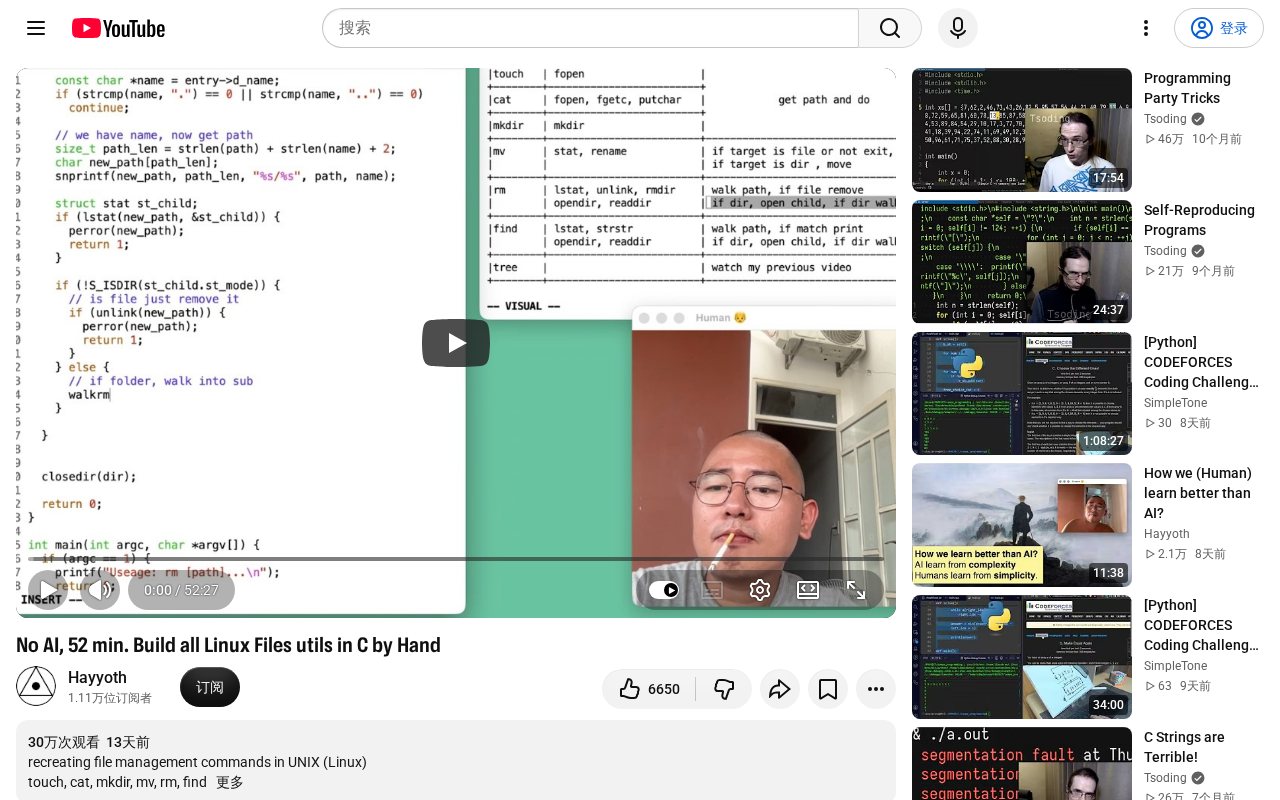
Developer hand-writes Linux file tools in 52 minutes without AI, sparking debate on systems programming fundamentals.
The article covers a developer's challenge to hand-write a Linux file utilities suite from scratch in C within 52 minutes without AI, a video that sparked Hacker News discussion. It analyzes why hand-writing system tools still matters amid AI code generation, emphasizing precise command of POSIX interfaces, system calls, and error handling, and argues that systems programming relies on hard-won muscle memory that can degrade with AI assistance.
In an era where AI coding assistants are increasingly ubiquitous, one developer chose a very different path: hand-writing a Linux file utilities suite from scratch in C within 52 minutes, without any AI tools. The video sparked discussion on Hacker News—though not explosively popular, it touched on a topic worth pondering: when AI can rapidly generate code, what is the value of hand-writing system tools?
The Core of the Challenge: Rebuilding File Utilities in C
The video's title states it plainly: No AI, 52 min, Build all Linux Files utils in C by Hand. Three qualifiers define the entire framework of the challenge—no AI assistance, a 52-minute limit, and hand-implementing a Linux file utilities suite in C.
Linux file utilities are the basic commands every developer uses daily—listing directories, inspecting file attributes, copying and moving files, and so on. These tools are typically wrappers around system calls, involving low-level knowledge such as file descriptor operations, directory traversal, and permission checks. Hand-writing them in C means confronting POSIX interfaces and system call details directly, rather than relying on abstractions from higher-level languages.
The 52-minute limit adds a performative dimension to the challenge. It tests not only coding ability but also familiarity with common system calls—the developer must recall and correctly use interfaces like open, read, write, stat, opendir, and readdir within a limited time, while handling error branches and edge cases.
POSIX (Portable Operating System Interface), mentioned in the article, is a set of standards established by IEEE that defines the application programming interfaces (APIs) an operating system should provide, covering file operations, process control, signal handling, and more. Linux, macOS, and most Unix systems follow the POSIX standard, so programs written in C using functions like open, read, write, and stat can maintain good portability across these systems. POSIX interfaces are essentially wrappers around system calls—for example, fopen in glibc ultimately calls the open system call. Understanding the layered relationship between POSIX and system calls is fundamental to systems programming.
The functions listed in the article—open, read, write, stat, opendir, readdir—are the most commonly used file operation interfaces in Linux systems programming. open is used to open or create a file and return a file descriptor; read/write read and write data; stat retrieves file metadata (such as size, permissions, and timestamps); and opendir/readdir traverse directories. Most of these functions are declared in headers like fcntl.h, unistd.h, sys/stat.h, and dirent.h. Developers need to memorize their parameter order, return value semantics, and error handling (usually by checking return values and errno). These interfaces form the underlying implementation foundation of virtually all Linux file tools (such as ls, cp, and mv).
Why "No AI" Deserves Emphasis
"No AI" is placed first in the title, showing that the creator is clearly aware of the current technological context: AI code generation tools can already rapidly produce runnable programs from natural language descriptions. Against this backdrop, the act of hand-writing basic tools is itself a statement.
From an engineering perspective, there is a qualitative difference between hand-written C system tools and AI-generated code. AI excels at generating structurally complete but generalized code, while systems programming demands precise command of memory layout, error handling, and platform differences. What should a failed stat call return? How should symbolic links be handled during directory traversal? How should buffer sizes be determined? These decisions depend on a deep understanding of Unix philosophy, which pattern matching cannot easily cover.
This is not to say AI cannot assist systems programming, but rather that the hand-writing process itself is a test of knowledge. The value of the video may not lie in how polished the resulting toolset is, but in demonstrating how a developer organizes their memory and understanding of system interfaces without relying on external generation.
The "Muscle Memory" of Systems Programming
Judging from the information in the video title, completing multiple file tools in 52 minutes means the average coding time per tool is quite tight. At this pace, the developer cannot frequently consult documentation and must rely more on long-accumulated "muscle memory"—familiarity with common headers, function signatures, and error codes.
This familiarity is precisely an important yardstick for judging a systems programmer's experience level. Knowing what declarations are in unistd.h, being able to write correct struct dirent usage from memory, and clearly knowing common values of errno—these details are actually more easily overlooked in the age of AI-assisted coding. When developers get used to letting AI complete code, their intuitive understanding of low-level interfaces may gradually degrade.
The demonstrative value of this video is that it brings the fundamentals of systems programming back into view. Although file utilities are simple, they cover multiple foundational dimensions—system calls, error handling, memory management, and command-line argument parsing—making them a suitable vehicle for testing low-level proficiency.
struct dirent is a structure in the POSIX standard used to represent directory entries, typically filled and returned by the readdir function. It contains at least members such as d_name (filename) and d_ino (inode number), and different systems may have additional fields like d_type. Developers need to include the dirent.h header when using it and note that the pointer returned by readdir points to static memory, so multiple calls will overwrite previous contents. Correctly using struct dirent is key to writing directory traversal tools (such as ls) and is a common test of systems programming fundamentals.
The Boundary Between Hand-Writing and AI Assistance
The data on Hacker News—only 3 comments and 11 upvotes—shows that this topic did not trigger a large-scale debate, but the question it points to is persistent: where should the boundary between hand-writing and AI assistance be drawn?
For application-layer code with complex business logic and frequently changing requirements, AI assistance can significantly improve efficiency, and there is little controversy about that. But for system tools, infrastructure, and security-sensitive components, the controllability and depth of understanding that hand-writing brings remain difficult to replace. Many senior developers have expressed similar views on various occasions: code for core infrastructure should be written by people who fully understand its behavior, not produced by generative models and then simply reviewed.
The symbolic significance of this 52-minute challenge outweighs its actual output. It reminds developers that AI tools are levers, not replacements—a lever still amplifies the user's own understanding. When foundational knowledge is solid, AI can help realize ideas faster; when foundational knowledge is weak, AI-generated code may hide hard-to-detect problems.
Practical Lessons for Developers
Actionable learning paths can be extracted from challenges like this. Regularly doing hand-coding exercises without AI, especially in systems programming, helps maintain sensitivity to low-level interfaces. File tools, text processing tools, and network tools are all suitable practice subjects because they are small enough to complete in one session yet realistic enough to involve actual engineering problems.
Time limits are a deliberate constraint. Without time pressure, developers easily fall into cycles of consulting documentation and repeated debugging; a time limit forces developers to rely on existing knowledge and exposes genuine weak points. The number 52 itself is not important; what matters is that it creates an environment requiring rapid decisions.
For developers who use AI assistance daily, a compromise worth trying is: first have AI generate an initial version of the code, then hand-write an implementation without looking at the generated result, and finally compare the differences. The differences often reveal blind spots in understanding.
One-line Summary
A developer hand-writes Linux file utilities in 52 minutes without AI, sparking discussion about the value of systems programming fundamentals.
Paragraph Summary
The article describes a challenge in which a developer hand-writes a Linux file utilities suite from scratch in 52 minutes without AI assistance, a video that sparked discussion on Hacker News. It analyzes the meaning behind this act: amid the growing prevalence of AI code generation, hand-writing system tools emphasizes precise command of low-level knowledge such as POSIX interfaces, system calls, and error handling. The article notes that systems programming relies on long-accumulated "muscle memory," and that this intuition tends to degrade with AI assistance. The boundary between hand-writing and AI assistance lies in the fact that system tools and infrastructure depend more on developers' deep understanding. Finally, the article suggests that developers regularly do time-limited hand-coding exercises to maintain sensitivity to low-level interfaces.
Related articles

Anthropic's IPO Crisis: Why $16.8B in Revenue Can't Buy a High Valuation
Anthropic posted $16.8B in Q3 revenue with 85% gross margin yet faces a cut to its IPO valuation. A deep dive into halved growth, the token price war, circular financing, and the clash between safety ideals and capital reality.

Anthropic Races Toward the Largest IPO in History: Can a $100 Billion Raise Ignite the AI Investment Boom?
Anthropic may file its prospectus as early as October 23, aiming to raise up to $100 billion at a valuation of up to $2 trillion, potentially the largest IPO ever. Q3 revenue hit $16.8 billion, up nearly 50% quarter over quarter, with adjusted profitability, but slowing growth has led some investors to cut valuation to $1.5 trillion. The IPO is a key test of whether the AI investment boom can continue.

Bessemer Partner on Anthropic IPO: The Public's First Direct Investment in AI Software
Bessemer partner Byron Theta on the Anthropic IPO: why it's called the moment everyone's been waiting for, the $650M four-round investment, the LP liquidity bind, and expectations of a 2027 IPO wave—plus open-source model pricing pressure, existential risk disclosures, and what the founders' 50.1% voting structure means for ordinary investors.