No Training Needed! MPPA Breaks Diffusion LLM Long-Context Bottleneck with Mask Patterns

MPPA dynamically adjusts position encoding using mask patterns unique to diffusion LLMs, enabling training-free long-context extension.
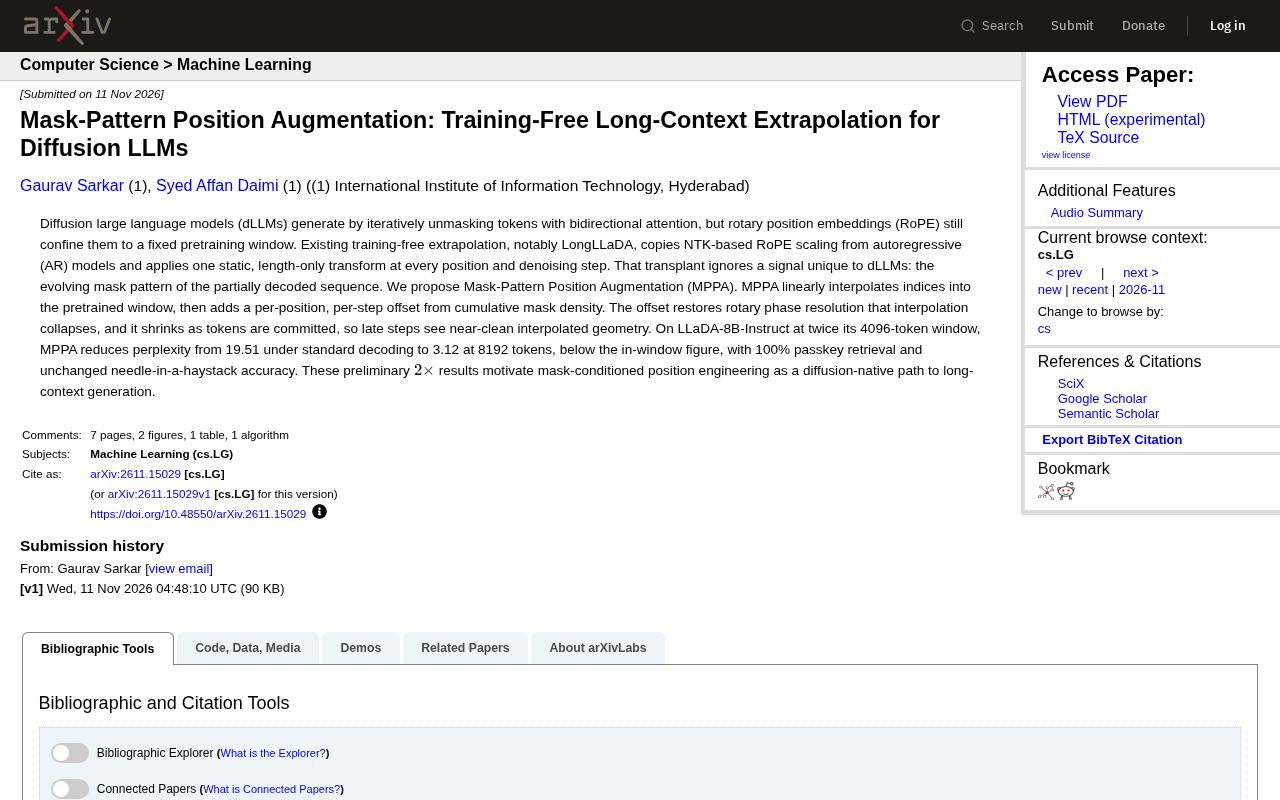
Diffusion large language models (dLLMs) generate text through iterative unmasking and bidirectional attention, but their rotary position embeddings (RoPE) still confine the model to its pre-training window. Existing training-free extrapolation methods like LongLLaDA directly port static NTK-RoPE scaling from autoregressive models, ignoring the dynamic mask signal unique to dLLMs. Researchers propose Mask-Pattern Position Augmentation (MPPA), which first linearly interpolates position indices to avoid out-of-range positions, then adds a dynamic offset for each position at each denoising step based on cumulative mask density, compensating in early stages for phase resolution loss and restoring near-clean interpolation geometry in later stages. On LLaDA-8B-Instruct extended to 8192 tokens, MPPA reduces perplexity from 19.51 to 3.12—lower than within the original window—while maintaining 100% passkey retrieval and unchanged needle-in-a-haystack accuracy.
Diffusion large language models (dLLMs) generate text through iterative unmasking and bidirectional attention, but their rotary position embeddings (RoPE) still confine the model to its pre-training window. Existing training-free extrapolation methods (such as LongLLaDA) directly port NTK-RoPE scaling from autoregressive models, applying a static transformation that depends only on length to all positions and denoising steps, ignoring a signal unique to dLLMs: the evolving mask patterns of partially decoded sequences. To address this, researchers propose Mask-Pattern Position Augmentation (MPPA), which uses cumulative mask density to add a dynamic offset for each position at each step, significantly improving long-context performance without fine-tuning.
Why do diffusion LLMs need their own long-context solution?
The generation process of diffusion LLMs is fundamentally different from that of autoregressive models. Autoregressive models generate word by word from left to right, whereas diffusion LLMs iteratively unmask in parallel, updating all unmasked positions at each step based on bidirectional attention. This paradigm difference means that simply applying position extrapolation methods designed for autoregressive models (such as NTK scaling) may not be optimal.
LongLLaDA is a previous representative training-free extrapolation approach that applies NTK-RoPE scaling statically to all positions and denoising steps. However, this one-size-fits-all transformation does not account for the dynamic changes in mask patterns during the diffusion process—in the early stages of denoising, many positions in the sequence are masked and information density is low; as steps progress, masks gradually decrease and the sequence approaches completeness. If position encoding could be aware of this process, it could potentially allocate resolution more reasonably.
Rotary Position Embedding (RoPE) is the position encoding scheme widely adopted by current mainstream large language models. Its core idea is to group query and key vectors in pairs by dimension and apply a rotation angle proportional to the absolute position to each group, so that attention scores depend only on the relative distance between two positions. RoPE's advantages are that it requires no additional parameters, naturally encodes relative positions, and has good length extrapolation potential. However, RoPE's rotation frequencies are fixed during pre-training, and when the inference sequence length exceeds the pre-training window, the model encounters position angles it has never seen, causing attention distributions to become disordered and perplexity to rise sharply. Therefore, the key to long-context extension lies in how to reasonably transform RoPE's position angles without retraining.
MPPA core mechanism: linear interpolation + mask-density offset
MPPA's design has two steps. First, the position indices are linearly interpolated into the pre-training window to avoid exceeding the position range the model has seen. But linear interpolation compresses the resolution of rotation phases, making it difficult for the model to distinguish adjacent positions. Second, an offset based on cumulative mask density is added for each position at each denoising step. This offset shrinks as more tokens are committed, thereby restoring phase resolution close to clean interpolation geometry in later steps.
The key to this dynamic adjustment is: in early steps, mask density is high and the offset is larger, compensating for the resolution loss caused by interpolation; in later steps, the sequence is nearly complete and the offset decreases, avoiding excessive perturbation. MPPA requires no additional training—only modifying the position encoding computation at inference time.
NTK-RoPE scaling is a classic training-free position extrapolation technique, whose name derives from the analysis of network frequency components in the Neural Tangent Kernel theory. Specifically, when the sequence length exceeds the pre-training window, the base frequency of RoPE's rotation frequencies in each dimension is reduced by a certain ratio, so that longer sequences map to a phase distribution range similar to that during pre-training. Intuitively, this is equivalent to "stretching" or "compressing" the position axis so that the model still sees familiar rotation angles on ultra-long sequences. NTK scaling usually only requires modifying the position computation at inference time, with no gradient updates, and thus has been directly ported to diffusion LLMs in works such as LongLLaDA. But as this paper points out, this scaling treats all positions and all denoising steps identically—it is a static transformation that cannot respond to the dynamic evolution of mask patterns during diffusion generation.
Experimental results: perplexity greatly reduced, retrieval ability preserved
On the LLaDA-8B-Instruct model, researchers extended the context window to twice its native 4096 tokens (8192 tokens). Under standard decoding, perplexity was 19.51; MPPA reduced perplexity to 3.12, even lower than the model's performance within its original window. This result shows that MPPA not only prevents long-context performance degradation but also improves modeling quality through more reasonable position encoding.
On retrieval tasks, MPPA achieved 100% passkey retrieval accuracy, and needle-in-a-haystack accuracy remained unchanged. This indicates that dynamic position augmentation does not impair the model's ability to capture key information. Although these are preliminary 2x-window results, they already demonstrate the potential of mask-conditioned position engineering as a diffusion-native path to long context.
Passkey retrieval and needle-in-a-haystack (NIAH) are two classic probe tasks for evaluating long-context ability. Passkey retrieval randomly inserts a "passkey" (such as a number) into a long text and requires the model to accurately repeat the passkey at the end of the text, mainly testing whether the model can locate and extract isolated information over long distances. Needle-in-a-haystack embeds a key fact (the "needle") in a large amount of irrelevant text (the "haystack"), testing the model's accuracy in retrieving that fact at different positions and depths, usually presented as a position-depth heatmap. Together they characterize the model's long-range memory and retrieval robustness: perplexity reflects overall language modeling quality, while these two tasks reflect whether key information is diluted or lost. MPPA maintains or even achieves full scores on these two tasks, indicating that its dynamic position offset does not trade retrieval precision for reduced perplexity.
Multi-source perspective: consensus and disagreement on training-free extrapolation
Around training-free long-context extrapolation, existing research has reached a consensus that "position encoding needs dynamic adjustment." Works such as LongLLaDA confirmed the effectiveness of NTK scaling, while MPPA further points out that customized adjustment for the dynamic masking characteristics of diffusion models can bring additional gains. According to some analyses, this mask-aware approach may have inspired subsequent position encoding designs that are sensitive to denoising steps.
However, there is disagreement on whether "static scaling is sufficient." Proponents of static approaches argue that NTK scaling is simple and general and has been validated on multiple models; the authors of MPPA emphasize that the mask patterns of diffusion LLMs are a unique signal that autoregressive models do not have, and ignoring it limits extrapolation performance. Currently MPPA has only been validated on a single model and a 2x window, and its generalization still needs more experimental support.
Limitations and future directions
MPPA currently reports only preliminary results for a 2x window and does not address performance on longer contexts (such as 4x or 8x). In addition, experiments are limited to a single model, LLaDA-8B-Instruct, and have not yet been validated on other diffusion LLM architectures. The specific computation of the mask-density offset and the choice of hyperparameters may also affect final performance. Future work could explore combining MPPA with more efficient denoising strategies, or evaluating its robustness on more diverse long-context tasks (such as long-document summarization and multi-turn dialogue).
Overall, MPPA provides a lightweight training-free solution for long-context extension of diffusion LLMs, achieving significant improvements in perplexity and retrieval tasks by leveraging mask patterns—a diffusion-native signal. As diffusion LLMs continue to develop, such position engineering methods are expected to become part of the standard toolchain.
One-line Summary
MPPA leverages mask patterns unique to diffusion LLMs to dynamically adjust position encoding, enabling training-free long-context extension.
Paragraph Summary
Diffusion large language models (dLLMs) generate text through iterative unmasking and bidirectional attention, but their rotary position embeddings (RoPE) still confine the model to its pre-training window. Existing training-free extrapolation methods such as LongLLaDA directly port the static NTK-RoPE scaling of autoregressive models, ignoring the dynamic masking signal unique to dLLMs. Researchers propose Mask-Pattern Position Augmentation (MPPA), which first linearly interpolates position indices to avoid out-of-range positions, then adds a dynamic offset for each position at each denoising step based on cumulative mask density, compensating in early stages for the phase resolution loss caused by interpolation and restoring near-clean interpolation geometry in later stages. When extended to 8192 tokens on LLaDA-8B-Instruct, MPPA reduces perplexity from 19.51 to 3.12—lower than within the original window—while maintaining 100% passkey retrieval and unchanged needle-in-a-haystack accuracy. This work shows that mask-conditioned position engineering is a lightweight path to diffusion-native long context, but it has so far been validated only on a 2x window and a single model.
Related articles

Programmers in the AI Era: How Deep Should You Learn Legacy Tech?
How should programmers transform under AI's impact? How deep should legacy tech be learned? Drawing on a Bilibili creator's share, this breaks down the levels of embracing AI, the shift from process-driven to project-driven learning, and how lower technical barriers affect junior and mid-level roles.

OpenAI Releases GPT-6.2 Dual Models Astra and Sol, API Price Cut by 20%
OpenAI releases GPT-6.2 Astra and Sol, with Astra's API price cut 20% to $8/$40 per million tokens and ranking second on the Artificial Analysis Intelligence Index. This article analyzes the dual-model strategy, price-cut impact, and developer selection advice.

Perplexity Computer Launches Multiagent: 16 AI Agents Cross-Validate Each Other
Perplexity launches Multiagent mode for Computer: a lead agent orchestrates up to 16 sub-agents on Claude, GPT, and Gemini, sharing findings and cross-validating work with effort above Ultra.