NVIDIA CEO Jensen Huang Resigns and DeepSeek Releases Full Suite API: This Week's Big Tech Stories

NVIDIA CEO Jensen Huang resigns, DeepSeek opens full suite API, TLC flash prices plunge, GitHub under heavy pressure.
This week in tech: NVIDIA founder and CEO Jensen Huang resigned over personal misconduct and national security concerns, prompting a successor search and gamer concerns about GPU strategy. DeepSeek released full suite app APIs, opening web search, deep thinking, and file input so developers can replicate client features; Anthropic launched its strongest model Fable 5.2/Mythos 5.2 but tightened mainland China restrictions. Open-source tools surged, including Craft Anything, NOIR, and Fly Island. TLC flash spot prices fell 11.67% in a week, PC memory capacity declined year-over-year for the first time, and recycled memory penetration is expected to rise. GitHub launched a new storage architecture but still suffered major outages; QQ bot frameworks stopped updates due to a lawyer's letter.
NVIDIA CEO Jensen Huang Resigns and DeepSeek Releases Full Suite API: This Week's Big Tech Stories
This week the tech world saw a flurry of activity, from upheaval in NVIDIA's leadership to DeepSeekAd opening up its full suite of application APIs, and unusual price movements in TLC flash memory. Each news item is reshaping the industry landscape. Below is a rundown and analysis of the week's key developments.
Major Shakeup at NVIDIA: Jensen Huang Resigns as CEO
According to official NVIDIA news, on October 8, 2026, founder and CEO Jensen Huang sent an email to employees acknowledging personal misconduct and mentioning national security concerns. NVIDIA's board of directors immediately launched an independent investigation. Four days later, on October 12, NVIDIA announced that Jensen Huang had resigned from his roles as president, chief executive officer, and board member, effective immediately. The current executive vice president and chief financial officer was appointed interim CEO, and the board began the search for a permanent successor.
This change has sparked concern among gamers. Judging from the financial statement structure, consumer graphics cards account for a limited share of profit, and a management change could affect future product strategy. Currently, official disclosures are limited, and the market is still digesting this sudden news.
NVIDIA uses a typical dual-class share structure, in which the founder and CEO also serves on the board of directors and has enormous influence over the company's strategic direction. As the company's founder, Jensen Huang's personal image is deeply tied to the company brand. This resignation is not just a management change but also involves the balance of power between the CEO and the board in corporate governance. Independent investigations are usually led by the audit committee or a special committee under the board, aimed at assessing whether the CEO's conduct violated company policy or the law. It is a common transitional arrangement for the CFO to serve as interim CEO because the CFO is familiar with the company's finances and operations, but the search for a permanent successor may consider internal technical executives or external industry leaders. The market concern is that NVIDIA's leading position in AI chips relies heavily on Jensen Huang's technical vision and ecosystem layout, and a management change could affect the continuity of long-term strategy.
DeepSeek Releases Full Suite Application API, Fully Opening Model Capabilities
This week, DeepSeek released its full suite application API. Its V4.1 Flash model now supports web search, deep thinking, file input, link reading, and model safety capabilities under multiple interfaces. Underlying capabilities such as text recognition, speech recognition, and speech generation can also be called as independent interfaces. With these interfaces, developers can implement functionality basically consistent with the DeepSeek client, and can even create a one-to-one replica.
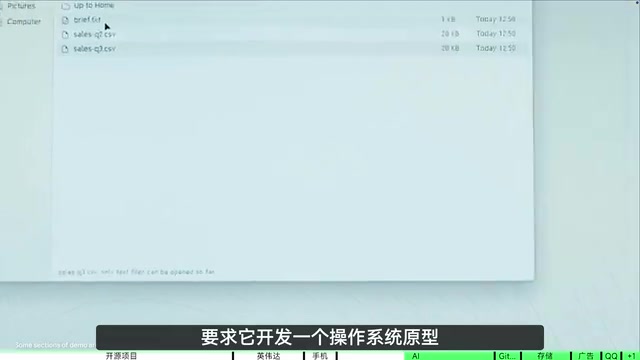
In the same period, Anthropic released Claude Fable 5.2 and Mythos 5.2 (note: transliterated in the original), which are essentially the same model. Ordinary users can only use Fable 5.2 with enhanced safety restrictions, while Mythos 5.2 requires a special application. According to official evaluations, this is Anthropic's strongest model to date, significantly outperforming Opus 5.5. Actual test cases have shown that the model can work continuously for several days starting from an empty folder to complete an operating system prototype, or generate a complete shooting game in just a few hours using only code, with all assets written in code. However, Anthropic has also tightened its whitelist rules, with mainland China, Hong Kong, and Macau not included, and the related usage restrictions have attracted attention.
Model Safety refers to mechanisms that use API interfaces to perform content filtering, harmful information interception, and compliance review on model outputs. DeepSeek's opening of a model safety interface in its API means developers can call an independent safety review service to conduct real-time detection of generated content and reduce application compliance risks. Web search capability allows the model to retrieve external information in real time during reasoning, breaking through the time limits of training data; deep thinking usually refers to the model expanding a multi-step chain of thought before output to improve the quality of solving complex problems; file input supports the model in directly parsing document content such as PDFs and Word files; link reading enables the model to crawl and understand web page information. Combined, these capabilities allow developers to replicate the DeepSeek client experience without building underlying infrastructure themselves, greatly lowering the barrier to AI application development.
Open Source Tools Surge: From Software Replication to Privacy Detection
After replicating Adobe's full suite and Office's full suite with AI assistance, developer StoryTold open-sourced a new project this week called Craft Anything. The project combines three major modules—research, development, and inspection—and includes 314 built-in tools. It can automatically break down target software or websites, analyze architecture and functionality, then develop new software according to user requirements, continuously comparing and optimizing against the original software during the process. Actual tests show that non-power users no longer need to subscribe to the original software.
Another open-source tool, NOIR, focuses on mobile privacy: after connecting to a computer, it lists all applications with network and sensitive permissions, identifies vendor categories by package name and domain, calculates a risk score based on permissions and commercial endpoints, and supports one-click disabling of dangerous permissions. It is suitable for privacy-conscious users to scan and investigate.
There is also a Windows Dynamic Island tool called Fly Island, which centralizes to-dos, clipboard, music, AI software, quick translation, and message reminders into a floating bar at the top of the screen, reducing window switching. And Witchhead Bridge, a WeChat chat history forwarding tool, uses WeChat's built-in forwarding interface rather than injecting code to safely forward records to various Agents, but it is limited by a forwarding cap of one hundred messages per time.
Hardware and Industry: TLC Flash Prices Plunge, Memory Capacity Falls for the First Time
According to Graphics Card Daily, TLC flash spot prices fell sharply by 11.67%, the largest single-week drop this year, basically returning to January levels. Original manufacturer SSD prices changed little because their main shipments shifted to KLC chips, so prices rose instead of falling; third-party SSD prices declined somewhat.
CPU-Z data shows that PC memory capacity fell year-over-year for the first time: users with 32GB memory dropped 2.5% year-over-year, and 64GB users fell 18%. A Trendforce report points out that smartphones have entered a recycling era, and continued memory price increases are pushing manufacturers to use recycled memory. The penetration rate of recycled memory is about 3-4% in 2026 and may climb to 7-9% in 2027, mostly for entry-level and low-priced models.
TLC (Triple-Level Cell) refers to NAND flash technology that stores 3 bits of data per cell. Compared with SLC (1 bit) and MLC (2 bits), TLC has advantages in cost and capacity and is the mainstream choice for consumer SSDs. KLC is not a standard industry term; the original text may refer to higher-layer stacking or a specific type of chip (such as a typo for QLC or PLC). Original manufacturers typically shift to higher-density chips to improve profits. Recycled Memory refers to memory chips dismantled from old devices, tested, and repackaged. Its cost is significantly lower than new chips, but reliability and lifespan are uncertain. Trendforce's penetration forecast reflects that during a period of rising memory prices, manufacturers of low-priced models are increasing the use of recycled memory to control costs, which may widen differences in performance and stability among entry-level devices.
Ecosystem Developments: GitHub Under Heavy Pressure, QQ Bot Frameworks Stop Updates
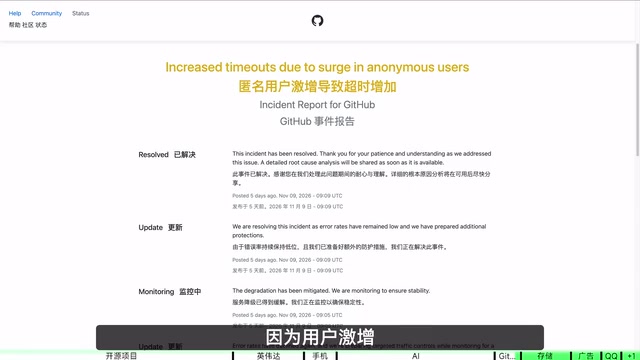
With the spread of AI development, GitHub is under unprecedented pressure. To address this, GitHub released a new Git storage architecture that supports 5,000 concurrent agents working in the same repository and 7,200 pushes per second to a repository. However, service failures still occurred multiple times this week, especially on October 9, when a surge in users caused widespread outages across multiple services.
In the QQ ecosystem, the well-known bot framework Snowroma (transliterated) announced that due to receiving a lawyer's letter from Tencent, it would become private and no longer public; another framework, Napcat QQ, had its GitHub repository contents cleared, leaving only a farewell message.
Huawei announced that it will release a new brand, the Aosta Starlight phone. The Kirin official account introduced the first logic-folding technology chip, the Kirin 9050 series, for several consecutive days, and Yu Chengdong shared the HarmonyOS foldable mini computer MateBook Fold. OPPO, vivo, Xiaomi, and Honor jointly launched a developer identity verification mechanism. Applications that have not completed verification will display a prompt when installed via sideloading, which may affect app distribution efficiency.
Tencent Yuanbao Search was officially launched in WeChat, and the input method launched an AI voice recorder feature that can transcribe surrounding sounds in real time and summarize them through AI, producing text transcripts and summary web pages.
This week's tech events show two extremes: on one side, turmoil in NVIDIA's leadership and leaps in AI model capabilities; on the other, storage price fluctuations and a tightening developer ecosystem. For developers and gamers, following official information and carefully evaluating tool risks is more important than chasing rumors.
Git storage architecture traditionally centers on centralized repositories, and concurrent operations on each repository are limited by file locks and reference update mechanisms. GitHub's new architecture supports 5,000 concurrent agents working in the same repository, meaning its underlying layer may use distributed reference databases, optimistic concurrency control, or sharded storage technology to handle scenarios in which AI agents frequently read and write code repositories. 7,200 pushes per second places extremely high demands on repository reference updates and object storage, and traditional Git protocols are hard-pressed to support this. QQ bot frameworks usually implement message sending and receiving through reverse engineering or unofficial interfaces. A lawyer's letter from Tencent means the framework author is accused of copyright infringement or violating terms of service, causing the project to become private or be cleared. Such incidents reflect a trend of platform operators tightening control over unofficial ecosystems, and developers need to pay attention to compliance risks.
One-line Summary
NVIDIA CEO Jensen Huang resigns, DeepSeek opens its full suite API, TLC flash prices plunge, and GitHub comes under heavy pressure.
Paragraph Summary
This week saw several major events in the tech sector: NVIDIA founder and CEO Jensen Huang resigned due to personal misconduct and national security concerns, and the board launched a successor search, raising concerns among gamers about graphics card strategy. DeepSeek released its full suite application API, opening capabilities such as web search, deep thinking, and file input, allowing developers to replicate client functionality; in the same period, Anthropic released its strongest model Fable 5.2/Mythos 5.2 but tightened usage restrictions in mainland China. Open-source tools emerged in concentration, including the software replication tool Craft Anything, the privacy detection tool NOIR, and the Windows Dynamic Island Fly Island. On the hardware side, TLC flash spot prices fell 11.67% in a single week, PC memory capacity declined year-over-year for the first time, and the penetration rate of recycled memory is expected to rise. GitHub launched a new storage architecture to cope with AI development pressure but still suffered major outages; QQ bot frameworks stopped updates due to a lawyer's letter, and ecosystem developments at Huawei, Tencent, and others were frequent.
Related articles
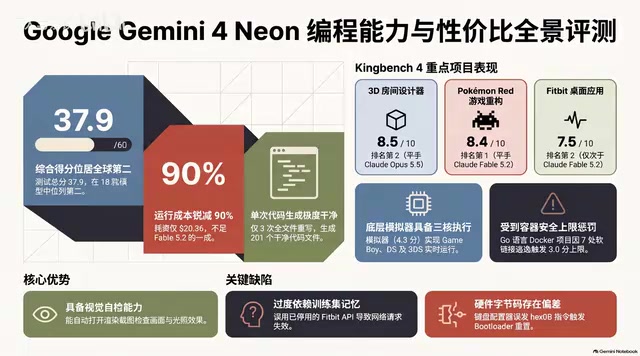
Gemini 4 Neon Hands-On: Value King or Confident Catastrophe?
Gemini 4 Neon review: 1M-token context, four thinking levels, 201 files in one KingBench4 pass at one-tenth Fable 5.2's cost—but it hallucinates fake data, leaves 7 symlink escapes, and bricks keyboards.

Google Gemini 4 Neon Hands-On: 6 3D Works That Impress and Fail
Hands-on with Google Gemini 4 Neon on a 3060 laptop: 6 3D works tested. Sunshower Fishing Harbor and mechanical keyboard impress; soft-body physics and faces fall short.
Gemini 4 Neo Web Novel Writing Test: Faint AI Flavor, Textured Dialogue
Bilibili creator's first-look review of Gemini 4 Neo for Chinese web novel writing: testing a Three Kingdoms transmigration opening with faint AI flavor, emotionally textured dialogue, and strong crisis building, plus comparison of 4A/4H/4C models and full workflow demos.