NVIDIA Mission Control 2.5: New Advances in Kubernetes Autonomous Recovery
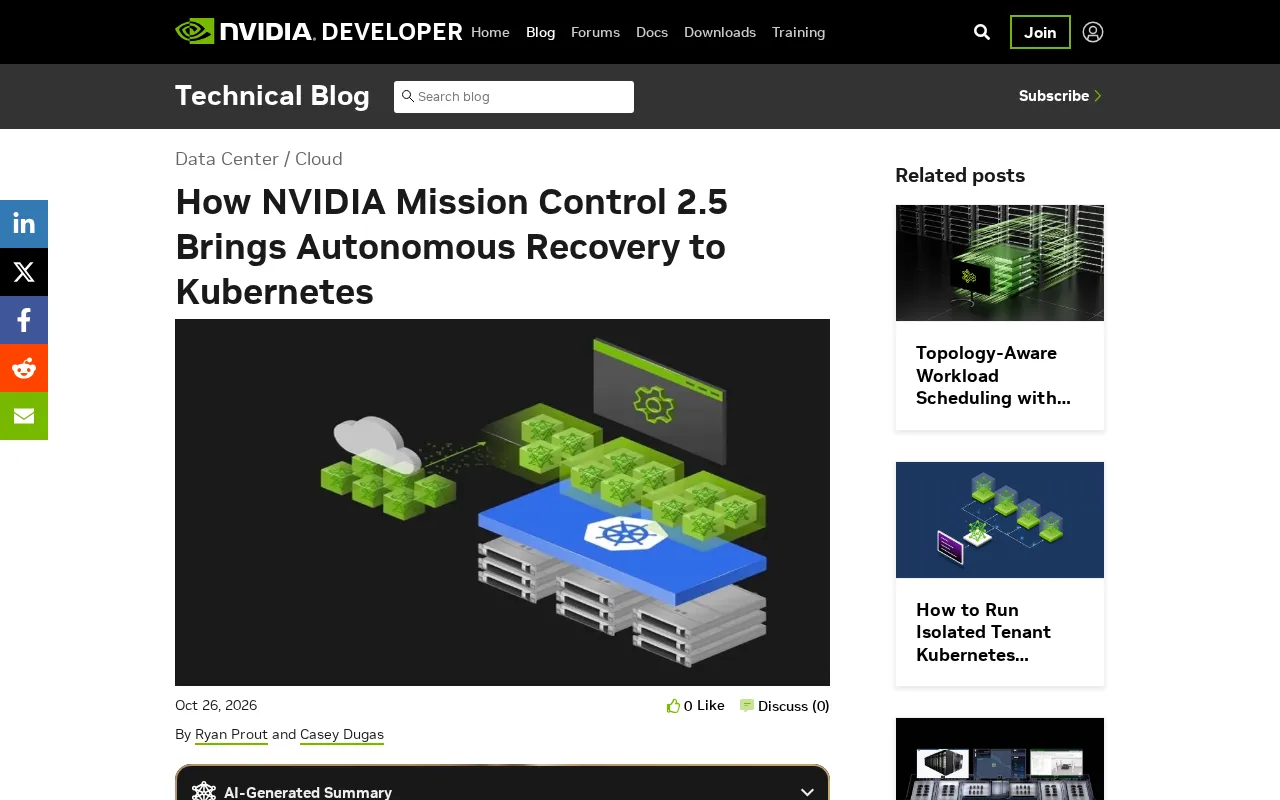
NVIDIA Mission Control 2.5 advances GPU cluster failure detection and resolution toward autonomous recovery.
The article discusses NVIDIA Mission Control 2.5 and why large-scale GPU training needs autonomous recovery. At thousands-of-GPUs scale, hardware failures and network jitter are the norm, and manual inspection with scripted retries wastes compute. Mission Control 2.5 uses Kubernetes as its orchestration foundation, building monitoring and automation into the system to compensate for Kubernetes's limited understanding of GPU hardware failure semantics, enabling recovery actions targeting true root causes. Its core value is standardizing handling of "gray failures," shifting operations from firefighting to policy-making, and requiring fine-grained signals and auditable actions.
Why Large-Scale GPU Training Needs "Autonomous Recovery"
Training large models on thousands of GPUs is a high-risk operation. At this scale, hardware failures, network jitter, and driver anomalies are no longer "occasional events" but the norm. NVIDIA's judgment in its developer blog is straightforward: monitoring and automation must be built into the system to optimize cluster resiliency.
The traditional approach relies on manual inspection and scripted retries: when a job fails, engineers log into the node to check logs, determine whether it's a hardware or software issue, and then decide whether to restart the container or isolate the node. This workflow is sustainable at the scale of a few dozen GPUs, but for training jobs spanning thousands of GPUs, any pause can mean hours of idle compute. Mission Control 2.5 is positioned to hand the entire "detect—diagnose—resolve" chain over to the platform itself, advancing recovery actions from manual operations to automation and even autonomy.
Core Changes in Mission Control 2.5
From "Monitoring and Alerting" to "Autonomous Closed Loop"
NVIDIA's description of Mission Control centers on two words: monitoring and automation. Version 2.5 uses Kubernetes as the orchestration foundation for training, meaning the health status of GPU clusters, job status, and the container orchestration layer are brought into a single observable and actionable system.
The logic behind this is not complicated: Kubernetes inherently provides declarative management and self-healing capabilities, but its understanding of failure semantics for specialized hardware like GPUs is limited—it knows a Pod has failed, but may not know that a certain GPU's memory has encountered an unrecoverable error. Mission Control fills exactly this "hardware context" gap, enabling recovery actions to target the true root cause rather than generically recreating Pods.
Kubernetes's declarative management and self-healing mechanism is centered on the controller pattern: users declare a desired state (e.g., a Deployment needs N replicas), and the controller continuously compares the actual state and takes action to converge the two. This pattern is naturally suited to expressing "the job should be in a running state," but its definition of "running state" stays at the container level—whether the Pod is ready and whether the process is alive. GPU failures often occur while the container is still alive and the process has not exited, but computation results are wrong or communication times out—something Kubernetes's default probes cannot detect. The so-called Operator pattern encodes domain knowledge into custom controllers: defining GPU node health states and recovery policies through Custom Resource Definitions (CRDs), then having controllers listen for hardware events and execute actions such as isolation, restart, or node replacement. The "hardware context" that Mission Control adds on top of Kubernetes is essentially a productized implementation of this kind of extension mechanism.
The Practical Problems Autonomous Recovery Solves
In large-scale training, the most time-consuming part is often not the failure itself but the localization and coordination that follows. A common scenario: a certain node exhibits intermittent anomalies, jobs repeatedly fail but succeed on every restart, and it's hard for humans to judge whether the node should be kicked out of the cluster. The value of autonomous recovery lies in replacing repeated human trial-and-error with policies and signals, standardizing the handling of such "gray failures."
For training platform teams, this means the operational focus shifts from "firefighting" to "formulating recovery policies." Which failures allow in-place retries, which require node isolation, which need rollback to the most recent checkpoint—these decisions can be written into rules in advance and executed by the system immediately when failures occur.
The "gray failures" mentioned in the article have a more specific counterpart in distributed training: silent data corruption and intermittent stragglers. The former refers to bit flips in GPU memory or interconnect links, where computation does not report errors but results are wrong; the latter refers to performance degradation in a certain GPU or network link, causing collective communication (such as AllReduce) to be slowed down overall. Neither type of failure causes the job to crash immediately, but both can cause abnormal training loss curves or sudden throughput drops, and are difficult to localize from single-point logs. Large model training typically employs periodic checkpoint mechanisms, and the "rollback to the most recent checkpoint" strategy of autonomous recovery works in tandem with this: after confirming the faulty node, the system restarts the job from the most recently persisted model state, sacrificing a segment of completed computation in exchange for determinism. The checkpoint interval thus becomes a key trade-off parameter between resiliency and efficiency.
Implications for AI Infrastructure Teams
NVIDIA discussing this in the Kubernetes context sends a signal: GPU cluster operations are converging toward the cloud-native paradigm. In the past, training platforms often built their own scheduling and health-check systems; now they increasingly tend to reuse Kubernetes's extension mechanisms, integrating GPU-specific failure handling in the form of controllers or Operators.
This also brings new engineering requirements. The prerequisite for autonomous recovery is high-quality signal collection—GPU metrics, network status, and job progress must be sufficiently granular and timely; otherwise, automated decisions will be built on incorrect information. At the same time, recovery actions themselves need to be auditable—teams must be able to answer "why did the system restart this job?"—which places higher demands on logging and event recording.
From an industry trend perspective, as model sizes continue to expand, cluster resiliency has shifted from a "nice-to-have" to a "must-have." The significance of Mission Control 2.5 is not any single feature but that it clearly establishes autonomous recovery as a product direction, providing a reference path for the automated evolution of training platforms.
GPU cluster observability typically revolves around two categories of metrics: the hardware layer, collected by NVIDIA's DCGM (Data Center GPU Manager), covering memory errors, ECC events, temperature, power consumption, and XID error codes; and the training layer, reported by the framework side, covering throughput, loss values, and communication latency. XID error codes are key signals for determining GPU failure types—for example, XID 79 indicates the GPU has fallen off the bus, and XID 48 indicates a double-bit ECC error; both typically require node isolation rather than in-place retry. For an autonomous recovery system to make correct decisions, the prerequisite is aligning DCGM events, Kubernetes events, and training framework logs on a unified timeline to form a consistent failure context. This also explains why auditability requirements are high: decision inputs are scattered across multiple data sources, and only by fully recording the event sequence can one retrospectively review whether a particular restart was necessary.
One-line Summary
NVIDIA Mission Control 2.5 advances GPU cluster failure detection and resolution toward autonomous recovery.
Paragraph Summary
The article centers on NVIDIA Mission Control 2.5 and discusses why large-scale GPU training needs autonomous recovery. At the scale of thousands of GPUs, hardware failures and network jitter become the norm, and traditional approaches relying on manual inspection and scripted retries lead to significant idle compute. Mission Control 2.5 uses Kubernetes as its orchestration foundation, building monitoring and automation into the system to address Kubernetes's limited understanding of GPU hardware failure semantics, enabling recovery actions to target true root causes rather than generically recreating Pods. The core value of autonomous recovery lies in standardizing the localization and handling of "gray failures," shifting operational focus from firefighting to formulating recovery policies. The article concludes by noting that this direction requires fine-grained signal collection and auditable recovery actions, signaling that GPU cluster operations are converging toward the cloud-native paradigm and that cluster resiliency has become a must-have.
Related articles

The Truth Behind Titanic's Sinking: Key Decisions and Communication Failures in the National Geographic Documentary
National Geographic's The Unsinkable Ship uses survivor testimony to reconstruct Titanic's fatal decisions—from the missing MSG telegram prefix and the broken boiler-room-to-bridge link to how 'unsinkable' thinking delayed damage control and evacuation.

74M-Parameter Open-Source Model Partially Outperforms Jev AI in Testing
Fastino AI's Glider 2.5 models, with just 74M–300M parameters, reportedly outperform Jev AI in some guardrail benchmarks per YouTube testing, run on consumer hardware, and even play Doom. We analyze small models' competitiveness and deployment value on specific tasks.

Gemini 4 Argon Hands-On: Aggressive Pricing, 3D Capabilities Need Coaching
Gemini 4 Argon hands-on: limited-time $2/$10 pricing, million-token output, strong 3D and reverse-engineering work, but weak front-end aesthetics and zero-shot ability need coaching.