NVIDIA Nemotron 3.5 Transcribe Released: 40 Languages, 1-Hour Recordings, Open Weights

NVIDIA releases Nemotron 3.5 Transcribe with 40 languages and day-0 deployment.
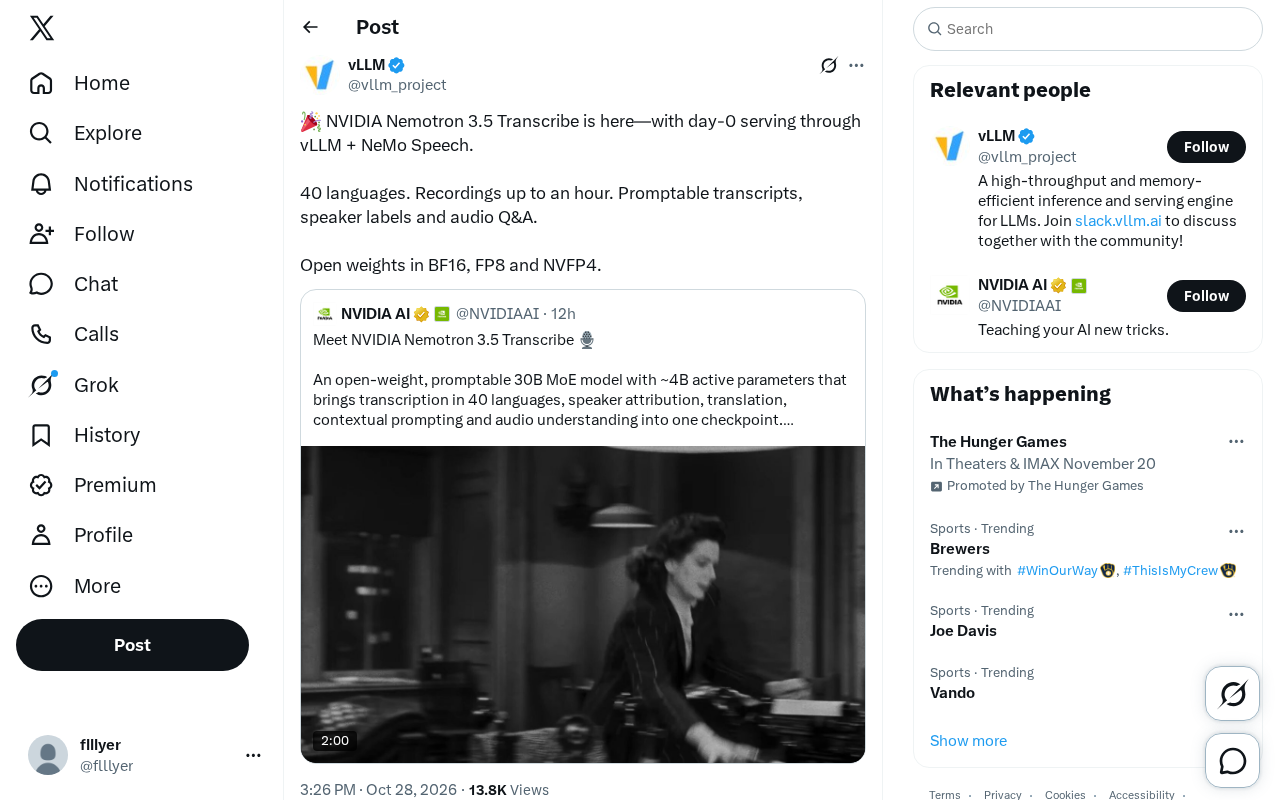
NVIDIA has released Nemotron 3.5 Transcribe, supporting 40 languages, recordings up to one hour, prompt-guided transcription, speaker labels, and audio question answering. Weights are open in BF16, FP8, and NVFP4, with inference serving available on launch day via vLLM and NeMo Speech. The article highlights day-0 serving as an ecosystem strategy that reduces engineering complexity for meetings, podcasts, and customer service analysis, while noting that parameter count, per-language accuracy, and low-precision quality loss remain undisclosed and require baseline testing.
NVIDIA has released the Nemotron 3.5 Transcribe speech transcription model, and its biggest highlight is that inference serving is available on launch day through vLLM and NeMo Speech. This means developers don't have to wait for framework adaptation and can call it immediately within their existing stacks. The model supports 40 languages, handles single recordings up to one hour long, and offers prompt-guided transcription, speaker diarization, and audio question answering. Weights are released in three precisions: BF16, FP8, and NVFP4.
Core Capabilities: From Transcription to Audio Understanding
Nemotron 3.5 Transcribe is positioned as more than traditional speech recognition. The official tweet lists several key features: 40-language coverage, processing of recordings up to one hour long, prompt-guided transcription, speaker labels, and audio question answering.
Prompt-guided transcription means users can control the output style or format through text instructions—for example, specifying terminology spelling, requesting a particular segmentation approach, or extracting only certain types of information. Speaker labels address the "who said what" problem in multi-person conversation scenarios, which is highly practical for meeting notes, interview organization, and similar use cases. Audio question answering further pushes the model from a transcription tool toward an audio understanding entry point—users can directly ask questions about audio content rather than just receiving a text transcript.
Speaker diarization refers to the technique of determining "who spoke when" in multi-person conversation audio and grouping the transcribed text by speaker. Traditional pipelines usually split this into separate steps—voice activity detection, speaker embedding extraction, and clustering—then time-align the results with ASR output, resulting in a long engineering chain where errors accumulate at each stage. Unifying speaker labels and transcription within a single model can reduce alignment issues caused by module stitching, but in scenarios with long audio, frequent speaker switches, or similar timbres, clustering stability and label consistency remain challenging. This is also why the article mentions the need for empirical validation.
Three Weight Precisions, End-to-End Serving Availability
The model releases weights in three precisions: BF16, FP8, and NVFP4. BF16 suits scenarios with the highest accuracy requirements, while FP8 and NVFP4 target environments sensitive to inference efficiency and memory footprint. NVFP4 is NVIDIA's own low-precision format, which—combined with its hardware ecosystem—can reduce deployment costs while maintaining usable quality.
More noteworthy is day-0 serving: vLLM and NeMo Speech provide support on launch day. vLLM is currently the mainstream high-throughput inference framework, while NeMo Speech is NVIDIA's own speech toolchain. Simultaneous adaptation of both indicates that NVIDIA prioritized "deployability" in its release cadence rather than making developers wait for the community to fill in support.
BF16, FP8, and NVFP4 are three different numerical precision formats that directly determine how model weights are stored in memory and the throughput efficiency during computation. BF16 (Brain Floating Point 16) represents floating-point numbers with 16 bits, retaining the same exponent width as FP32 but compressing the mantissa, which is why it is widely used as the default precision for training and inference in deep learning. FP8 further compresses each number to 8 bits, typically divided into E4M3 and E5M2 variants—the former offering higher precision and the latter greater dynamic range. With scaling factors during inference, throughput can be significantly improved with almost no quality loss. NVFP4 is a 4-bit floating-point format introduced by NVIDIA alongside the Blackwell architecture, employing micro-block scaling so that a group of weights shares scaling coefficients, thereby maintaining usable precision even at extremely low bit widths. Lower precision means less memory usage and bandwidth pressure, but also greater quantization error—so the three weight tiers actually represent different trade-offs among precision, cost, and hardware compatibility.
vLLM is a high-throughput inference framework for large model serving, with its core mechanism being PagedAttention—managing KV cache by pages, much like an operating system manages memory, to reduce memory fragmentation and support larger batch concurrency. It also provides an OpenAI-compatible interface for easy integration into existing applications. NeMo Speech, on the other hand, is NVIDIA's speech toolchain covering training and inference pipelines for tasks such as speech recognition and speaker diarization. The two have different positioning: vLLM focuses on general-purpose, high-concurrency serving deployment, while NeMo Speech focuses on end-to-end pipelines in the speech domain. The model being adapted to both on launch day means that whether a team follows the general inference serving route or the speech-specific toolchain route, they can directly launch the model without writing their own adaptation layer or waiting for community-merged support.
Practical Impact for Developers and Enterprises
Long audio processing has long been a pain point in speech transcription. The one-hour recording limit, combined with speaker diarization, allows this model to be used directly for full meeting records, podcast transcription, customer service call analysis, and similar scenarios, reducing the engineering complexity of segmented processing.
Support for 40 languages expands the applicable scope. For product teams that need multilingual content processing, a single model covering multiple languages can reduce model selection and maintenance costs. Open weights plus multiple precision options also give enterprises the possibility of local deployment under data compliance requirements.
From a competitive landscape perspective, the open-source speech model赛道 has become more active in recent years, but few can connect with mainstream inference frameworks on launch day. Nemotron 3.5 Transcribe's day-0 strategy essentially treats ecosystem collaboration as part of its product capability.
Observations and Points to Verify
The official tweet did not disclose the model's parameter count, recognition accuracy for each language, specific evaluation results for audio question answering, or the degree of quality loss at NVFP4 precision. This information will need to be supplemented by the model card and technical report before actual performance can be judged. In addition, the instruction generalization ability of prompt-guided transcription and the stability of speaker diarization on long audio are also worth prioritizing in real-world validation.
For developers, the first step now is to launch the model in a vLLM or NeMo Speech environment and run a baseline test with audio from their own business scenarios, focusing on recognition quality for target languages and end-to-end latency for long recordings.
One-line Summary
NVIDIA releases Nemotron 3.5 Transcribe, supporting 40 languages with day-0 deployment.
Paragraph Summary
NVIDIA has released the Nemotron 3.5 Transcribe speech transcription model, supporting 40 languages, single recordings up to one hour, and offering prompt-guided transcription, speaker labels, and audio question answering—expanding its positioning from pure transcription to audio understanding. The model releases weights in three precisions—BF16, FP8, and NVFP4—balancing accuracy and deployment efficiency; inference serving is available on launch day through vLLM and NeMo Speech, so developers don't need to wait for framework adaptation. The article argues that day-0 serving reflects a strategy of treating ecosystem collaboration as product capability, and that long-audio and multilingual coverage can reduce engineering complexity in scenarios such as meeting notes, podcast transcription, and customer service analysis. However, the official release did not disclose parameter count, per-language accuracy, or quality loss at low precision, so actual performance still needs to be verified through baseline testing.
Related articles

Why Does Self-Play AI Always Get Crushed by Cheap Units? An RTS Developer's Account of the Dilemma
An independent developer trained an RTS commander AI with pure self-play, only to find it dominated historical versions but was crushed by human players using cheap tier-1 units. This article analyzes the causes of self-play strategy collapse, explores solutions such as exploiters, diversity rewards, and reward design, and introduces the open Bot Kit and AI league plan.
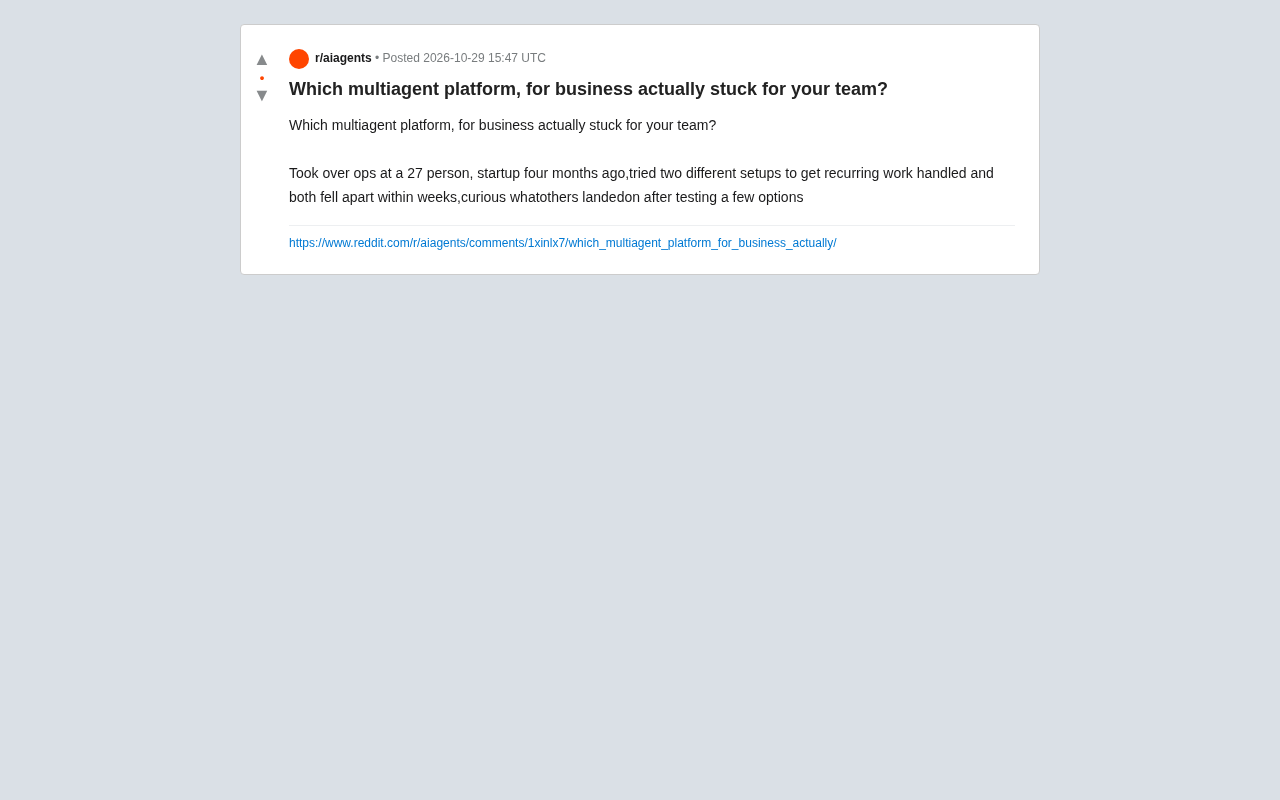
Which Multi-Agent Platform Wins? A Small Team's Battle Scars and Selection Considerations
A 27-person startup's ops lead tried two multi-agent platforms in four months and both failed. This article analyzes why small-team deployments break down, and offers selection guidance on integration depth, observability, and progressive rollout.

Thrive Holdings Takes ADT Private in $7.6 Billion Deal
Thrive Holdings acquires ADT for $7.6 billion in an all-cash take-private deal expected to close in Q1 2027. Analysis of the deal structure, ADT's asset value, and impact on the smart home security industry.