Nvidia's Backup Plan for China's Autonomous Driving

Nvidia uses special-edition chips and its software ecosystem to offer Chinese autonomous driving automakers a backup plan against regulatory and supply chain risks.
Based on a TechCrunch Mobility report, this article outlines Nvidia's "backup plan" in China's autonomous driving sector: through export-control-compliant special-edition chips, software optimization compromises, and localized support for toolchains such as CUDA and DriveOS, it helps Chinese automakers maintain R&D continuity amid tightening regulation and supply chain uncertainty. The strategy is both risk hedging and market defense, but lacks a concrete product roadmap and timeline.
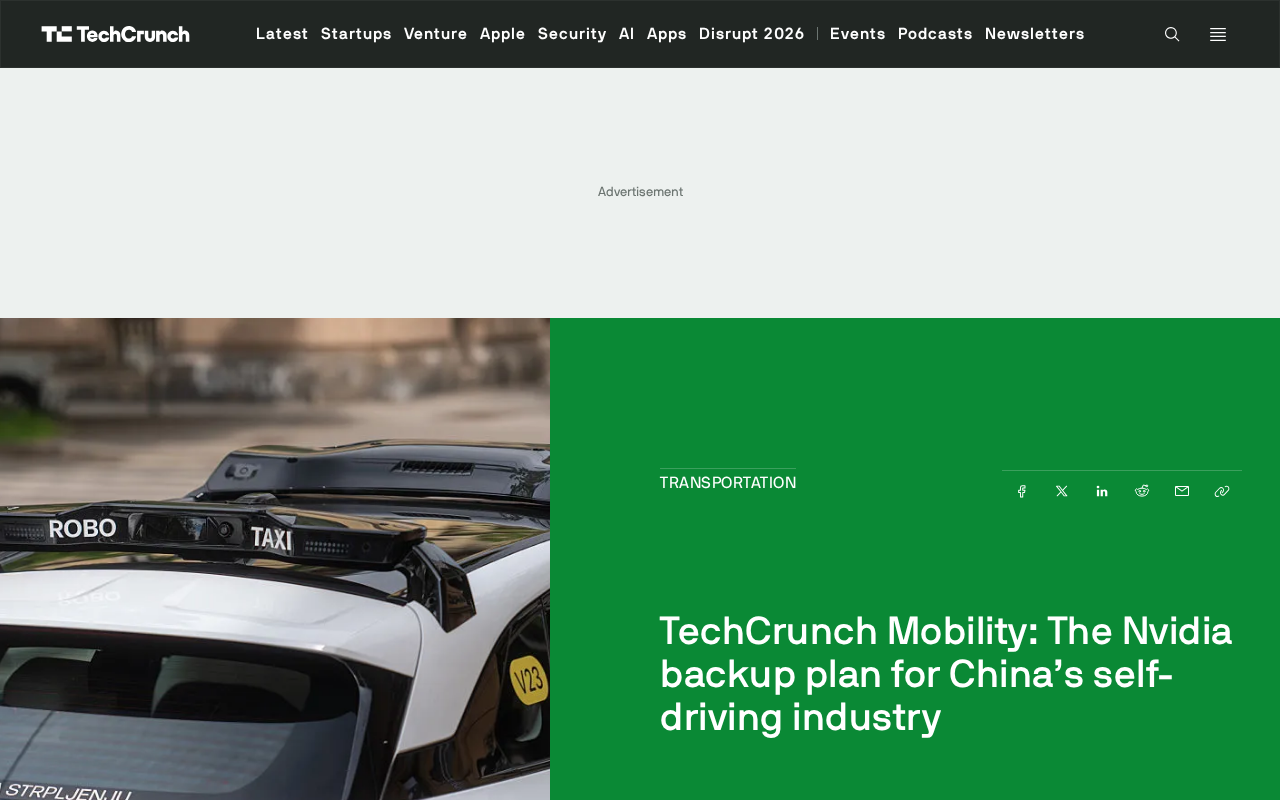
Nvidia is playing a subtle yet critical role in China's autonomous driving sector. According to TechCrunch Mobility, the company is offering a "backup plan" for China's autonomous driving industry to cope with an increasingly complex regulatory environment and supply chain challenges.
What Is Nvidia's Backup Strategy?
According to TechCrunch, Nvidia's "backup plan" is not a single product but a flexible combination of technology and business approaches. At its core, it aims to help Chinese automakers maintain continuity in autonomous driving R&D amid an uncertain policy environment by offering diversified chip solutions and software toolchains.
The backdrop to this strategy is intensifying competition from domestic autonomous driving chipmakers in China, alongside rising supply chain risks driven by geopolitical factors. Nvidia needs to maintain its technological influence in the Chinese market while complying with export controls. TechCrunch notes that Nvidia's approach is to offer "backup" options—including both special-edition chips that meet regulatory requirements and compromise solutions that compensate for hardware performance through software optimization.
Why Is a "Backup" Needed?
China's autonomous driving industry is facing dual pressures: on one hand, domestic chipmakers are rising rapidly with policy and capital support; on the other, the supply stability of international chip giants is being disrupted by external factors. Nvidia's backup plan is essentially a form of risk hedging—ensuring that Chinese customers still have viable technology paths in extreme scenarios while preserving its own market access.
Export Controls and Special-Edition Chips
Since 2022, the U.S. Department of Commerce's Bureau of Industry and Security (BIS) has imposed export controls on advanced computing chips, setting thresholds based on computing power (such as total processing performance, TPP, and performance density). To continue serving the Chinese market, Nvidia introduced compliant models such as the A800 and H800 with reduced interconnect bandwidth, and later designed products like the H20 in response to stricter rules. These "special editions" are not simply downclocked—they are trimmed in metrics such as interconnect bandwidth and NVLink scale to fall below regulatory red lines. Such chips are significantly limited when training very large models, but remain usable for inference, in-vehicle perception training, and simulation, making them the hardware foundation of the "backup plan."
CUDA and DriveOS Ecosystem Lock-In
CUDA is Nvidia's parallel computing platform and programming model, forming its software moat: a large number of autonomous driving perception and training frameworks are optimized for CUDA by default, and migrating to other chips requires rewriting operators and re-tuning, which is costly. DriveOS, meanwhile, is a real-time safety operating system for the vehicle side, providing a runtime environment and middleware that meet functional safety (ISO 26262) requirements. The combination of the two means automakers tend to retain Nvidia's software stack even when switching hardware—this is the key to how the "backup" sustains customer stickiness.
Automotive-Grade Chips and Functional Safety Thresholds
Autonomous driving chips are not direct ports of consumer-grade GPUs; they must pass AEC-Q100 reliability certification and ISO 26262 functional safety level assessments (commonly ASIL-B/D), with development cycles often lasting 2-3 years. This means automakers' chip selection is strongly path-dependent: once a platform completes automotive-grade certification and mass-production validation, the cost of switching suppliers mid-course is extremely high. Nvidia's "backup" option essentially reduces the risk of customers being forced to switch platforms due to supply disruptions—which also explains why, although domestic alternatives are accelerating, they remain difficult to fully replace in the short term.
Impact on the Industry
TechCrunch's analysis suggests that Nvidia's move could reshape the competitive landscape of China's autonomous driving chips. Domestic players will face more intense substitution competition, while automakers gain more bargaining room and technology choices. However, the report also implies that this "backup" relationship is inherently fragile—it depends on continued regulatory leniency and the non-sensitive nature of the technology.
For autonomous driving developers, Nvidia's software ecosystem (such as CUDA and DriveOS) remains an important development platform. The backup plan may include localization adaptations and long-term support commitments for these tools to bolster customer confidence.
Uncertainty Remains
Although Nvidia has demonstrated flexibility, TechCrunch's report does not provide a specific product roadmap or timeline. This means the "backup plan" is more of a strategic posture than a fully implemented solution. Participants in China's autonomous driving industry need to closely monitor subsequent policy signals and Nvidia's actual moves.
Conclusion
Nvidia's backup plan for China's autonomous driving reflects the survival strategies of multinational tech companies in a complex geopolitical environment. It is both a commitment to customers and a defense of its own market position. For readers following the autonomous driving supply chain, this development is worth continued tracking.
One-line Summary
Nvidia leverages special-edition chips and its software ecosystem as bargaining chips to offer Chinese autonomous driving automakers a backup solution against regulatory and supply chain risks.
Paragraph Summary
Based on a TechCrunch Mobility report, this article outlines Nvidia's "backup plan" in China's autonomous driving sector: through special-edition chips compliant with export controls, software optimization compromises, and localized support for toolchains such as CUDA and DriveOS, it helps Chinese automakers maintain R&D continuity amid tightening regulation and supply chain uncertainty. This strategy is both risk hedging and market defense—under the dual pressures of rapidly rising domestic chipmakers and disrupted international supply stability, Nvidia uses it to preserve market access and customer stickiness. The report suggests the plan could intensify substitution competition and expand automakers' bargaining room, but it lacks a specific product roadmap and timeline, making it more a strategic posture than a fully implemented solution whose sustainability depends on the regulatory environment and technology sensitivity.
Related articles

Claude Adds Three New Interactive Artifacts: Whiteboard, Sheets, and Data
Anthropic adds Whiteboard, Sheets, and Data interactive artifacts to Claude in Beta for all paid plans. This hands-on breakdown covers usage, sharing, and external app connections.

Do Men's Friendships Need to Be "Deep"? Emotionally Restrained Camaraderie Counts Too
The Atlantic's Tyler Austin Harper argues that fewer male friendships is a real problem, but emotionally restrained, activity-based friendship is not inherently wrong.

Apple's First Smart Glasses Revealed: No AR, Coming at Next Year's WWDC
Bloomberg's Mark Gurman says Apple's first smart glasses will lack AR, launch at June's WWDC, and possibly ship by year-end. We analyze positioning, timeline, and impact.