Ollama v0.40.13 Update: LFM3 Audio Models Land on Linux and Windows
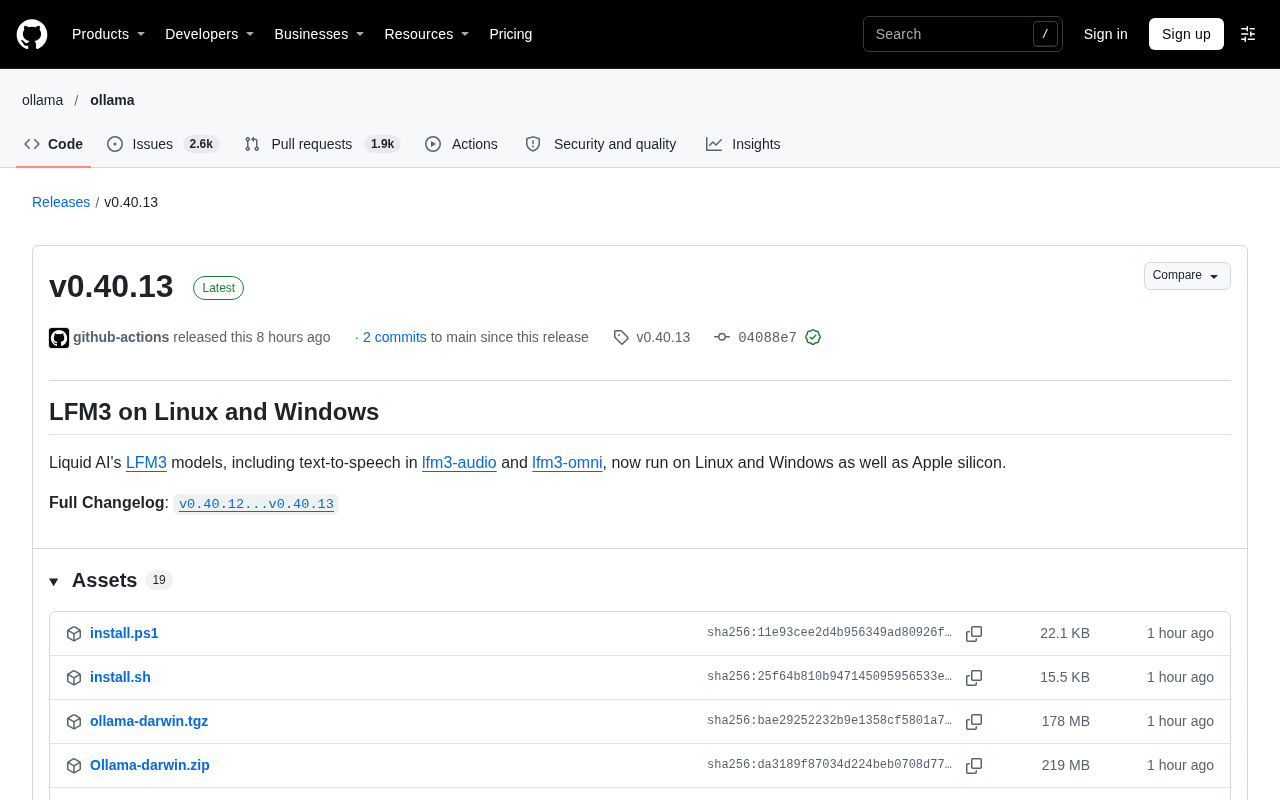
Ollama v0.40.13 extends LFM3 audio model support from Apple silicon to Linux and Windows.
Ollama released minor update v0.40.13, extending Liquid AI's LFM3 series models from Apple silicon to Linux and Windows. LFM3 isn't text-only: its lfm3-audio and lfm3-omni variants offer audio capabilities such as text-to-speech, which have long been scarce in local deployment and usually require extra frameworks and service processes. With unified management in Ollama, users can pull audio-capable models just like text models, significantly lowering the barrier to entry. The update contains just 1 commit — a platform adaptation iteration with no underlying architecture changes. Release notes give no specific performance data or hardware requirements; real-world performance still depends on device configuration and model quantization.
Ollama has released version v0.40.13. The core message of this update isn't complicated, but it matters a lot to local LLM enthusiasts: Liquid AI's LFM3 series models are no longer confined to Apple silicon — Linux and Windows users can now run them directly. For developers accustomed to deploying models locally, this effectively means the official project has extended a capability that was previously somewhat "Apple-exclusive" to mainstream desktop platforms.
What LFM3 Is and Why It's Worth Watching
LFM3 is a model series from Liquid AI. Judging from the naming and feature coverage, it isn't a pure text model. The release notes explicitly mention that the lfm3-audio and lfm3-omni variants support text-to-speech, which means LFM3 has multimodal capabilities related to audio input and output.
Models like this have always been relatively scarce in local inference scenarios. Most open-source models are text-only, and models involving speech synthesis or audio understanding often require additional inference frameworks and separate service processes, resulting in a longer deployment chain. By bringing LFM3 under unified management, Ollama means users can obtain a model with audio capabilities in the same way they pull text models, lowering the barrier to trying it out.
Liquid AI and the LFM Series
Liquid AI is an AI startup incubated at MIT (Massachusetts Institute of Technology). Its core research direction is "Liquid Neural Networks" — a model architecture inspired by biological nervous systems that emphasizes dynamically adjusting network state during inference to achieve temporal and sequence modeling with fewer parameters. LFM (Liquid Foundation Model) is the company's foundational model product line, positioned as a lightweight, efficient, locally deployable family of general-purpose models. LFM3 is the third generation of this series, with noticeably expanded multimodal capabilities compared to its predecessors. Understanding this background helps gauge LFM3's product positioning: it's not an open-source giant model chasing parameter scale, but rather one focused on completing text and audio tasks on consumer-grade hardware with low resource usage — which makes its inclusion in a local inference tool like Ollama quite reasonable.
What the Expanded Platform Support Means
Previously, LFM3 on Ollama could only run on Apple silicon devices, which relates to how Apple's unified memory architecture is friendly to model inference. This update extends support to Linux and Windows, and the practical impact can be seen on two levels.
From a user coverage perspective, Linux is the primary system for servers and development machines, while Windows covers a large number of individual developers and small teams. With support for these two platforms, LFM3's potential user base expands from Mac users to the vast majority of local deployment scenarios. From an ecosystem perspective, this also shows that Ollama's adaptation to different hardware backends is continuing to advance, and audio models are no longer an experimental feature on just one platform.
It's worth noting that the release notes don't provide specific performance data or hardware requirements. Actual performance depends on the device configuration and the model quantization version.
Apple Silicon Unified Memory and Model Inference
Apple silicon (M-series chips) uses a Unified Memory Architecture, where the CPU and GPU share the same physical memory without needing to move data between VRAM and system memory. This feature is especially friendly to large model inference: model weights can reside directly in shared memory, accessed by the GPU at high bandwidth, avoiding the VRAM capacity bottlenecks common with discrete GPUs. That's why many local inference frameworks prioritize Apple silicon adaptation — and why Ollama previously limited LFM3 to that platform. Linux and Windows platforms typically rely on NVIDIA CUDA, AMD ROCm, or pure CPU inference, with more complex hardware combinations, greater adaptation effort, and wider performance variance — which is the technical reason this platform expansion is noteworthy.
How to Use and Update
This release was automatically built by github-actions. The release record shows 1 commit, with the full changelog pointing to v0.40.12...v0.40.13. Judging from the version number span, this is a minor iteration, with changes focused on model platform support and no major adjustments to the underlying architecture.
For users already using Ollama, the usual upgrade process will get the new version. After upgrading, you can try pulling the LFM3-related models and observe how the audio capabilities perform on your machine. If this is your first time with local audio models, it's advisable to first confirm whether your disk space and RAM meet the model size requirements.
Ollama's Model Pulling and Version Management Mechanism
Ollama distributes models in layers similar to container images. Users pull models via ollama pull <model>, and model files are cached locally by layer, so updates only download the changed layers. Ollama itself and models are versioned separately: upgrading the Ollama client only updates the inference runtime and platform adaptation layer. Already-downloaded models don't change automatically — you need to pull again to get new versions or new variants. So when the article says "after upgrading, you can try pulling the LFM3-related models," the actual process is to first upgrade Ollama via a package manager or install script, then explicitly pull specific model tags like lfm3-audio and lfm3-omni. In addition, Ollama's model quantization versions directly affect memory usage and inference speed, so devices with limited resources should prioritize tags with fewer parameters or higher quantization levels.
Summary
Ollama v0.40.13 is a focused update: extending Liquid AI's LFM3 audio models from Apple silicon to Linux and Windows. It doesn't pile on flashy features, but for developers who want to experience speech synthesis capabilities locally, it's a genuine usability improvement. What's worth watching next is LFM3's inference quality and latency performance across different hardware — that will determine whether it can truly enter everyday development workflows.
One-line Summary
Ollama v0.40.13 extends LFM3 audio model support from Apple silicon to Linux and Windows.
Paragraph Summary
Ollama has released a minor update, v0.40.13, whose core change is extending support for Liquid AI's LFM3 series models from Apple silicon to Linux and Windows. LFM3 isn't a pure text model — its lfm3-audio and lfm3-omni variants offer audio capabilities such as text-to-speech, and such models have always been scarce in local deployment scenarios, typically requiring additional inference frameworks and service processes. With unified management in Ollama, users can obtain audio-capable models in the same way they pull text models, significantly lowering the barrier to trying them. This update contains only 1 commit and is an iteration at the platform adaptation level, with no underlying architecture changes. The release notes don't provide specific performance data or hardware requirements; actual performance still depends on device configuration and model quantization version.
Related articles

Ollama Local Deployment Guide: Run Open-Source LLMs with Zero Experience
Ollama local deployment tutorial: what Ollama is, why choose it, how to download, install, and run open-source LLMs, and use its API for custom development. Beginner-friendly.

n8n: The 187K-Star Open-Source Automation Powerhouse That Turns Repetitive Work into Workflows
n8n is a 187K-star open-source visual workflow automation engine with 400+ nodes, Webhook/schedule/polling triggers, self-hosting for data security, and AI Agent support. Here's a guide to its core concepts, use cases, and pitfalls.

Self-Hosting n8n in Practice: Docker + PostgreSQL + Caddy Deployment Guide
A step-by-step guide to deploying a self-hosted n8n instance with Docker Compose, PostgreSQL, and Caddy automatic HTTPS, including env var pitfalls, Feishu alerting, and backup/upgrade/rollback tips.