One MCP to Connect All Devices: Ending AI's Forgetfulness

MCP aims to use a unified protocol to let agent memory persist across devices and load on demand.
Starting from the pain point of "AI forgets, context breaks," the article notes that tools are scattered across devices and applications. MCP's core claims: letting agent knowledge persist as cross-session, cross-device memory, and loading only task-relevant content to avoid context bloat. MCP is positioned as a unified access layer. The article also notes this is conceptual promotion lacking implementation details and performance data.
AI's memory problem has long been a pain point for developers. Every time you switch devices or restart a conversation, the carefully tuned context vanishes, and you have to re-explain the same background. A solution called MCP is trying to change this—it promises to connect all tools with a single protocol, letting knowledge learned by agents persist as cross-device memory and loading only what's truly relevant.
The Problem: AI Forgets, Context Breaks
The short video opens by hitting the pain point directly: "Your AI forgets, so you explain it, again." Your AI forgets things, so you have to explain over and over. Then again, "Your tools are everywhere. Your context isn't." Tools are scattered across different devices, applications, and sessions—but context can't follow.
This actually points to a common dilemma in current agent applications: model capabilities are improving, but memory and context management remain fragmented. Every machine and every tool is its own island, forcing users to manually shuttle information between islands.
MCP's Solution: Memory Persistence and On-Demand Loading
The video's core claim is simple: "Only MCP. What your agent learns becomes memory. Only what's relevant gets loaded." In other words, what the agent learns is transformed into memory, and only the portion relevant to the current task is loaded when needed.

There are two key designs here. First, memory persistence—no longer relying on a single session's context window, but storing learned knowledge so it's available across sessions and devices. Second, relevance filtering—instead of dumping all history into the model, retrieving on demand to avoid the cost and interference of context bloat. Only by combining these two does "memory" become truly usable rather than just another bloated database.

Context window refers to the maximum number of tokens an LLM can process in a single inference—conversation history and tool return results all consume this budget. Once the window fills up, earlier content gets truncated or discarded, which is one of the technical roots of "AI forgets." RAG (Retrieval-Augmented Generation) is a common approach to this limitation: store external knowledge in a vector database, retrieve the most relevant fragments by semantic similarity, and splice them into the prompt rather than stuffing all history into the window at once. The "load only relevant content" emphasized in the article is essentially combining memory persistence with relevance retrieval—memory handles cross-session retention, retrieval controls the amount of information entering the window, thereby maintaining long-term consistency within a limited context budget.
One Connection, Covering All Tools and Devices
The latter half of the video emphasizes: "Specialized agents, ready on every machine. All your tools, one connection. One MCP, every device." Specialized agents are ready on every machine, all tools connect through a single connection, and one MCP covers all devices.
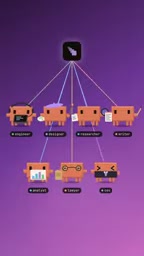
From an architectural perspective, this amounts to treating MCP as a unified access layer: tools no longer need to be adapted separately for each agent, and agents don't have to rebuild context for each device. For multi-device users, this "configure once, use everywhere" experience may be more practically valuable than simply improving model capabilities.
MCP (Model Context Protocol) is a protocol proposed and open-sourced by Anthropic for establishing a unified interface between models/agents and external tools and data sources. It uses a client-server structure: an MCP Server encapsulates a tool or data source into standard capabilities (such as resources, tool calls, and prompt templates), while an MCP Client is implemented on the agent side to discover and invoke these capabilities on demand. This means tool providers only need to implement an MCP Server once to be reused by multiple agents that support the protocol, without writing separate adaptation layers for each host—this is the technical meaning of "all your tools, one connection" in the article. It's important to distinguish that the protocol itself addresses "standardized access," while memory persistence and relevance loading depend more on specific implementations rather than being mandated by the protocol specification.
A Sober View: What the Short Video Doesn't Clarify
It's worth noting that this content is essentially conceptual promotion. It describes MCP's vision—memory persistence, on-demand loading, unified cross-device connection—but doesn't elaborate on specific implementation mechanisms, the range of supported devices, or provide performance or compatibility data. To what extent these capabilities have been realized and what the integration costs are for different tools all require more technical details to verify.
For developers, MCP's direction is worth watching: elevating context from "session" to "asset," and simplifying tool integration from "individual adaptation" to "unified protocol." But the real criterion is still whether it can reliably deliver on these promises in actual workflows.
One-line Summary
MCP aims to use a unified protocol to let agent memory persist across devices and load on demand.
Paragraph Summary
The article starts from the pain point of "AI forgets, context breaks," pointing out that tools are scattered across devices and applications, forcing users to repeatedly explain background. MCP's core claims are twofold: first, letting knowledge learned by agents persist as cross-session, cross-device memory; second, loading only content relevant to the current task, avoiding the cost and interference of context bloat. Architecturally, MCP is positioned as a unified access layer, with all tools connected through a single connection and specialized agents ready on every machine, achieving configure-once, use-everywhere. The article also notes that this content is essentially conceptual promotion, without disclosing implementation mechanisms, device support scope, or performance data, and the degree of realization still needs verification.
Related articles

Running Real-Time Local Voice AI on a Single 12GB GPU: Full Pipeline with a 35B Model and Voice Conversation
A developer shows how to run a 35B MoE LLM, Whisper ASR, and Breeze TTS2 locally on a single 12GB GPU, cutting end-to-end voice chat latency from 8s to 2–3s via streaming, parallel synthesis, and quantization, plus Agent tool-calling integration.
Qwen4 Architecture Preview Open-Sourced: 125B Parameters, 512 Experts, Designed for VRAM-Constrained Hardware
Qwen4 isn't released yet, but its architecture is previewed via open-source Qwen3.8 Flash Next: 125B params, 6B activated per token, 512 experts, 262K context, built for VRAM-limited hardware. This article covers official confirmations, key config.json metrics, and local deployment tests on 24G memory.
Run 8K Images on 6GB VRAM! Hands-On Test of Fudan's Open-Source MOSS-Image Model
Fudan OpenMouse team and Shanghai MOSS Intelligence open-source MOSS-Image, a 500M-parameter DT architecture text-to-image model that runs locally on 6GB VRAM with precise text rendering, structured layout control, and 4K Token prompt support—ideal for e-commerce posters and local deployment by individual creators.