Open-Source English Learning Skill: Make Memorized Words Reappear in Videos and Songs
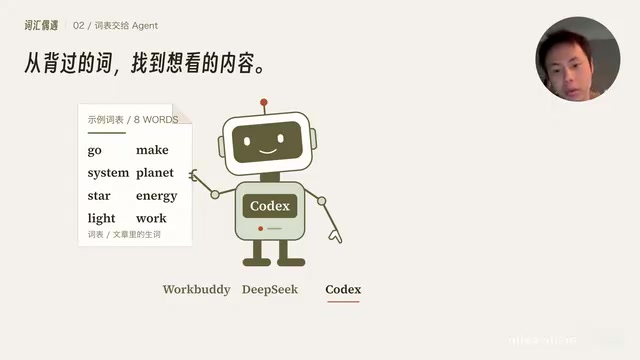
Bilibili creator open-sources an English learning Skill that revives memorized words through contextual videos and songs.
A Bilibili creator open-sourced an English learning Agent Skill to solve the pain point of memorizing words but never using them. Users input the day's words (by photo or text); the Skill calibrates English level and content preferences, then matches videos from Bilibili, Douyin, and Xiaohongshu that contain those words, marking their positions. Matching includes derived words and inflections, with difficulty adjusted to level. It also reads liked songs from QQ Music/NetEase Cloud Music to recommend playlists based on the day's words—inefficient, the creator admits, but it leverages existing listening habits. The core value is packaging a teacher's manual workflow into a reusable vertical-scenario Agent tool.
The most painful part of memorizing vocabulary isn't forgetting—it's that the words you learn never get used. You vaguely recognize them while reading, but in listening comprehension they don't register at all. A Bilibili creator has open-sourced an English learning Skill that tries to solve this problem through "contextual recurrence": you give it the words you memorized today, and it returns a batch of videos and songs containing those words.
How Exactly Does This Skill Work?
The workflow is surprisingly simple. Students send the words they memorized that day to the Agent—whether by photographing a paper textbook or typing the text directly—and as long as the Agent has this Skill installed, it takes over the rest of the process.
On first use, the Skill gets to know your English level and content preferences—what kinds of topics you usually watch, what difficulty you can handle. This "calibration" step determines how accurate subsequent recommendations will be. According to the creator's demo on Bilibili, the system then marks where the target words appear in videos; users click to watch, with no extra navigation friction in between.
Domestic users are preferentially recommended content sources from platforms like Bilibili, Douyin, and Xiaohongshu—a detail that significantly affects the actual experience. After all, only videos you can open directly can be called "smooth."
Agent Skill is a form of capability packaging that has emerged alongside the large language model Agent ecosystem in recent years. You can think of it as "a plugin or skill pack installed for an AI assistant." A Skill typically includes prompt templates, tool invocation logic (such as searching, reading files, or calling third-party APIs), and workflow orchestration rules. Once installed, the Agent can automatically execute a complete set of actions in specific scenarios. Unlike the traditional approach of "re-explaining requirements in every conversation," a Skill solidifies reusable workflows so that users only need to provide the trigger condition (such as today's memorized words), and the Agent completes the subsequent steps according to the preset flow. This model lowers the barrier for ordinary users to use AI and lets developers distill experience from vertical scenarios into shareable modules.
Matching Mechanism: More Than One Word to One Video
If it simply took words and searched for videos mechanically, it would be no different from a search engine. The difference with this Skill lies in the "elasticity" of matching.
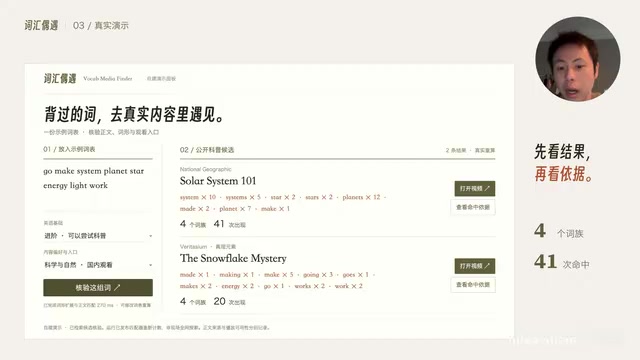
According to the creator, the system includes derived words in its matching scope—past tense and past participle forms of verbs, noun forms, and so on can all become matching targets. This means the same word root appears repeatedly in different forms across your input materials, diversifying the exposure. The materials mentioned—TED Education and National Geographic 101—are intermediate-to-advanced content, but the Skill adjusts difficulty based on the user's self-reported English level, so it won't discourage people right away.
The logic behind this design deserves a bit more explanation: words are truly remembered not through repetition count but through "re-encounters" in different contexts. A word appearing once in a science video and again in song lyrics builds stronger neural connections than drilling it ten times in a vocabulary list. The creator's phrasing is to "turn words into living words" rather than "dead words" that are forgotten days after memorization and that cause you to stumble in reading and fail to keep up in listening.
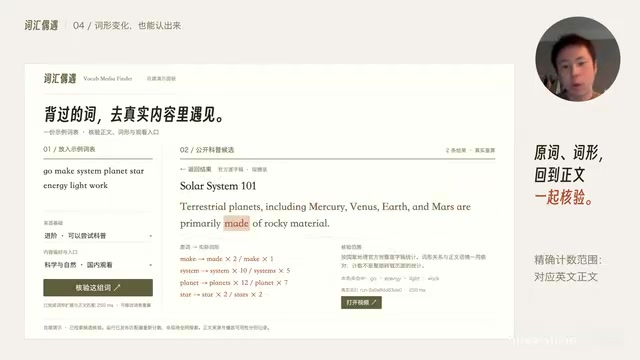
Derived words and inflections are core concepts in English vocabulary learning. English words often derive new words by adding prefixes, suffixes, or changing internal spelling—for example, the verb create can derive creation (noun), creative (adjective), and created (past tense/past participle). If a matching system only recognizes the base form of a word, then when users see running in a video, the system cannot associate it with the run they memorized, causing a large number of real-context exposures to be missed. Including derived words in the matching scope essentially treats the "word family" as the unit of matching, letting the same root recur in different grammatical forms. This is consistent with vocabulary acquisition research conclusions that "multiple forms of one word and recurrence across contexts" help deepen memory.
Music Recommendations: An Inefficient but Clever Component
The other track of the Skill is song recommendations. Through the QQ Music or NetEase Cloud Music Agent, it reads the user's "liked songs" to understand listening preferences, then combines that with the day's memorized words to recommend a daily playlist.
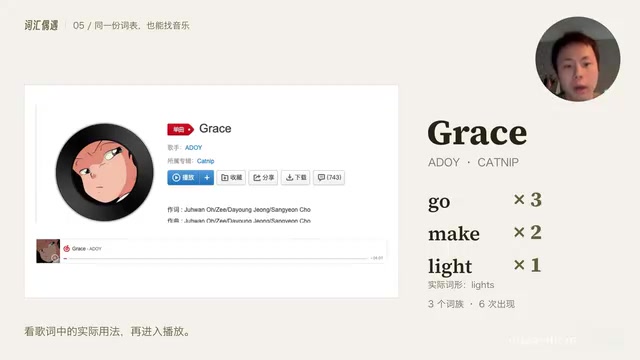
The creator himself admits that learning words through songs is "not a very efficient method." This judgment is honest—lyrics are far inferior to instructional videos in vocabulary coverage and contextual clarity. But it captures a real scenario: you're going to listen to music anyway, and if a song happens to contain a word you recently memorized, that word becomes a little more familiar. This is about embedding learning into existing habits rather than asking users to carve out extra time.
From an implementation perspective, the creator mentions that you can use the computer use feature to operate music apps, or directly call backend API interfaces—the latter is clearly simpler. This detail reveals the Skill's design orientation: prioritizing lowering the usage barrier rather than showing off technical prowess.
computer use is a category of capability in the Agent field, referring to AI operating graphical interface software by simulating mouse clicks, keyboard input, and screen reading—essentially letting AI "use a computer like a human." Its advantage is that it doesn't depend on whether the target software exposes APIs, making it highly general-purpose; its drawback is slowness and stability affected by interface changes. The alternative is directly calling backend API interfaces, which is fast and reliable but requires the target platform to provide interface permissions. The article mentions both approaches are viable, and prioritizing APIs reflects that such learning tools value practical usability and low friction over technical generality in their design.
What Does Open Source Mean?
The project is already open-sourced. In the video, the creator calls on users to give it a star and expresses hope to work with everyone to make the Skill better. He also mentions that this is his first time doing something like this, with a clear "testing the waters" tone.
From a content creator's perspective, the value of such a Skill lies not in technical complexity—it essentially automates a manual workflow (a teacher looks at words, picks videos, sends links)—but in demonstrating a path for Agent implementation: don't build a general assistant, just build the "just enough" link in a specific scenario. Packaging teachers' daily repetitive labor into reusable tools is an approach that applies equally to other vertical scenarios.
The matching mechanism still has room for improvement, and the creator says he will continue to refine it. For English learners, it's ready to try now; for those who want to build similar tools, this open-source repository provides an extremely low-cost starting point.
One-line Summary
Bilibili creator open-sources an English learning Skill that brings memorized words to life through contextual videos and songs.
Paragraph Summary
A Bilibili creator has open-sourced an English learning Agent Skill aimed at solving the pain point of "memorizing words but never using them." Users input the words they memorized that day (via photo or text), and the Skill first calibrates English level and content preferences, then matches videos containing those words from platforms like Bilibili, Douyin, and Xiaohongshu, marking where the words appear; matching includes derived words and inflections, with difficulty adjusted to the user's level. Another track reads liked songs from QQ Music/NetEase Cloud Music and recommends playlists combined with the day's words—the creator admits it's not highly efficient but leverages existing listening habits to increase exposure. The project is open-sourced, and its core value lies in packaging a teacher's manual workflow into a reusable vertical-scenario Agent tool.
Related articles
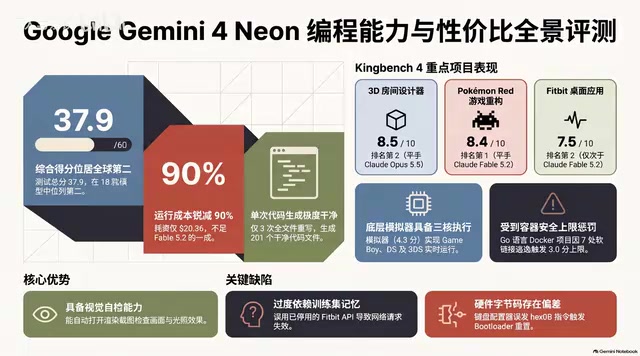
Gemini 4 Neon Hands-On: Value King or Confident Catastrophe?
Gemini 4 Neon review: 1M-token context, four thinking levels, 201 files in one KingBench4 pass at one-tenth Fable 5.2's cost—but it hallucinates fake data, leaves 7 symlink escapes, and bricks keyboards.

Google Gemini 4 Neon Hands-On: 6 3D Works That Impress and Fail
Hands-on with Google Gemini 4 Neon on a 3060 laptop: 6 3D works tested. Sunshower Fishing Harbor and mechanical keyboard impress; soft-body physics and faces fall short.
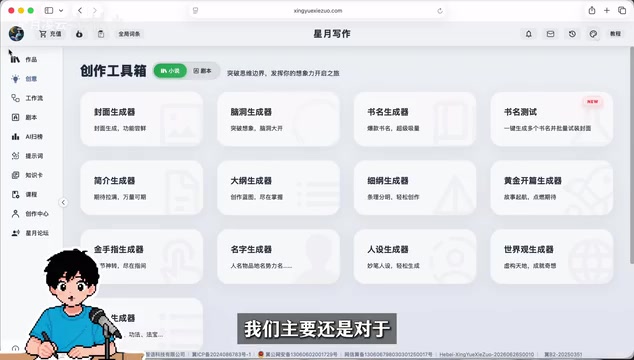
Gemini 4 Neo Web Novel Writing Test: Faint AI Flavor, Textured Dialogue
Bilibili creator's first-look review of Gemini 4 Neo for Chinese web novel writing: testing a Three Kingdoms transmigration opening with faint AI flavor, emotionally textured dialogue, and strong crisis building, plus comparison of 4A/4H/4C models and full workflow demos.