OpenAI Agents SDK Doesn't Lock You Into OpenAI Models: A Hands-On Guide to Python Multi-Agent Handoffs
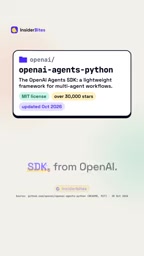
Breaking down how the MIT-licensed, 30k+ star OpenAI Agents SDK uses handoffs for multi-agent collaboration
Based on the Insider Bytes demo and GitHub project info, this article breaks down OpenAI Agents SDK, a lightweight MIT-licensed Python framework with over 30,000 GitHub stars. It notes the common misconception that it only works with GPT-series models, when the README explicitly states provider agnostic. A single agent runs with three lines of code, and the core use case is a front desk agent delegating requests to expert agents via handoffs for separation of responsibilities and routing. The framework also includes tools, guardrails, sessions, and tracing, covering needs from prototyping to observable deployment. The article also notes that multi-provider configuration details should follow official documentation and offers guidance on who should use it.
OpenAI Agents SDK is often misunderstood as usable only with GPT-series models, but its README explicitly states "provider agnostic" — it isn't tied to any single model provider. That means you can use the same lightweight Python framework to build a system where multiple agents collaborate to complete tasks, while the underlying model can be swapped flexibly.
This article is based on a demo from the YouTube channel Insider Bytes, combined with project information on GitHub, to break down how this MIT-licensed framework with over 30,000 stars uses "handoffs" to achieve task delegation between agents.
Positioning of a Lightweight Framework
According to Insider Bytes, the goal of OpenAI Agents SDK is to keep "one agent handing work off to another agent" simple. It is not a bloated orchestration platform, but a small, focused Python library. The project is MIT-licensed, has accumulated over 30,000 stars on GitHub, and requires Python 3.10 or newer to run.
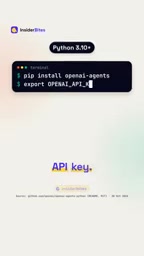
Installation is straightforward: run pip install openai-agents, then configure an OpenAI API key to get started. Although the default examples use an OpenAI key, the framework itself claims to be provider agnostic, which we'll expand on later.
Provider agnostic means a framework doesn't deeply couple application logic to a specific model vendor's API or SDK. Under this design, models are typically called through a unified abstraction interface, and developers only need to change configuration or adapters to run the same agent logic on OpenAI, Anthropic, local open-source models, or proxy gateways. For multi-agent systems, this characteristic directly affects cost, latency, and availability: teams can assign different models to different agents based on task complexity, and can quickly switch when one provider experiences an outage. Note that which providers are supported and how to configure keys and endpoints still depends on the framework version and official documentation — you can't infer all the details from a single README statement.
Hello World: Get Your First Agent Running in Three Lines of Code
The getting-started example in the README shows the minimal viable form: create an agent with name and instructions, call Runner.run_sync, and print the final output. No complex configuration files, no mandatory project structure.
This design orientation lowers the barrier to entry. For developers who want to quickly validate "is multi-agent right for my use case," they can get a single agent running first, then gradually introduce handoff logic, rather than building full infrastructure from the start.
Core Use Case: Front Desk Agent + Expert Agents
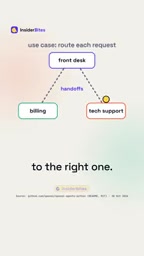
The most practical scenario in the demo is "front desk triage": configure a front desk agent with multiple handoff targets, each being an expert agent responsible for a specific domain. When the front desk agent determines that a request falls outside its scope, it can hand the task off to the corresponding expert.

The engineering value of this pattern lies in separation of responsibilities. Rather than stuffing all instructions into one agent and making it hard to maintain, it's better to split into multiple small, specialized agents and express routing logic through handoff relationships. Request classification, specialized processing, and result return each have their own role, making debugging and iteration easier.
Handoff is the key mechanism that distinguishes this framework from ordinary function calls. It doesn't simply pass a string result to the next agent; it transfers the current conversation context and execution responsibility to the target agent, which then takes over subsequent model calls and tool usage. In engineering terms, handoffs are typically registered declaratively on the agent, and the framework exposes these handoff targets as actions the model can select, so that routing logic is partly determined by the model and partly constrained by code. For debugging, every responsibility transfer along the handoff chain should be traced; otherwise it's very hard to reconstruct which agents a request actually passed through.
Beyond Handoffs: Tools, Guardrails, Sessions, and Tracing
The framework also includes several supporting capabilities. tools let agents call external functions; guardrails impose constraints on inputs and outputs; sessions manage multi-turn conversation state; and tracing provides visualization and debugging capabilities so you can see exactly which steps the agent executed.
Combined, these capabilities cover common needs from prototyping to observable deployment. Tracing is especially important — in multi-agent systems, a single user request may trigger multiple model calls and handoffs, and without tracing information it's hard to pinpoint which step the problem occurred at.
Guardrails are validation logic executed before an agent's input or output passes through, with typical uses including blocking inappropriate content, restricting sensitive operations, and validating that structured outputs meet expectations. In single-agent scenarios, guardrails only guard one door, but in multi-agent and handoff chains, each hop may need independent guardrails; otherwise a delegated expert agent could bypass the front desk's constraints. Sessions are responsible for persisting context across multi-turn conversations, avoiding the need to reassemble history from scratch on every request; when combined with handoffs, pay special attention to the boundaries and trimming strategies for context as it passes between agents, to prevent state bloat or information leakage.
What Provider Agnostic Means
The "provider agnostic" statement in the README is an underappreciated aspect of this framework. The cost and latency of multi-agent applications are often concentrated in model calls; if the framework allows swapping the underlying model, teams can choose different models for different tasks — a lightweight model for triage, a more capable model for complex processing.
However, it's worth noting that the original demo didn't elaborate on specific multi-provider configuration details, and this capability should be based on official documentation. For teams evaluating multi-agent frameworks, this is a direction worth further verification.
Who Should Use It
If you're already building applications in Python and want to introduce agent collaboration with minimal dependencies, this framework's MIT license and streamlined API are clear advantages. Routing-type scenarios like front desk triage can directly apply the handoff pattern; while systems requiring stronger orchestration and more complex state machines may still need to evaluate heavier solutions.
Insider Bytes' positioning is to introduce one AI tool every workday, and this episode itself illustrates: the selling point of OpenAI Agents SDK isn't model binding, but expressing collaboration relationships between agents clearly with minimal code.
Related articles
 Tech Frontiers
Edge AI on Microcontrollers: When Is It Actually Worth Deploying?
Drawing on Reddit discussions and Arm case studies, this article analyzes the real-world use cases for edge AI on microcontrollers: when each device needs independent inference, when a gateway or cloud is more reasonable, and the costs and boundaries of specialized hardware.
 Tech Frontiers
Pushing the Limits of Extreme Sudoku on a 16GB GPU: Insights from Depth and Flow Matching
A researcher trained a 16.54M-parameter model on a 16GB GPU to solve extreme Sudoku, finding effective depth breaks the 60% plateau and flow matching with improved sampling pushes accuracy past 99% with ~50× lower layer-evaluation budget.
 Tech Frontiers
AI Agent Approval Workflows: Why Human Confirmations Always Get Mindlessly Clicked
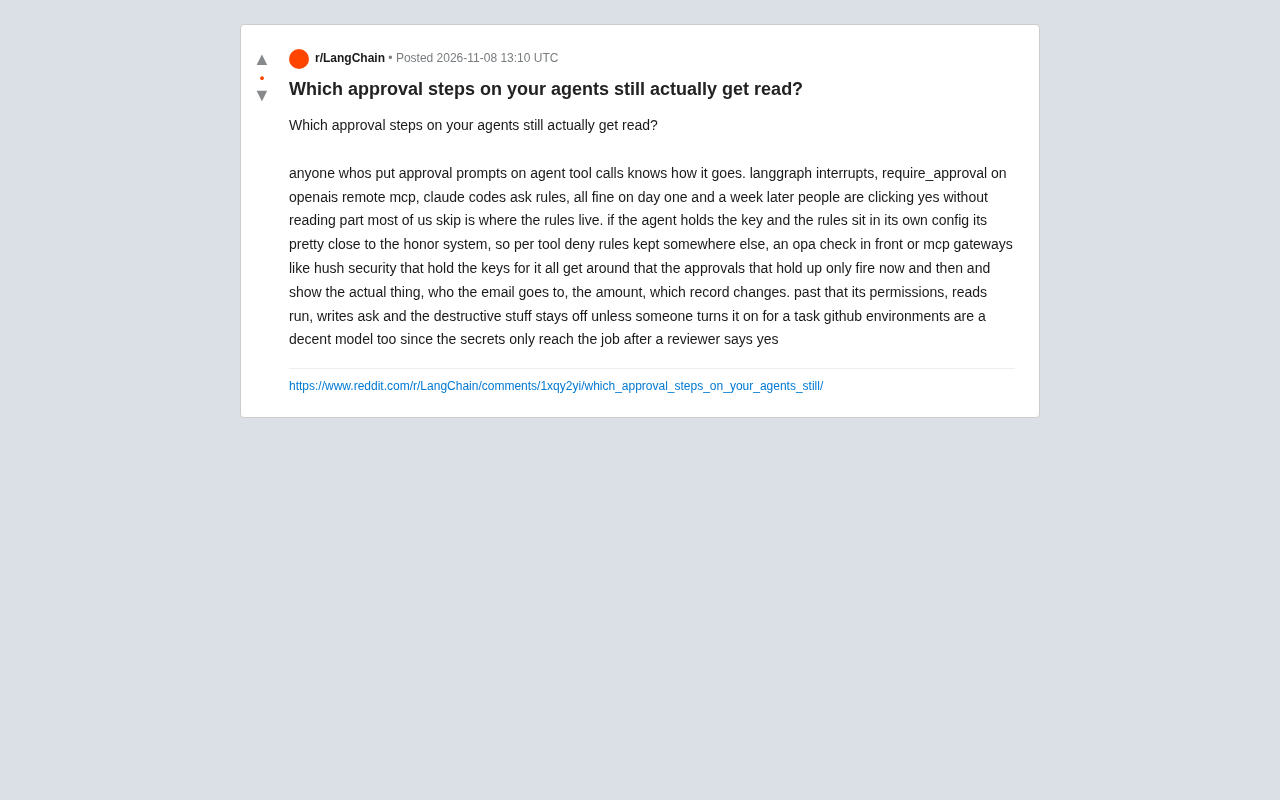
Why do AI agent approval workflows always get mindlessly clicked? A Reddit discussion shows that separating rules from keys, low-frequency high-risk approvals, and GitHub Environments-style gates are the keys to effective approvals.