OpenAI and Oracle Deepen Partnership: Enterprise Apps and AI Agents Come to ChatGPT

OpenAI and Oracle pursue bidirectional integration, extending ChatGPT toward the entry point of enterprise business systems.
OpenAI and Oracle are expanding their partnership into a bidirectional integration: bringing Oracle's enterprise business applications and AI agents into ChatGPT while using OpenAI's model capabilities to support Oracle's new products. The article notes that the core signal is ChatGPT extending from a general-purpose conversational assistant toward a front-end entry point for enterprise workflows. The real difficulty in enterprise AI deployment lies not in the models themselves but in the connection layer between models and existing systems such as ERP, CRM, databases, and approval workflows—and Oracle happens to control entry points to these core systems. The partnership offers value to both sides: OpenAI gains a realistic path to reaching large organizational customers, while Oracle continues its investment in cloud and AI infrastructure. Because the announcement discloses limited information, details such as permission boundaries, data isolation, and operation auditing remain unclear, and these will determine the integration's practical usability in enterprise environments.
OpenAI and Oracle are expanding the scope of their partnership: bringing Oracle's enterprise business applications and AI agents into ChatGPT, while feeding OpenAI's model capabilities back into Oracle's new products. The core signal here is that ChatGPT is moving beyond a general-purpose conversational entry point and extending further into enterprise workflows and business systems.
Two directions of the partnership
According to information released by OpenAI, this collaboration is bidirectional. On one side, Oracle's business applications and AI agents are being integrated into ChatGPT; on the other, OpenAI's capabilities are being used to support new services launched by Oracle. In other words, this isn't a simple model-calling relationship—both parties are pushing their respective product boundaries into each other's territory.
This structure is worth noting. Over the past year, the difficulty of deploying enterprise AI has often lain not in the models themselves, but in the connection layer between models and enterprises' existing systems (ERP, CRM, databases, approval workflows). Oracle happens to control entry points to a large number of core enterprise systems, while OpenAI needs to prove that ChatGPT can enter real business scenarios—not just remain limited to document writing and code completion.
ERP (Enterprise Resource Planning) and CRM (Customer Relationship Management) are the two core systems in the enterprise software stack. ERP covers back-office processes such as finance, supply chain, production, and HR, and is typically regarded as an enterprise's "system of record"; CRM manages front-office data such as sales, marketing, and customer service. Both have long been dominated by vendors like Oracle, SAP, and Salesforce, with complex data structures, multiple permission layers, and high degrees of customization. The so-called "connection layer" refers to establishing secure, auditable calling channels between these existing systems and AI models, including engineering work such as API orchestration, identity authentication, field mapping, and business semantic transformation. It becomes a deployment challenge because models cannot directly understand ERP table structures and business rules, and enterprises do not allow models to freely read and write core data.
ChatGPT is becoming the entry point for enterprise applications
Bringing Oracle's business applications and agents into ChatGPT means users may no longer need to switch to separate enterprise software interfaces, but can directly trigger business operations or queries within a conversation. This is a substantive expansion of ChatGPT's product positioning: it is no longer just an assistant that answers questions, but is gradually becoming the front-end interface for invoking enterprise systems.
The value of such integration lies in lowering the barrier to use, but it also raises new questions—how to design permission boundaries, data isolation, and operation auditing. The original article does not disclose specific technical implementations or permission models; these details will determine the practical usability of the integration in enterprise environments.
"AI agent" refers to a form of large-model application that can autonomously plan steps, call external tools or APIs, and iterate actions based on returned results, distinguishing it from single-turn question-and-answer chatbots. In enterprise scenarios, agents may be assigned specific tasks such as querying orders, creating tickets, or initiating approvals. Permission boundaries (which data and operations are open to agents), data isolation (data from different tenants or departments does not leak to one another), and operation auditing (recording the source and result of each agent call) are three basic governance requirements for agents entering production environments, and are also the core concerns of enterprise compliance and security teams when evaluating such integrations.
Oracle's role: both channel and infrastructure
In the partnership, Oracle is not only the party providing applications but is also using OpenAI's capabilities to build new products. This continues Oracle's recent investment direction in cloud and AI infrastructure, and also preserves its room for multi-track cooperation among large-model vendors.
For OpenAI, binding with enterprise software and cloud vendors like Oracle is a realistic path to reaching large organizations. Enterprise procurement decisions often revolve around existing system ecosystems, and model APIs alone are hard to penetrate.
OCI (Oracle Cloud Infrastructure) is Oracle's public cloud platform, which in recent years has gained a share of the large-model infrastructure market thanks to high-bandwidth networking and GPU cluster resources required for AI training and inference. Oracle also maintains partnerships with multiple model vendors; this multi-track strategy allows it to serve both as a channel for enterprise applications and as an infrastructure provider for model distribution and compute supply. For model vendors, connecting to such cloud and software ecosystems means bypassing the sales cycle for individual customers and directly reaching large organizations already within the ecosystem.
Points to watch
The information disclosed in this announcement is relatively limited. What deserves attention going forward: which specific Oracle applications will be integrated first, how agent permissions will be divided within ChatGPT, and which types of customers Oracle's new products based on OpenAI capabilities will actually target. These details will say more about how far enterprise AI integration can go than the partnership itself.
One-line Summary
OpenAI and Oracle pursue bidirectional integration, extending ChatGPT toward the entry point of enterprise business systems.
Paragraph Summary
OpenAI and Oracle are expanding their partnership into a bidirectional integration: on one hand, bringing Oracle's enterprise business applications and AI agents into ChatGPT; on the other, using OpenAI's model capabilities to support Oracle's new products. The article notes that the core signal is ChatGPT extending from a general-purpose conversational assistant toward a front-end entry point for enterprise workflows. The real difficulty in deploying enterprise AI lies not in the models themselves but in the connection layer between models and existing systems such as ERP, CRM, databases, and approval workflows—and Oracle happens to control entry points to these core systems. The partnership offers value to both sides: OpenAI gains a realistic path to reaching large organizational customers, while Oracle continues its investment in cloud and AI infrastructure and preserves room for multi-track cooperation. Because the announcement discloses limited information, details such as permission boundaries, data isolation, and operation auditing remain unclear—and these will determine the integration's practical usability in enterprise environments.
Related articles

Last Week Tonight Exposé: The Dangerous Ties Between Politicians and White Supremacy
Last Week Tonight investigates Georgia Senate candidate Mike Collins and Florida candidate Marshall Rawson, exposing their multiple ties to white supremacists and the Republican Party's silent response.
AI Buzz Weekly: GPT-6.5 Leak, New Claude Model, and MiniMax's Cost-Effectiveness
This week's AI buzz roundup: suspected GPT-6.5 leak, Microsoft configs showing GPT-6.1 Tera, Anthropic's new model that can identify entire classes of bugs, disappointing early Gemini 4 Carbon results, and MiniMax M3.1 Flash beating Claude Opus 5 and GPT-5.6 Sol in benchmarks at extremely low cost.
AI Briefing: Gemini 4 Carbon Released, Ant Open-Sources Ling-3.1
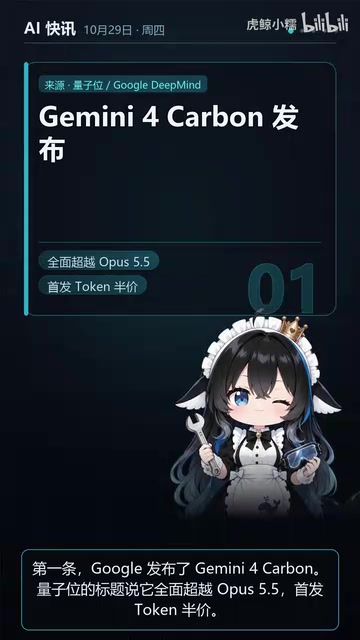
AI Briefing: Google releases Gemini 4 Carbon qubit model, claiming to surpass Opus 5.5 with half-price tokens; Ant open-sources Ling-3.1-1019 for real-task Personal Agents; domestic AI drug discovery succeeds in 18 of 19 projects, hitting all 6 GPCR targets; zero-revenue company valued at $20B raises another $1B; Sichuan convenience store robot sales fail.