OpenAI Disbands Robotics Team as GPT-6 Astra Takes Over General-Purpose Control

OpenAI disbands its independent robotics team, pivoting to general-purpose models for direct robot control.
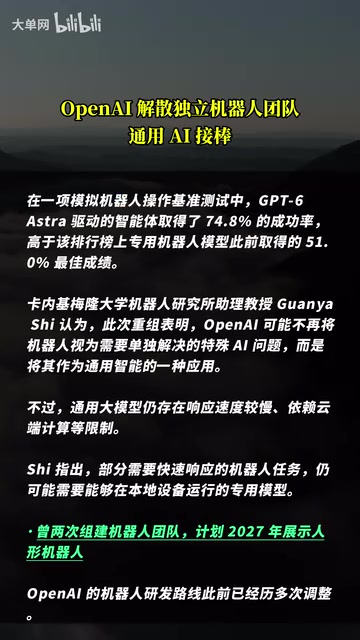
OpenAI has disbanded its independent robotics team, moving researchers into core research and applied hardware staff into the Applied division. Robotics remains a long-term focus, but the path shifts from specialized systems to general models like GPT-6 Astra directly controlling robots, achieving 74.8% in NVIDIA simulations. Response speed and cloud dependency remain shortcomings, and the 2027 humanoid showcase plan is unchanged.
The Independent Team Bows Out as Robotics Strategy Shifts Toward General Models
According to a Fortune report, OpenAI has disbanded its independent robotics team. Researchers from the original team have been folded into the core research team, while those responsible for applied robotics and hardware have moved to the Applied division. This adjustment does not mean OpenAI is abandoning robotics—officials have made clear that robotics remains a long-term direction, but the path to achieving it has fundamentally changed.

From an organizational standpoint, this change looks more like a "return to core competencies": when general-purpose large models begin to show the potential to directly drive robots, the need to maintain a separate research track for robotics is declining. OpenAI is choosing to bet on general intelligence rather than specialized robotic systems.
Why Now: What GPT-6 Astra Has Demonstrated
The direct driver of this adjustment is the improvement in general-purpose large model capabilities. OpenAI noted that models including GPT-6 Astra have already demonstrated the ability to directly control robots. In other words, robots no longer require a research system custom-built for hardware—the general model itself may become the control layer.

In a simulated operation test by NVIDIA, an agent powered by GPT-6 Astra achieved a success rate of 74.8%. This number deserves closer examination: it shows that general models have reached a considerable level on standardized manipulation tasks, but there is still a gap to stable and reliable Physical AI. OpenAI also acknowledges that general models currently face limitations such as response speed and cloud dependency.
Physical AI refers to AI systems capable of perceiving, deciding, and executing actions in the physical world, as opposed to AI that only processes text or images in digital environments. It typically combines vision-language models, motion planning, and real-time control, requiring the model to translate high-level semantic instructions into joint or wheel action sequences within millisecond-level latency. Compared to pure software AI, the difficulty of Physical AI lies in having to cope with real-world noise, unpredictability, and safety constraints, and thus it has traditionally relied on specialized control algorithms and extensive hardware customization. For a general-purpose large model to take on this role, it needs to reach engineering-usable levels in response speed, spatial reasoning, and closed-loop error correction. The 74.8% simulated success rate is precisely a rough indicator of this threshold.
Opportunities and Shortcomings of General Models Taking Over Robotics
Handing robot control to general-purpose large models has the advantage of reusing the same set of cognitive capabilities: understanding instructions, decomposing tasks, and adapting to new scenarios—in theory, none of these require training a separate specialized system for robots. This is also the premise that gave OpenAI the confidence to disband its independent team.
But the shortcomings are equally obvious. Response speed determines a robot's safety in real physical environments, while cloud dependency means reliability is questionable in offline or weak-network scenarios. These two issues are exactly what specialized robotic systems have focused on solving in the past. A general model taking over amounts to trading cognitive generality for real-time performance and deployment flexibility. Whether this trade is worthwhile still requires more empirical data to verify.
Cloud dependency in this context refers to a robot sending perception data and decision requests to a large model inference running on a remote server, then transmitting the results back for execution. The benefit of this architecture is the ability to call upon models with parameter scales far exceeding onboard compute, facilitating centralized updates and reuse. The cost is the introduction of network round-trip latency and connection reliability issues: in scenarios such as industrial grasping and human-robot collaboration, jitter of tens of milliseconds can affect safety; in offline, weak-network, or privacy-sensitive environments, cloud inference may even be unavailable. Specialized robotic systems typically deploy control loops on local edge chips to ensure deterministic real-time response. Therefore, if general models are to truly take over robotics, they often need model distillation, on-device inference, or hybrid cloud-edge architectures to compensate for this shortcoming.
Humanoid Robot Plan Unchanged, but the Path Is Different
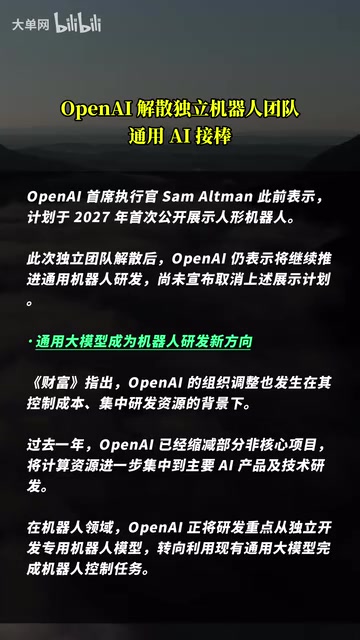
One detail worth noting: OpenAI has not announced the cancellation of its plan to showcase a humanoid robot in 2027. This means the organizational adjustment is not a strategic retreat but a switch in R&D path: from "building a brain for robots" to "letting a general brain directly drive robots."
For the entire industry, this is a signal. When a leading player begins replacing specialized robotics research teams with general models, the differentiation space for robotics startups will be redefined—the competitive focus may shift from hardware and specialized control algorithms to who can better bring general model capabilities into the physical world. OpenAI's adjustment may only be the beginning of this transformation.
One-line Summary
OpenAI disbands its independent robotics team, pivoting to using general-purpose large models to directly drive robots.
Paragraph Summary
OpenAI has disbanded its independent robotics team, with researchers folded into the core research team and applied robotics and hardware staff moved to the Applied division. Officials emphasize that robotics remains a long-term direction, but the implementation path has shifted from "building specialized brains for robots" to "letting general-purpose large models directly drive robots." The direct driver is that models including GPT-6 Astra have demonstrated the ability to directly control robots, achieving a 74.8% success rate in NVIDIA's simulated operation test. General models can reuse the same set of cognitive capabilities, but response speed and cloud dependency remain shortcomings—exactly the problems specialized systems were designed to address. OpenAI has not cancelled its plan to showcase a humanoid robot in 2027, and this adjustment is interpreted as a switch in R&D path rather than a strategic retreat, potentially redefining the competitive focus for robotics startups.
Related articles
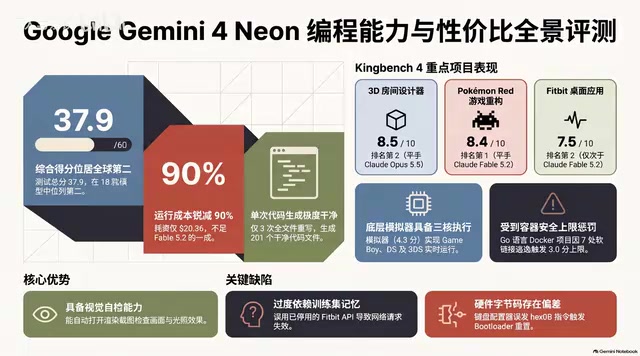
Gemini 4 Neon Hands-On: Value King or Confident Catastrophe?
Gemini 4 Neon review: 1M-token context, four thinking levels, 201 files in one KingBench4 pass at one-tenth Fable 5.2's cost—but it hallucinates fake data, leaves 7 symlink escapes, and bricks keyboards.

Google Gemini 4 Neon Hands-On: 6 3D Works That Impress and Fail
Hands-on with Google Gemini 4 Neon on a 3060 laptop: 6 3D works tested. Sunshower Fishing Harbor and mechanical keyboard impress; soft-body physics and faces fall short.

Gemini 4 Neo Web Novel Writing Test: Faint AI Flavor, Textured Dialogue
Bilibili creator's first-look review of Gemini 4 Neo for Chinese web novel writing: testing a Three Kingdoms transmigration opening with faint AI flavor, emotionally textured dialogue, and strong crisis building, plus comparison of 4A/4H/4C models and full workflow demos.