OpenAI Disbands Robotics Team: Astra Hits 74.8% Simulation Success Rate, Humanoid Robot Strategy Shifts

OpenAI disbands robotics team as the general-model vs. dedicated-stack debate enters real-machine validation.
On November 13, OpenAI disbanded its standalone robotics team, merging research into the main research team, citing GPT and Astra's ability to directly handle robot control without a dedicated model stack. NVIDIA tests show Astra at 74.8% success in simulated manipulation vs. 51.0% for dedicated models, though real-machine methodology is disputed. OpenAI still targets a 2027 humanoid demo; Tesla Optimus is in production with end-2027 delivery guidance. Industry financing and IPOs are intense, dexterous hands and tactile sensing are new focal points, and edge-side chips remain a gap. Hunan's scenario-solution path has built a ~50 billion yuan industry chain.
OpenAI's decision to disband its standalone robotics team has dropped a bombshell on the embodied intelligence community. The company, which is pursuing artificial general intelligence, is now answering a long-debated question through action: does robot control really require a dedicated technology stack?
OpenAI's Answer: General Models Take Direct Control of Robots
On November 13, OpenAI disbanded its independently operated robotics team, redistributing personnel to other departments. The official explanation is clear: general frontier models such as GPT, SIX, and Astra have demonstrated the ability to be directly applied to robot control tasks, eliminating the need to develop dedicated models for robotics.
In terms of organizational structure, the robotics research team was merged into the main research team, reporting to Chief Research Officer Mark Chen; the applied robotics and hardware teams were placed under the Apply organization, reporting to President Greg Brockman. This effectively downgraded robotics from an "independent business line" to "one application scenario of general capabilities."
The company also stated it is still developing its own humanoid robot, with Sam Altman's goal of completing the first public demonstration in 2027. This piece of information was overshadowed by the disbandment news, but it shows that OpenAI has not given up on hardware—it has only abandoned the idea of building a separate model system for robotics.
Astra's Report Card: The Strategic Debate Behind 74.8%
The key data supporting this decision comes from an NVIDIA test. In a simulated manipulation benchmark, the agent powered by Astra achieved a success rate of 74.8%, while the best dedicated robot model reported a metric of 51.0%.
NVIDIA's concurrently released Astronomy report provided further details: in 120 simulated manipulation tests, GPT-6 Astra achieved a 74.8% success rate in zero-shot control of the Franca robotic arm; in the RoboCurve test, the task of placing a block into a bowl succeeded 19 out of 20 times, with a token count about one-sixth that of CloudFable 5.1.
But this report card is not without controversy. NVIDIA estimates that for the model to complete the task of "putting yogurt into a bowl," it would take about 4 minutes in the real world, while the robotic arm's actual movement time is only about 5 seconds—the gap between inference overhead and physical execution remains significant.
The OpenROA team pointed out methodological flaws in the RoboDojo leaderboard testing: when recalculated under real-machine conditions, RoboDunk's success rate drops to 1.0%, and RoboICL falls to 63.5 points. This indicates that high scores in simulation environments are still a considerable distance from reliable operation in the real world. Cross-referencing multiple sources, the conclusion that "general models outperform dedicated models" is supported by multiple sources at the simulation level, but consensus has not yet formed at the real-machine level.
Zero-shot control refers to a model generating control actions directly based on language instructions or visual input without fine-tuning training for a specific robot body, task, or environment. In contrast, traditional dedicated robot models typically require large-scale demonstration data collection and policy fine-tuning on the target robotic arm. Astra's achievement of zero-shot manipulation on the Franca robotic arm is significant because it validates that general multimodal models can transfer "seeing" and "speaking" capabilities to "doing" without retraining a policy for each piece of hardware. This is also one of the core arguments for OpenAI's proposal to eliminate the dedicated robot model stack. However, zero-shot success rates are highly sensitive to task distribution, object categories, and camera viewpoints, and high scores in simulation may not transfer linearly to real machines.
The sim-to-real gap is a classic challenge in robot learning: policies trained or evaluated in physics simulators often suffer performance degradation when transferred to real hardware due to sensor noise, friction and deformation modeling errors, lighting variations, actuator delays, and other factors. The inference overhead issue mentioned in the article also falls into this category—large models require hundreds of milliseconds to several seconds to generate action tokens, while a robotic arm completes a grasp in just a few seconds of physical time; the mismatch in tempo brings obvious pauses and failure risks. Common mitigation approaches in the industry include domain randomization, system identification, real-data fine-tuning, and high-frequency reflex compensation on local controllers—which is also the origin of the three-layer division of labor idea: "general models handle high-level planning, local controllers handle low-level execution."
Hardware and Industry Chain: From Simulation to Production Lines
In August, OpenAI secured approximately 200,000 square feet of industrial space in Richmond, California, for robot R&D and manufacturing, and separately trained an embodied foundation model. An industry consensus is forming around a three-layer division of labor: general large models handle high-level planning and most mid-level actions, while local controllers handle low-level reflexes.
The industry chain is equally active. SoftBank Group led a $500 million funding round for German robotics AI startup Agile Robots, with NVIDIA participating in the round; the company is preparing for a potential IPO. Niushida Planetary Transmission Technology's IPO application was approved by the Shenzhen Stock Exchange, with plans to raise approximately 823 million yuan; its revenue in the embodied intelligence robot sector grew 1235.46% and 315.17% year-over-year in 2025 and January-June 2026 respectively, with 623 million yuan of the proceeds to be used for building an intelligent manufacturing base with an annual capacity of 1.5 million precision planetary reducers and transmission modules.
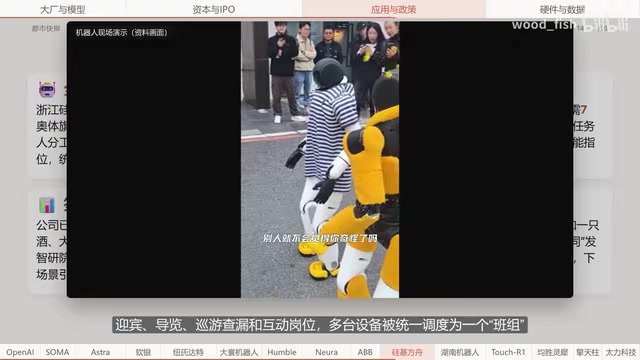
Dahuan Robotics filed for IPO coaching registration with the Shenzhen Securities Regulatory Bureau on November 13, initiating its A-share listing process; its products have cumulative shipments exceeding 300,000 units. Zhejiang Guiji Ark's Douke Energy Station Hangzhou Olympic Sports flagship store opened on November 12, with 6 robots handling roles including ordering, pickup, and greeting/guidance; the pickup robot takes about 7 seconds to complete the journey from shelf to pickup port.
Tesla Optimus Enters Production: Delivery Guidance Points to End of 2027
Tesla has begun producing Optimus humanoid robots at its Fremont factory. The company states that the Optimus units rolling off the line are the first batch of robots to reach production quality, with delivery guidance to external customers starting at the end of 2027.
IDC estimates global humanoid robot shipments in the first half of the year at approximately 25,000 units, with about 70% used for display and validation, covering research, education, performances, and government data collection. Four research institutions estimate global humanoid robot shipments for the first half of 2026 ranging from 19,400 to 36,000 units; the wide range reflects that the industry is still in an uncertain early scaling phase.
Domestically, Wei Wei, Director of the Science and Technology Department at the Ministry of Industry and Information Technology, disclosed that in the first half of this year, China's humanoid robot complete product offerings exceeded 400 models, with output exceeding 40,000 units and expected to surpass 100,000 units for the full year; products are being rapidly validated and deployed in over 300 key scenarios.
Dexterous Hands and Touch: The "Last Centimeter" of Embodied Intelligence
Beyond complete robots, end effectors are becoming a competitive focus. The TouchRB model developed by Shenzhen Daimeng Robotics was officially accepted by Neural IPS 2026; this research is the first to systematically introduce reinforcement learning into tactile reasoning. The team built the TouchReson EM dataset containing 14,700 tactile sequences and 1.323 million synchronized data pairs, achieving a composite score of 60.1 on its self-built benchmark—about 24.7 points higher than GPP4O.
Lei Xiong, CEO of Ningbo Junsheng Lingxi Intelligent Technology, predicts that domestic dexterous hand shipments in the humanoid robot industry will reach 60,000 to 70,000 units this year. Its first Lingxi dexterous hand adopts an in-palm integration plus hybrid drive solution, integrating direct drive, tendon drive, and linkage drive; the second-generation product changes the in-finger V-shaped actuator from a cylindrical housing to an exposed square housing, further reducing volume. Lei Xiong believes that for dexterous hands to move from laboratory prototypes to products, breakthroughs are needed across three dimensions—perception, actuation, and control—from "usable" to "consistently usable," while the edge-side chip market supply is still a blank.
Taili Technology has applied nanofluid STF technology to bio-inspired tendon-driven robot R&D; after treatment, the fatigue life indicator of tendon drives can be increased from the industry-typical tens of thousands of cycles to hundreds of thousands or even millions of cycles. The relevant tendon drives have entered testing and validation with leading customers.
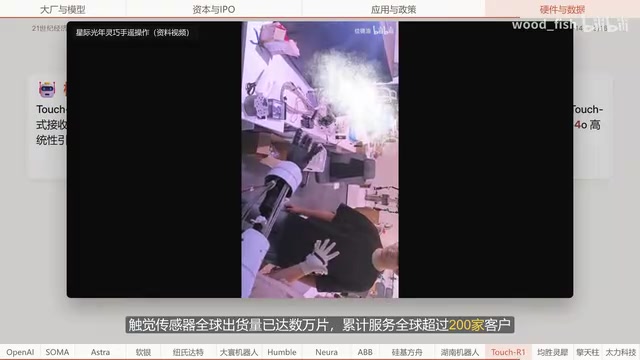
Dexterous hand drive solutions directly determine volume, force, precision, and lifespan. Direct drive offers fast response and simple control, but motors are bulky and power density is limited; tendon drive can relocate actuators to the forearm, making the palm thinner and more flexible, at the cost of cable wear and fatigue life—which is the practical context for Taili Technology's use of nanofluid STF treatment on tendon drives to improve lifespan; linkage drive offers good rigidity and strong load capacity, but degree-of-freedom placement is constrained. Hybrid drive combines multiple transmission methods in a single hand, using each method's strengths to cover the needs of different fingers or joints. The three-dimensional breakthroughs in perception, actuation, and control mentioned by Lei Xiong correspond precisely to three parallel technical bottlenecks: tactile sensing resolution, transmission efficiency and durability, and edge-side real-time control computing power.
The Hunan Sample: From Selling Products to Selling Solutions
Hunan's robotics industry is undergoing a positioning shift. In 2025, the province's industrial robot exports reached 99.72 million yuan, up 82.1% year-over-year, becoming a new calling card for foreign trade. The Youlong series has cumulative shipments exceeding 20,000 units, with the first batch of 2,000 units already shipped to France, Italy, and the UK; the Chaoneng Xiaokang traditional Chinese medicine health robot has sold tens of thousands of units, exported to over ten countries and regions; Zhongke Yungu's RobotOps made its global debut at Hannover Messe.
Hunan has gathered approximately 300 robotics upstream and downstream enterprises, with the industry chain scale approaching 50 billion yuan in 2025. The province has set targets of exceeding 100 billion yuan in industry chain revenue by 2028 and 200 billion yuan by 2030. The significance of this sample lies in the fact that it demonstrates a path different from "betting on general large models": building industrial scale through solution capabilities for specific scenarios.
OpenAI's disbandment of its robotics team does not mean the robotics sector is cooling down; rather, it means the competitive dimension is shifting from "who has a dedicated model" to "whose general model can better land in the physical world." Astra's simulation lead coexists with real-machine controversy, Tesla's production start and delivery guidance are separated by time, and the industry chain's financing, IPOs, and capacity expansion are placing bets with real money. This battle of the gods is far from decided.
One-line Summary
OpenAI disbands robotics team as the general-model vs. dedicated-stack debate enters real-machine validation.
Paragraph Summary
On November 13, OpenAI disbanded its standalone robotics team, merging research into the main research team on the grounds that general frontier models like GPT and Astra can already directly handle robot control without a dedicated model stack. Key supporting data comes from NVIDIA testing: Astra achieved a 74.8% success rate in simulated manipulation benchmarks, higher than the dedicated model's 51.0%, but testing methodology is disputed under real-machine conditions, and the gap between inference overhead and physical execution is significant. On the hardware side, OpenAI is still advancing its own humanoid robot, targeting a first public demonstration in 2027; Tesla's Optimus has entered production at Fremont, with external delivery guidance set for the end of 2027. Industry chain financing, IPOs, and capacity expansion are intensive, dexterous hands and tactile perception have become new focal points, and edge-side chip supply remains a blank. Hunan, meanwhile, has achieved an industry chain scale of nearly 50 billion yuan through a scenario-solution path.
Related articles
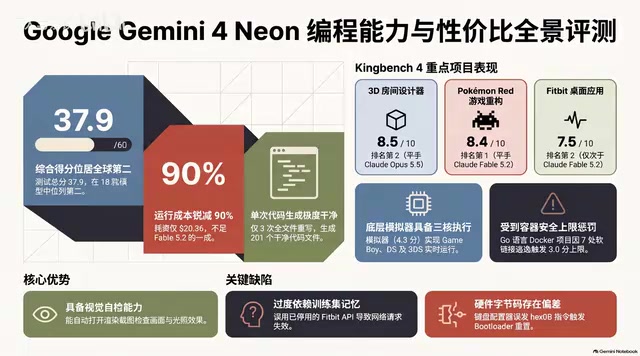
Gemini 4 Neon Hands-On: Value King or Confident Catastrophe?
Gemini 4 Neon review: 1M-token context, four thinking levels, 201 files in one KingBench4 pass at one-tenth Fable 5.2's cost—but it hallucinates fake data, leaves 7 symlink escapes, and bricks keyboards.

Google Gemini 4 Neon Hands-On: 6 3D Works That Impress and Fail
Hands-on with Google Gemini 4 Neon on a 3060 laptop: 6 3D works tested. Sunshower Fishing Harbor and mechanical keyboard impress; soft-body physics and faces fall short.
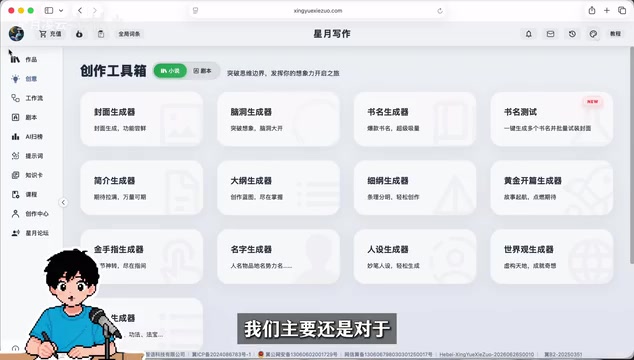
Gemini 4 Neo Web Novel Writing Test: Faint AI Flavor, Textured Dialogue
Bilibili creator's first-look review of Gemini 4 Neo for Chinese web novel writing: testing a Three Kingdoms transmigration opening with faint AI flavor, emotionally textured dialogue, and strong crisis building, plus comparison of 4A/4H/4C models and full workflow demos.