OpenAI Launches dots: An AI Assistant That Gets Things Done Proactively

OpenAI's dots is a proactive AI assistant that autonomously drives tasks forward while keeping users in control.
OpenAI has released dots, a proactive assistant that moves beyond the traditional question-and-answer model by continuously advancing work across complex projects and daily tasks without requiring manual hand-offs at every step. Its two core pillars are proactivity — evolving AI into a collaborator that can plan, execute, and track tasks, consistent with the industry's AI Agent trend — and controllability, directly addressing concerns about AI automation running unchecked by promising to return control to users at critical decision points. While dots signals a clear shift from conversational AI toward work execution agents, its specific functional boundaries and controllability mechanisms still await further disclosure and real-world validation.
What Is dots
OpenAI has released a new product called dots, officially positioned as a "proactive assistant." Unlike traditional chat-based AI that waits for users to issue instructions one by one, dots is designed to keep work moving forward across complex projects and everyday tasks — in other words, it doesn't just answer when asked; it actively pushes things along in the background.
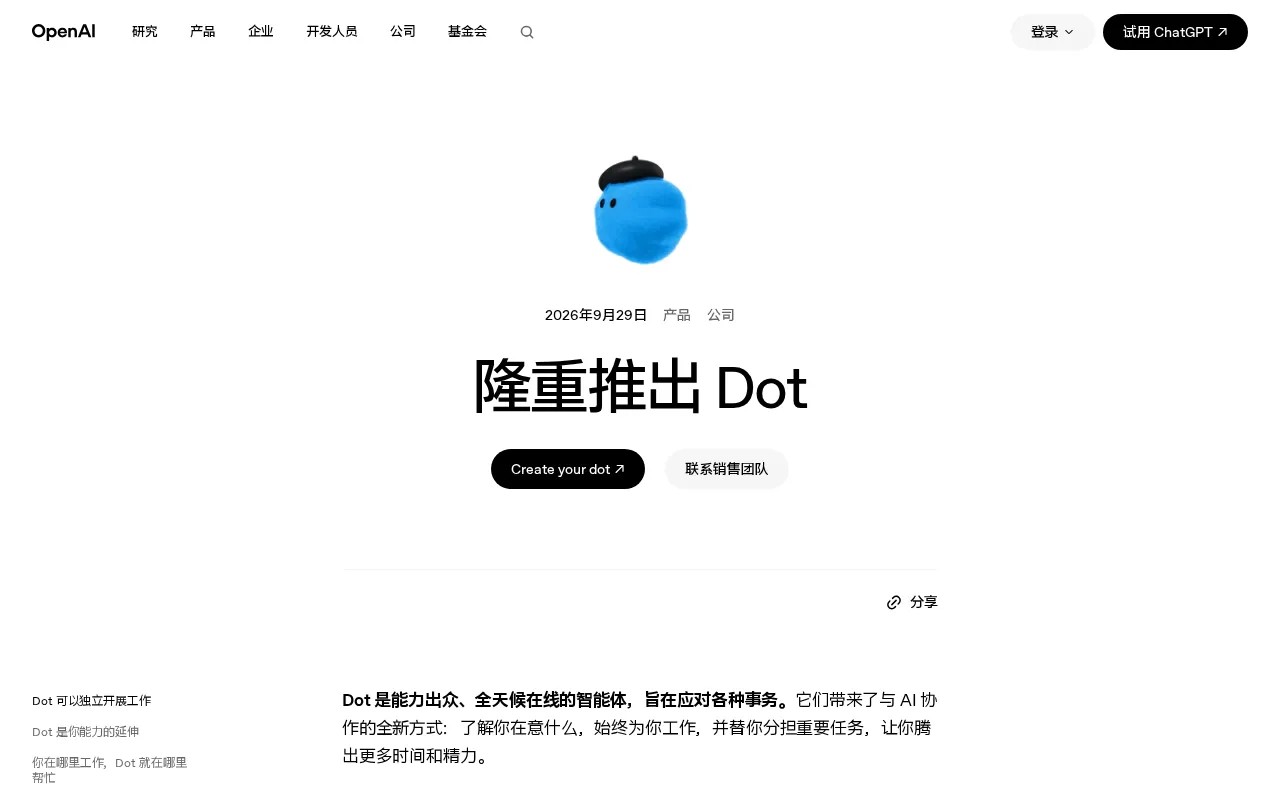
Based on OpenAI's introduction, dots is built around two core value propositions: proactivity and staying in control. The former means the assistant takes on a more active execution role, while the latter is a direct response to the biggest concern around AI automation today — losing control.
From "Q&A" to "To-Do": A Product Shift
Most AI assistants today still operate within a "question and answer" interaction paradigm: a user states a need, the model produces a result, and then waits for the next instruction. This works well for single-point tasks, but becomes awkward when dealing with complex, multi-step projects that unfold over time.
Dots is designed to address exactly this gap. The official description emphasizes that it can "keep working across complex projects" — maintaining progress throughout a longer workflow rather than requiring human hand-offs at every step. This aligns with the industry's broader exploration of AI Agents: evolving AI from a passive tool into a collaborator capable of planning, executing, and tracking tasks.
What Does "Proactive" Actually Mean
Proactivity is a double-edged sword. It can significantly reduce the operational burden on users, allowing AI to proactively remind, complete, or advance tasks at the right moment — but it also raises trust issues. Users need confidence that AI won't take incorrect or unauthorized actions without their permission.
AI Agents are one of the most closely watched technical directions in AI over the past two years. Unlike pure language models, an Agent has a closed-loop "perceive–plan–execute" capability: it can break down a complex goal into multiple subtasks, invoke external tools (such as search, code execution, or file read/write), and dynamically adjust subsequent steps based on results until the goal is achieved. Well-known examples include AutoGPT, the LangChain framework, and OpenAI's own Assistants API with Code Interpreter. Dots fits squarely within this paradigm — it's not just "a smarter chat box," but an attempt to handle real-world workflows through an Agent architecture. This is what fundamentally distinguishes it from traditional conversational products like ChatGPT.
Controllability Is a Core Design Consideration
The phrase stay in control, which appears repeatedly in the dots introduction, is central to understanding this product. As AI takes on more automated responsibilities, keeping humans in the driver's seat has become a non-negotiable design requirement.
A mature proactive assistant needs to strike a balance between automation and user authorization: it should be able to handle tedious steps on the user's behalf, while handing control back at critical decision points. By explicitly committing to "keeping work moving forward while users stay in control," dots signals that OpenAI is taking seriously the trust costs involved in bringing Agent-type products to market.
Human-in-the-Loop (HITL) is the mainstream design principle for managing the risk of uncontrolled Agents. The core idea is that AI must pause and request human confirmation before executing high-risk or irreversible actions, rather than proceeding fully autonomously. This mechanism has long been practiced in industrial automation and self-driving vehicles, and is now being incorporated into AI assistant product design. Different products define "critical decision points" differently — some draw the line at action type (e.g., sending an email, deleting a file), others at a confidence threshold. The "stay in control" promise from dots is essentially a product-level expression of the HITL principle, though the specific authorization granularity and trigger mechanisms have not yet been made public — and that's precisely the detail most worth watching.
An Important Industry Signal
The launch of dots continues the broader trend of AI products evolving from "conversational assistants" to "work execution agents." Whether in coding, project management, or everyday task handling, proactive assistants could fundamentally reshape how people collaborate with AI.
That said, since the publicly available information is still limited, the exact functional boundaries of dots, the types of tasks it supports, how it integrates with existing tools, and the real-world performance of its controllability mechanisms all remain to be clarified through further official disclosure and user testing. For anyone tracking AI productivity tools, this is a direction well worth following closely.
Related articles

Running a PS2 Emulator in the Browser with Claude: Inside TabStationToo
TabStationToo ports the PCSX2 core to the browser with WebAssembly and WebGPU, letting a PS2 emulator run in a tab. We break down its tech, AI workflow, and optimization.

AI Customer Service Evaluation Gone Wrong: 41 Failures, 28 Were Test Bugs
A live evaluation of a Shopify AI customer service agent produced 41 failures, but 28 were test bugs. This article analyzes scorer flaws, overly strict response checks, and other evaluation pitfalls, and summarizes best practices to prevent test bugs from masking real model failures.

No API Needed! Build a WhatsApp Receptionist with a Free Claude Account
A developer shares a weekend experiment: using a free Claude.ai account and browser scripts to turn WhatsApp Web into an automated receptionist—no API required.