OpenAI's New Model Shakes the Math World: From Assistant Tool to Research Partner

OpenAI's new model stuns mathematicians with advanced reasoning, triggering both awe and existential anxiety.
A report on OpenAI's new model demonstrating strong reasoning on hard mathematical problems has sparked intense debate in the tech community. The words "Breathtaking" and "Devastating" capture the mathematical world's dual reaction: genuine awe at AI's leap from pattern matching to structured reasoning, and anxiety about the potential reshaping of mathematicians' roles and research paradigms. The article examines both the optimist view (AI as a liberating super-assistant) and the skeptic view (human irreplaceability being steadily eroded), drawing on the historical precedent of computer-assisted proofs like the four-color theorem. The author also urges caution — limited report details mean emotional reactions should not be mistaken for fully validated capability assessments.
A Story Stirring Debate Across the Mathematics Community
Recently, a report about OpenAI's latest model sparked discussion across the tech community, using charged terms like "Breathtaking" and "Devastating" to capture the complex emotions researchers felt when confronting the new model's capabilities. While the piece was still gaining traction on Hacker News (5 upvotes, 5 comments at the time), the subject matter carries serious weight: as AI begins to tackle high-difficulty mathematical problems, what kind of disruption awaits mathematics — the oldest discipline, and the one most dependent on human intellect?
The two adjectives in the headline reveal an underlying tension within the mathematics community. On one hand, researchers are genuinely stunned by the model's demonstrated reasoning ability — a massive leap forward at the tool level. On the other hand, the word "Devastating" betrays a deeper anxiety: that the role of human mathematicians, the value of academic work, and the entire research paradigm may be on the verge of being reshaped.
Why Mathematics Is Particularly Sensitive
Mathematics has long been considered a fortress of pure human rationality. Unlike many tasks that can be accomplished through massive-data "memorization" and "imitation," high-level mathematical proof demands rigorous logical chains, creative problem reframing, and deep insight into abstract structures. For precisely this reason, mathematics has always served as a litmus test for AI's "genuine intelligence."
A Qualitative Shift in Reasoning Ability
Earlier language models handling math problems often "looked right but were actually wrong" — their reasoning steps couldn't withstand scrutiny. If the new generation of models can produce verifiable, logically consistent solutions to genuinely hard mathematical problems, it signals a shift from "pattern matching" to something closer to "structured reasoning." This is the core reason some researchers find the results "breathtaking."
From a technical perspective, several key developments underlie this shift. First is Chain-of-Thought prompting, which requires the model to explicitly write out intermediate reasoning steps before giving an answer, dramatically reducing the chance of skipping steps and making errors. Second is Reinforcement Learning from Human Feedback (RLHF) and, more recently, outcome-based reinforcement learning — the latter using "is the final answer correct?" as the reward signal, encouraging the model to explore more rigorous reasoning paths. Third is the incorporation of formal verification tools specifically designed for mathematics, such as Lean and Coq. When a model-generated proof can be verified step-by-step by a proof assistant, "logical consistency" is no longer just a matter of human judgment — it gains a computationally guaranteed form of assurance. The combination of these techniques means the latest generation of models differs fundamentally from earlier versions that operated purely on statistical language patterns.
The Anxiety of Role Redefinition
The flip side of "Devastating" points to the professional and academic ecosystem. If AI can take over tedious proof verification, literature review, and even portions of creative work, the day-to-day activities of mathematicians will be redefined. This shift isn't simply about "being replaced" — it's a deeper disruption to existing evaluation frameworks, research division of labor, and talent development pipelines.
Tool or Rival: A Paradigm Debate
The community holds two distinct views on AI's role in mathematics.
Optimists see it as a "super-assistant" — helping researchers quickly rule out dead ends, test conjectures, and handle mechanical derivations, freeing human energy for the parts that truly require intuition and creativity. Computer-assisted proof has historical precedent: the four-color theorem already demonstrated that machines can be genuine collaborators in mathematical discovery.
Skeptics worry that as the model's capability frontier keeps expanding, the irreplaceability of humans within proof chains will be steadily eroded. The deeper question is this: if a proof is generated by AI and is difficult for humans to fully understand, will the status of "understanding" itself within mathematics be reconsidered? Is the goal of mathematics the correctness of results, or the human comprehensibility of the process?
The history of computer-assisted proof offers an important frame of reference. In 1976, Kenneth Appel and Wolfgang Haken used a computer to exhaustively check approximately 1,936 configurations to complete the proof of the four-color theorem — the first major theorem in mathematical history to rely primarily on computer verification. At the time, fierce debate erupted in the mathematical community: does a machine-enumerated result count as a "real proof"? Can humans claim to truly "understand" the theorem? More than four decades later, with the maturation of formal proof languages like Lean and Isabelle, a growing number of mathematicians have come to accept "machine verifiability" as an important dimension of proof reliability. The current impact of AI follows directly in the tradition of the four-color theorem controversy — only the scale and speed have been dramatically amplified. The core tension remains: does the value of mathematics lie in arriving at truth, or in constructing human understanding?
A Few Points That Deserve Rational Perspective
It must be noted that the available public information around this report is quite limited. The original material does not specify which model was involved, which benchmarks or real-world problems were tackled, or what the actual results looked like. The emotionally charged language in the community — "breathtaking," "devastating" — reflects psychological impact more than a thoroughly validated assessment of capability.
When encountering news like this, two forms of restraint are necessary: avoid overestimating the model's general mathematical ability based on a handful of impressive results, and avoid letting anxiety cause you to underestimate the unique value human mathematicians bring to asking good questions and constructing theoretical frameworks. Real change is rarely an either/or replacement — it's a gradual evolution in how humans and machines collaborate.
Conclusion
Regardless of what the new model's actual capabilities turn out to be, this discussion itself signals a clear trend: AI is moving from a computational aid toward the core territory of human intellectual activity. The mathematics community's mix of "awe" and "anxiety" may well be the shared experience that every knowledge-intensive field is about to face. For researchers, rather than fixating on the fear of being replaced, the more constructive response is to think carefully about how to redefine their own way of collaborating with machines — that is the more productive stance to take in the face of technological change.
Related articles

Medicare Spends $50,000 Treating a Heart Attack but Won't Spend $100 Preventing One: The Mismatch in Healthcare
Medicare pays ~$50,000 to treat a heart attack but won't spend $100 to prevent one. This article unpacks the MedPage Today opinion piece and Hacker News debate on why healthcare payment favors treatment over prevention and the deep causes of incentive misalignment.

Nvidia May Cosign Loan for Nscale's West Virginia AI Data Center
Nvidia is considering cosigning a loan for Nscale's West Virginia AI data center. This article analyzes the signal significance of chip vendors entering data center financing, the risk-sharing logic, and project uncertainties.
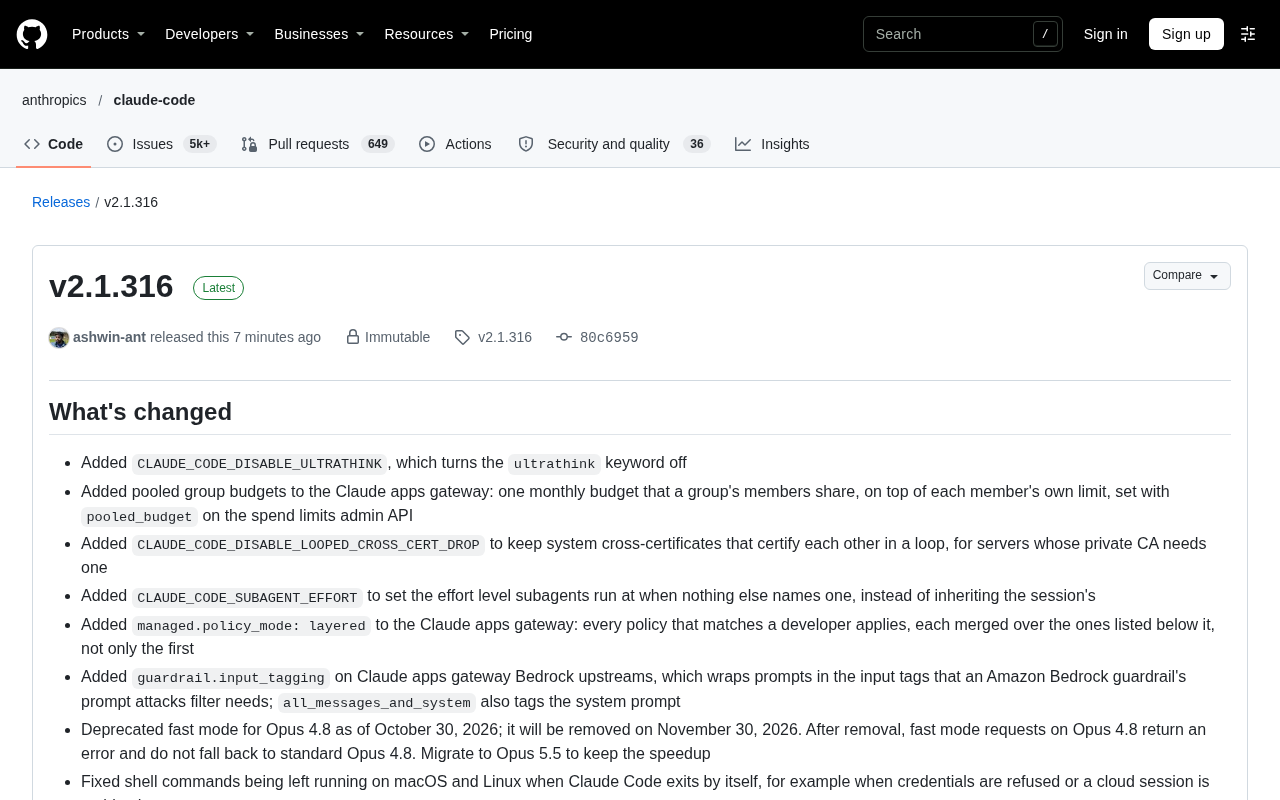
Claude Code v2.1.316 Update Analysis: Enterprise Gateway and Multiple Stability Fixes
Claude Code v2.1.316 released: new enterprise gateway pooled group budgets, layered policy mode, subagent effort control, dozens of Shell, network, and session recovery fixes, and Opus 4.8 fast mode deprecated.