OpenAI Says Its AI Disproved a Core Complexity Theory Hypothesis and Published the Proof

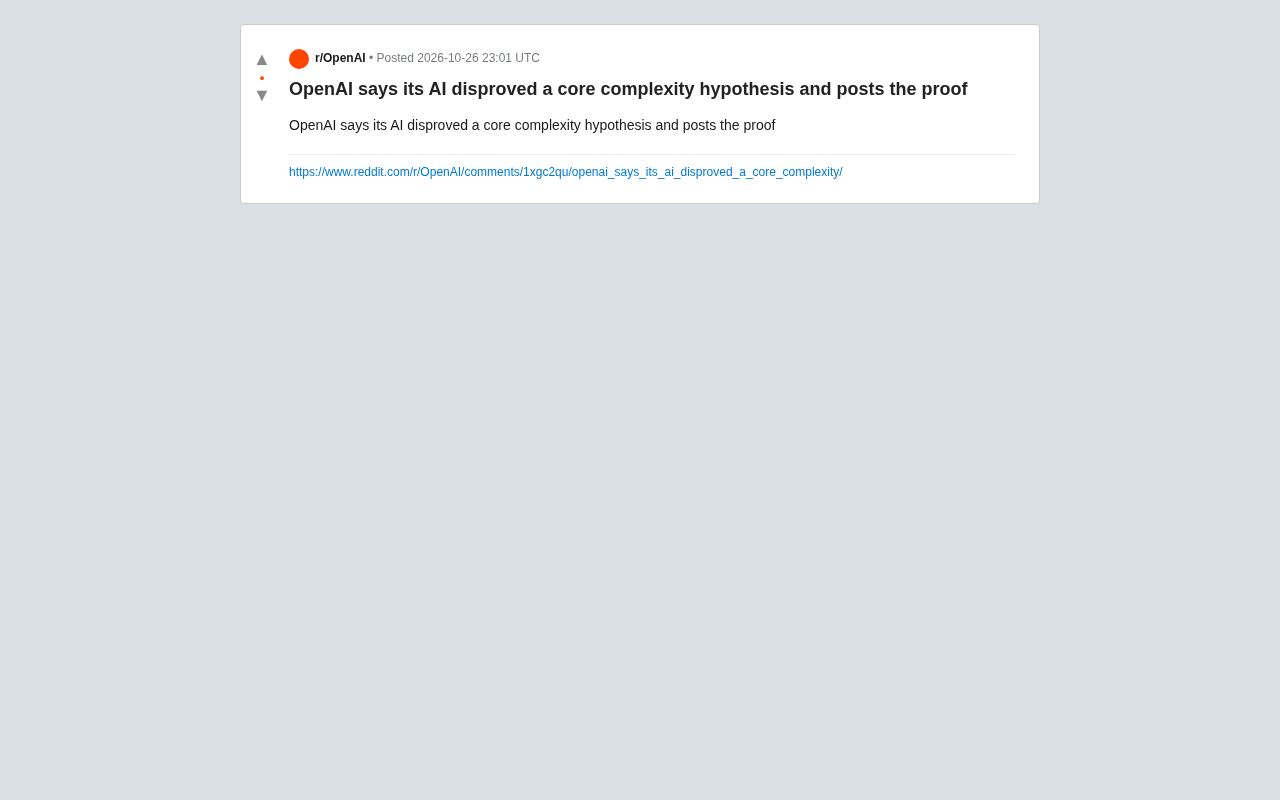
OpenAI says its AI disproved a core complexity hypothesis and published the proof.
OpenAI announced that its AI system disproved a core hypothesis in complexity theory and published the complete proof, sparking heated discussion on Reddit. The article notes that disproving an accepted hypothesis is more disruptive than proving a theorem, since hypotheses underpin entire chains of reasoning. The key difference is that the AI produced readable, checkable proof text. Community views are split between excitement and calls for independent verification.
Event Overview: AI Independently Disproves a Core Complexity Theory Hypothesis for the First Time
According to a widely discussed post in the Reddit community, OpenAI announced that its AI system has disproved a core hypothesis in complexity theory and published the complete mathematical proof. The news quickly drew widespread attention from academia and the AI community, as—if true—it would mark a landmark breakthrough for AI in the realm of pure mathematical theory.
Complexity theory has long focused on classifying the intrinsic difficulty of computational problems, and many hypotheses form the inferential foundation of the field. Disproving a core hypothesis means the applicable boundaries of related theorems may need to be re-examined, and it could even give rise to new research directions. OpenAI's choice to publish the proof rather than merely announcing the conclusion also gives the community an actionable entry point for verification.
Complexity theory is a branch of theoretical computer science that studies the intrinsic difficulty of computational problems under resource constraints (such as time, space, and randomness), and on that basis classifies problems into complexity classes such as P, NP, and PSPACE. Many conclusions in this field rest on unproven assumptions, such as P≠NP, or stronger working hypotheses like the Exponential Time Hypothesis (ETH). These assumptions serve as inferential cornerstones: if an assumption is disproved, the conditional theorems, lower-bound proofs, and algorithmic infeasibility conclusions that depend on it all need to be re-evaluated. Therefore, when a core hypothesis is negated, what is affected is not a single theorem but the stability of an entire chain of reasoning.
Why "Disproving a Hypothesis" Deserves More Attention Than "Proving a Theorem"
In mathematics and theoretical computer science, proving a theorem is certainly difficult, but disproving a widely accepted hypothesis is often more disruptive. Hypotheses are usually used as the starting point of inferential chains, and once they fail, every corollary built on them must be re-examined.
According to the Reddit post, OpenAI's AI not only produced a counterexample or a proof by contradiction but also output proof text that human mathematicians can read and check. This "verifiability" is the key dividing line for judging AI's mathematical ability: producing a conclusion is easy, but producing a derivation that withstands peer review is the real threshold.
From "Assisted Computation" to "Proposing Counterexamples"
In the past, AI's role in mathematics was mostly concentrated in symbolic computation, conjecture generation, or assisted search. What makes this announcement different is that the AI directly constructed a negative argument against an established hypothesis. If the proof passes independent verification, AI's position in theoretical discovery will shift from tool to collaborator.
Counterexamples and proof by contradiction are two classic paths for negating a universal proposition in mathematics. A counterexample is a concrete instance that satisfies the premises but violates the conclusion, sufficient to directly break an assertion that "holds for all cases"; proof by contradiction assumes the proposition is true and derives a logical contradiction, thereby proving the original proposition false. In complexity theory, many hypotheses take the form of "no algorithm of a certain kind exists" or "all problems satisfy a certain property," so constructing a counterexample or contradiction often requires precisely characterizing computational models, resource bounds, and problem reductions. If AI can complete this process automatically, it means it must not only understand formal definitions but also locate the key construction within a vast search space—placing extremely high demands on both the rigor and the creativity of reasoning.
Community Reaction: Excitement and Caution Coexist
The Reddit discussion reveals two typical attitudes. Some users see this as direct evidence of a leap in AI's reasoning ability, especially valuing OpenAI's decision to publish the proof; others emphasize that caution is warranted until independent mathematicians reproduce and confirm the result, and that a PR announcement should not be equated with academic consensus.
This divergence is itself informative. AI research results often spread first through media and social platforms before entering the peer review process, and this time lag can easily create cognitive bias. Publishing the proof at least gives skeptics a concrete object to examine, rather than leaving them to argue only against vague claims of capability.
Practical Implications for AI's Mathematical Ability
The core point of this event is not "whether AI is smarter than humans," but whether AI can undertake discovery work in domains with a high degree of formalization and clear feedback signals. Complexity theory happens to have exactly these characteristics: clear definitions, reasoning chains that can be checked step by step, and errors that are easy to locate.
Verification Remains the Key Step
Even if the AI provides a proof, the final authority still rests with the mathematical community. The length of the proof, its readability, and whether it relies on unstated premises will all affect how quickly it is accepted. OpenAI's approach of publishing the proof is commendable, but the real test is the subsequent independent reproduction and review conclusions.
For readers interested in the practical application of AI, this event suggests a more pragmatic criterion: to evaluate AI's reasoning ability, one should look at whether it can produce results that domain experts can check line by line, rather than merely judging the novelty of its conclusions.
Formal verification refers to rewriting mathematical proofs in a computer-checkable formal language and using proof assistants (such as Lean, Coq, and Isabelle) to mechanically verify their correctness line by line. Compared with natural-language proofs, formal proofs eliminate implicit premises and skipped steps, but the conversion cost is extremely high. Most mathematical proofs generated by AI today are presented in natural language, and their readability and checkability depend on review by human experts. If in the future AI can directly output formal proofs and have them verified by proof assistants, the cycle from announcement to acceptance will be greatly shortened. This is also one of the technical yardsticks for judging the credibility of "AI mathematical discoveries."
One-line Summary
OpenAI says its AI disproved a core complexity theory hypothesis and published the proof, sparking debate over verification and caution.
Paragraph Summary
OpenAI announced that its AI system disproved a core hypothesis in complexity theory and published the complete mathematical proof, prompting heated discussion in the Reddit community. The article notes that disproving a widely accepted hypothesis is more disruptive than proving a theorem, because hypotheses often serve as the starting point of inferential chains, and once they fail, related corollaries must be re-examined. The key difference in this announcement is that the AI output proof text that human mathematicians can read and check, rather than merely giving a conclusion. Community reaction is divided: some see it as evidence of a leap in AI reasoning ability, while others stress the need for independent reproduction and confirmation by mathematicians. The article argues that evaluating AI's mathematical ability should depend on whether it can produce results that can be checked line by line, and that the final authority still rests with the mathematical community.
Related articles

Last Week Tonight Exposé: The Dangerous Ties Between Politicians and White Supremacy
Last Week Tonight investigates Georgia Senate candidate Mike Collins and Florida candidate Marshall Rawson, exposing their multiple ties to white supremacists and the Republican Party's silent response.
AI Buzz Weekly: GPT-6.5 Leak, New Claude Model, and MiniMax's Cost-Effectiveness
This week's AI buzz roundup: suspected GPT-6.5 leak, Microsoft configs showing GPT-6.1 Tera, Anthropic's new model that can identify entire classes of bugs, disappointing early Gemini 4 Carbon results, and MiniMax M3.1 Flash beating Claude Opus 5 and GPT-5.6 Sol in benchmarks at extremely low cost.

AI Briefing: Gemini 4 Carbon Released, Ant Open-Sources Ling-3.1
AI Briefing: Google releases Gemini 4 Carbon qubit model, claiming to surpass Opus 5.5 with half-price tokens; Ant open-sources Ling-3.1-1019 for real-task Personal Agents; domestic AI drug discovery succeeds in 18 of 19 projects, hitting all 6 GPCR targets; zero-revenue company valued at $20B raises another $1B; Sichuan convenience store robot sales fail.