OpenAI SDK v3.28.0 Released: New Agent Environment Suspension and Expiration Mechanisms
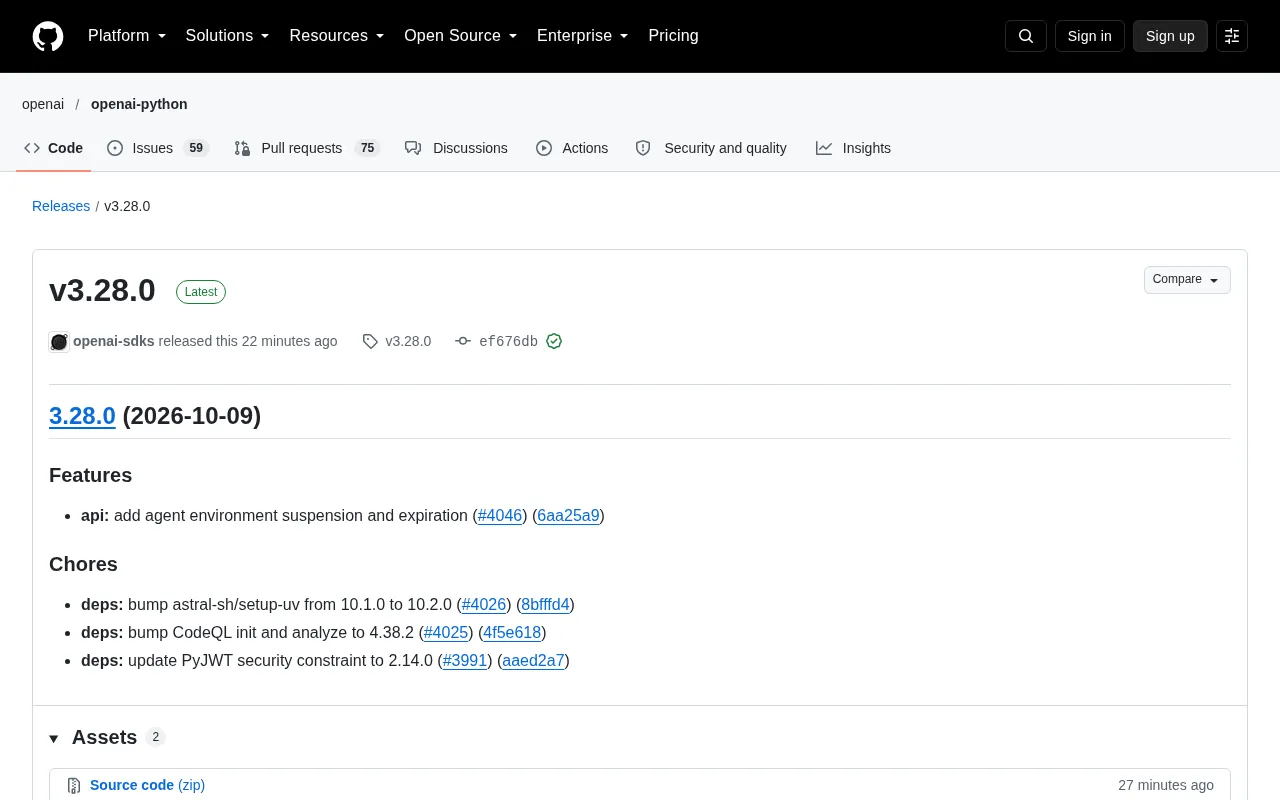
OpenAI SDK v3.28.0 adds Agent environment suspension and expiration support alongside PyJWT security updates.
OpenAI SDK v3.28.0 is an incremental feature and dependency maintenance release. Its core new capability is support for Agent environment suspension and expiration, allowing developers to pause environments without destroying state and set automatic expiration deadlines — balancing resource efficiency with context preservation for large-scale agent deployments. The release also upgrades PyJWT security constraints to 2.14.0 and performs routine maintenance on CI tools like setup-uv and CodeQL. No breaking changes are introduced, and the commit is GitHub signature-verified.
Release Overview
The OpenAI official SDK has shipped v3.28.0, pushed to GitHub by the openai-sdks team. This is a relatively focused update, with its core highlights centered on expanded Agent capabilities alongside several dependency security and maintenance updates.
Based on the release notes, this is primarily an incremental feature and dependency maintenance release. While it may appear routine, the newly introduced Agent environment management capabilities offer real practical value for developers building automated agent applications.
Core Feature: Agent Environment Suspension and Expiration
The most notable new feature in this release is API-level support for Agent environment suspension and expiration (corresponding to PR #4046).
This capability gives developers finer-grained lifecycle control over the environments that agents depend on. Suspension means pausing an environment's execution without destroying its state, while expiration allows developers to set a validity period for an environment, after which it automatically becomes invalid.
Why This Feature Matters
Managing resource consumption and state across long-running or multi-session Agent applications has always been a pain point. Keeping an active environment alive indefinitely for every agent session wastes significant resources, while frequently destroying environments causes context state to be lost.
Suspension offers a middle ground — preserving state while freeing up compute resources. The expiration mechanism further enables automatic resource reclamation, preventing lingering zombie environments from continuously consuming quotas. For scenarios requiring large-scale agent deployments, this kind of lifecycle control is a critical component of production readiness.
From a broader technical perspective, an Agent environment typically refers to an isolated execution sandbox that an agent depends on at runtime — encompassing tool call permissions, context memory, filesystem state, and other resources. In OpenAI's Assistants API and Agent framework, each run thread may be bound to a stateful environment. Previously, developers lacked fine-grained environment lifecycle APIs and had to rely on timeout configurations or manual resource deletion for management. Suspension and expiration are well-established patterns in cloud-native resource management — analogous to VM "pause" and "snapshot expiration" — and bringing these patterns to the Agent layer signals that OpenAI is advancing the engineering maturity of agent applications toward production grade, making resource scheduling in multi-tenant and high-concurrency scenarios genuinely feasible.
Dependency Maintenance and Security Updates
Beyond the new feature, v3.28.0 also includes several maintenance updates to dependencies:
- PyJWT security constraint upgraded to 2.14.0 (PR #3991): A security-related update ensuring the JWT token handling library meets the latest security baseline.
- astral-sh/setup-uv upgraded from 10.1.0 to 10.2.0 (PR #4026): A routine version bump for the CI toolchain.
- CodeQL initialization and analysis components upgraded to 4.38.2 (PR #4025): Keeps the automated code security scanning capabilities current.
While these chore-type updates don't directly affect end-user functionality, they reflect the project's ongoing investment in security and engineering quality. The PyJWT security constraint upgrade in particular is worth noting — any project using this SDK for authentication should plan to update promptly.
PyJWT is a widely used JSON Web Token implementation library in the Python ecosystem, used to generate and verify JWT tokens. JWTs are common in API authentication scenarios, and vulnerabilities in the dependency version (such as signature verification bypass or algorithm confusion attacks) can lead to identity spoofing or privilege escalation risks. Pinning the PyJWT security constraint to 2.14.0 means the SDK will enforce the use of versions containing the latest security fixes during dependency resolution, rather than allowing downgrades to versions with known vulnerabilities. For applications using the OpenAI SDK in production for API key validation or user identity propagation, this kind of constraint upgrade is a quiet but non-trivial security hardening measure.
Upgrade Recommendations
For developers already using the OpenAI SDK, the upgrade risk for this release is low — there are no breaking changes indicated, and the update consists primarily of feature additions and dependency maintenance.
If your application involves Agent environment management — particularly scenarios requiring lifecycle control over agent runtime environments — upgrading soon to take advantage of the new suspension and expiration capabilities is recommended. Even for general-use cases, the PyJWT security upgrade makes it worthwhile to include this dependency update in your plans.
This version was released on October 9, 2026, with a commit verified via GitHub's signature verification, so it's safe to adopt with confidence.
Summary
v3.28.0 is a typical incremental feature plus maintenance release. The addition of Agent environment suspension and expiration mechanisms reflects OpenAI's continued effort to build out the engineering infrastructure for agent applications, giving developers more control at the resource management layer. Combined with the synchronous security dependency upgrades, this is a stable release worth following.
Related articles

Cursor AI in Practice: Weighing Efficiency Gains Against Costs in an AI IDE
An in-depth look at Cursor AI IDE's interface layout, four modes (Agent/Plan/Debug/Ask), model selection, and Git context integration, with hands-on demos weighing subscription costs against going direct to Claude.

Free Landing Page Design Rules Library: A Practical Guide for Claude Code and Cursor
A free landing page design skill for Claude Code and Cursor: MIT licensed, nearly 9,000 stars, asks about offer/audience/action before planning 12 sections with hard font and spacing constraints.

Cursor Keeps Writing Wrong Code? The Problem May Be Context, Not Prompts
Cursor keeps writing wrong code? The problem may be context, not prompts. Learn how to supply relevant files, full error messages, and expected results, plus a plan-first, small-step, test-driven workflow to reduce AI coding errors—while remembering code review remains the developer's job.