OpenBot: The Open-Source Project Giving Every AI Colleague Their Own Computer

Open-source OpenBot gives each AI Agent its own computer with decide-first, record-after trustworthy autonomy.
OpenBot is an open-source AI Agent runtime from the CopilotKit team that gives each Agent an independent browser, file system, and toolset to solve state isolation and resource contention in multi-Agent collaboration. Its core mechanism—deciding every action before execution and recording it afterward—inserts an auditable gate before the action step of the ReAct loop, making Agent behavior intervenable and traceable. It connects to any Agent framework via the AG-UI protocol without ecosystem lock-in. The project has 7,749 GitHub stars and 1,030 forks, with 240 new stars in a day, and is written in TypeScript. Key details on decision implementation and environment resource overhead remain undisclosed, and the project is still early-stage.
From Tool to Colleague: OpenBot Redefines AI Agents
In today's increasingly crowded AI Agent landscape, most products still position themselves as "assistants"—you ask, it answers; you give instructions, it executes. But an open-source project on GitHub is attempting a more radical paradigm: giving every AI Agent its own independent computer environment so it can work like a real colleague.
This is OpenBot, launched by the CopilotKit team (the project name continues their long-standing thinking on AI collaboration). According to GitHub data, the project has already gained 7,749 stars and 1,030 forks, with 240 new stars in a single day—a clear sign of its popularity. Written in TypeScript, its core proposition can be summed up in one sentence: open-source AI colleagues, each equipped with their own browser, files, and tools, where every action is decided before it happens and recorded after.
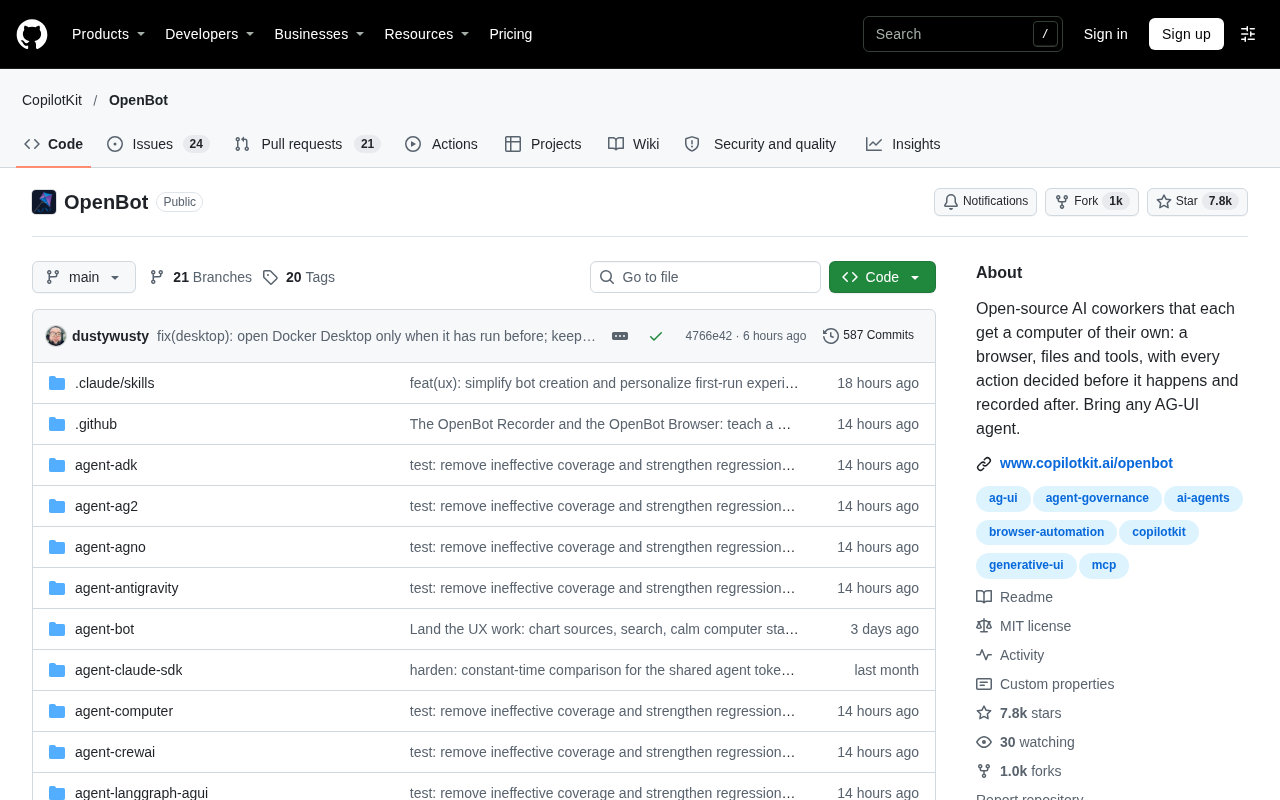
This description contains three key design choices: independent computing environments, pre-action decision-making, and post-action auditing. Together they point toward a single goal—making AI Agents truly trustworthy when autonomously executing complex tasks.
What Does an Independent Computer Mean?
"Every AI colleague gets its own computer" is not a metaphor. OpenBot allocates an independent runtime environment to each Agent instance, including a browser, file system, and toolset. This solves a core pain point in multi-Agent collaboration: state isolation and resource contention.
In traditional multi-Agent systems, multiple Agents often share the same execution context, and one Agent's mistake can pollute global state. By isolating environments, OpenBot lets different Agents each handle their own responsibilities without interfering with one another. You can simultaneously run an Agent responsible for market research (operating a browser to scrape competitor information) and an Agent responsible for content production (reading and writing local files), with completely independent action spaces.
More importantly, this design makes each Agent's behavioral boundaries clear. What each Agent can access and what it can modify are hard-constrained at the environment level, architecturally reducing the risk of "privilege escalation."
Pre-Action Decisions and Post-Action Records: Building Auditable Autonomy
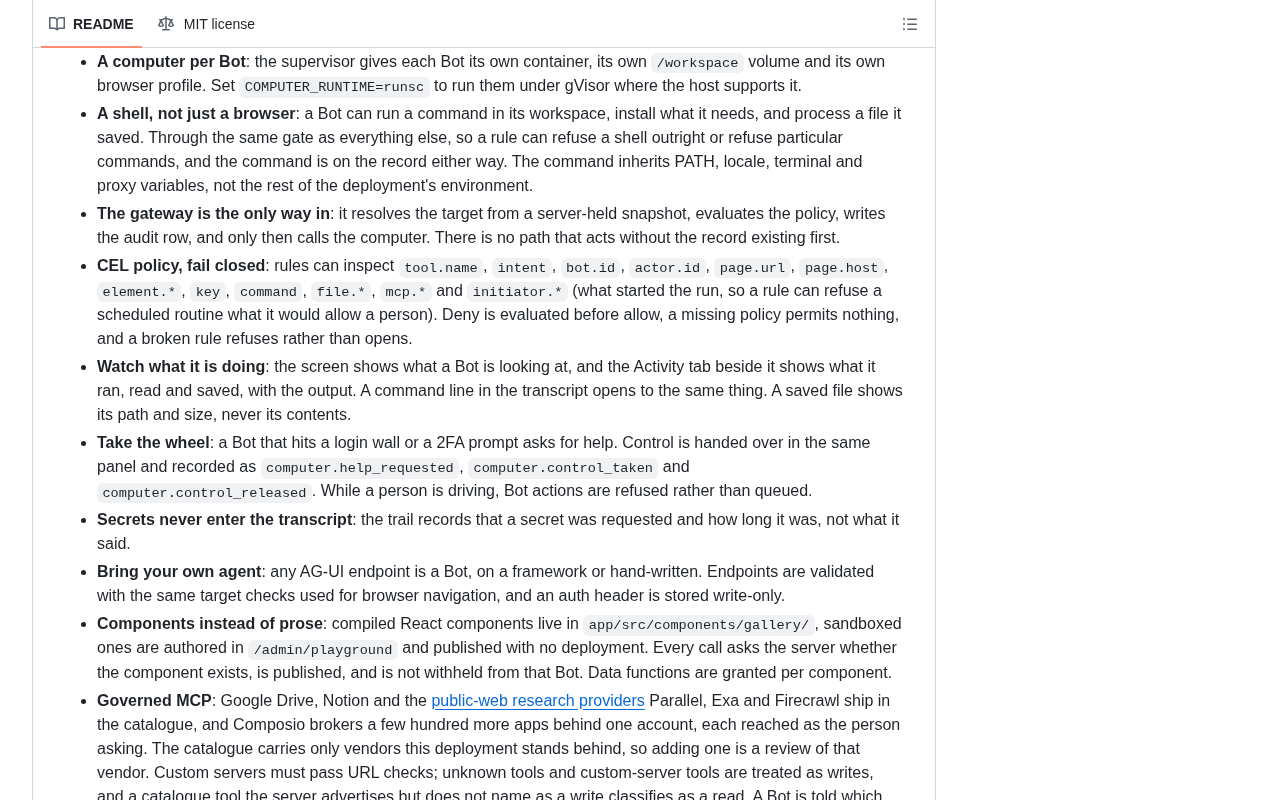
The most noteworthy mechanism in OpenBot is that "every action is decided before it happens and recorded after"—each action must go through a decision process before execution and is fully logged afterward.
This is fundamentally different from the current mainstream "ReAct loop" pattern. In ReAct, an Agent's thinking and actions are intertwined, and actions often happen directly. OpenBot makes the decision step explicitly upfront: the Agent must first propose an action intent, which only lands and executes after the decision layer confirms it. The direct benefit of this design is auditability and intervenability—before an action happens, the system (or a human) has a chance to examine "what it plans to do."
According to the project description, all actions are recorded after execution. This means the complete operation trajectory can be traced back, which is almost a hard requirement for scenarios needing compliance review or debugging of complex tasks. From a product experience perspective, this closed loop of "decide first, execute next, record after" makes the AI colleague feel more like an employee bound by process than a black-box executor.
ReAct (Reasoning and Acting) is an Agent paradigm proposed by Shunyu Yao and others in 2022. Its core is to interweave reasoning and action in the same loop: the large model first outputs a "Thought," then decides on an "Action," observes the result, and continues to the next round of thinking. This pattern allows Agents to dynamically decompose tasks and adjust strategies based on environmental feedback, and it is the foundation of most current Agent frameworks. However, ReAct's action step usually triggers tool calls directly, lacking an independent confirmation or interception layer, making it difficult to conduct human or system-level review before actions land. By making decisions explicitly upfront, OpenBot essentially inserts an auditable gate before the "action" node of the ReAct loop, providing a more controllable execution path for enterprise scenarios that require compliance and safety constraints.
Embracing AG-UI: No Lock-In to a Single Agent Framework
OpenBot explicitly states "Bring any AG-UI agent"—supporting integration with any Agent that conforms to the AG-UI protocol. AG-UI is an emerging protocol for Agent-to-frontend interaction, aiming to standardize Agent states, actions, and streaming output so that Agents built with different frameworks can connect to the UI layer in a unified way.
This choice is strategically astute. The current Agent framework ecosystem is highly fragmented, with LangChain, AutoGen, CrewAI, and others each having their own followers. OpenBot does not try to be a "catch-all" framework but positions itself as an Agent runtime and collaboration platform, decoupling from upper-layer Agent frameworks through the AG-UI protocol. Developers can build Agents with their familiar frameworks and then connect them to OpenBot to gain independent computers and action auditing capabilities.
This open strategy also explains the project's growth momentum: it lowers the integration cost, requiring developers to follow only an interaction protocol rather than rewrite Agent logic. The accumulation of 7,749 stars largely stems from this "no lock-in" positioning.
AG-UI (Agent-User Interaction Protocol) is an open protocol for communication between Agents and frontend applications. It typically uses event streams (such as Server-Sent Events) to push intermediate Agent states, tool calls, text deltas, and other information to the UI in real time. Its design goal is similar to the OpenAI API standard in the language model space: decoupling the Agent backend from the frontend interface so that a single UI can render Agent interactions from different frameworks. As long as an Agent encapsulates its reasoning steps, action intents, and execution results into the event format defined by AG-UI, it can be consumed by any compatible frontend. For OpenBot, adopting AG-UI means it does not need to embed the runtime of any specific Agent framework but instead gains generality through a protocol adaptation layer—at the cost of maintaining protocol version compatibility and event mapping complexity.
The Promise and Open Questions of Open-Source AI Colleagues
Viewed against the broader industry backdrop, OpenBot represents a class of emerging demand: AI Agents moving from "single-task execution" to "continuously collaborating colleagues." A colleague means long-term existence, fixed responsibilities, and a traceable work record—and OpenBot's independent environments, pre-action decisions, and post-action records are precisely the infrastructure supporting the "colleague" positioning.
That said, the project is still in an early stage. The GitHub description does not elaborate on the specific implementation mechanism for action decisions (whether a rules engine, model judgment, or human review queue), nor does it explain the resource overhead and concurrency capacity of independent environments. These details will determine its usability in real production scenarios. In addition, the maturity and ecosystem acceptance of the AG-UI protocol itself will also affect how broadly OpenBot can be integrated.
But the direction is worth watching: while the industry is still debating whether Agents "can do" something, OpenBot is already answering "how to make what Agents do trustworthy." Open source, TypeScript, and multi-framework compatibility—these labels together make it an interesting sample for observing the evolution of AI collaboration infrastructure.
One-line Summary
Open-source OpenBot gives every AI Agent its own computer and achieves trustworthy autonomy through decide-first, record-after execution.
Paragraph Summary
OpenBot is an open-source AI Agent runtime environment launched by the CopilotKit team. It advocates giving each Agent its own independent browser, file system, and toolset, thereby addressing state isolation and resource contention in multi-Agent collaboration. Its core mechanism is that "every action is decided before execution and recorded after," inserting an auditable gate before the action node of the ReAct loop so that Agent behavior is both intervenable and traceable. The project connects to any Agent framework via the AG-UI protocol, avoiding lock-in to the upper-layer ecosystem and lowering migration costs for developers. The project currently has 7,749 stars and 1,030 forks on GitHub, with 240 new stars in a single day, and is written in TypeScript. The article also notes that key details—such as the specific implementation of action decisions and the resource overhead and concurrency capacity of independent environments—have not yet been disclosed, and the project remains at an early stage.
Related articles

Gemini 4 Carbon Tops Global Rankings as AI Productivity and Open-Source Ecosystems Surge
Google DeepMind's Gemini 4 Carbon tops global benchmarks, built for complex agents and system security. ByteDance launches Doubao Work integrated with Feishu, Anthropic's AI autonomously breaches 5 system-level attack chains, and ModelBest and Fudan open-source on-device multimodal and image generation models.

Overseas Creator Breaks Down N8n AI Agent Business Playbook: From Tooling to Monetization
An overseas creator breaks down the N8n AI agent business playbook: comparing Zapier, Make, and N8n, detailing four monetizable automation categories—lead capture, WhatsApp follow-up, booking, and content pipelines—plus agency pricing and a sales playbook.

Empacer: The Voice-First AI Assistant for Small Business Owners That Topped Product Hunt
Empacer is a voice-first AI assistant for small business owners: three-question setup, voice requests turned into customer replies, social posts, and invoices—all owner-approved. It won #1 Product of the Day on Product Hunt with 231 upvotes and 47 comments.