Orbi: The AI Second Brain for Content Teams — Predict Viral Hits and Replicate Your Brand Voice
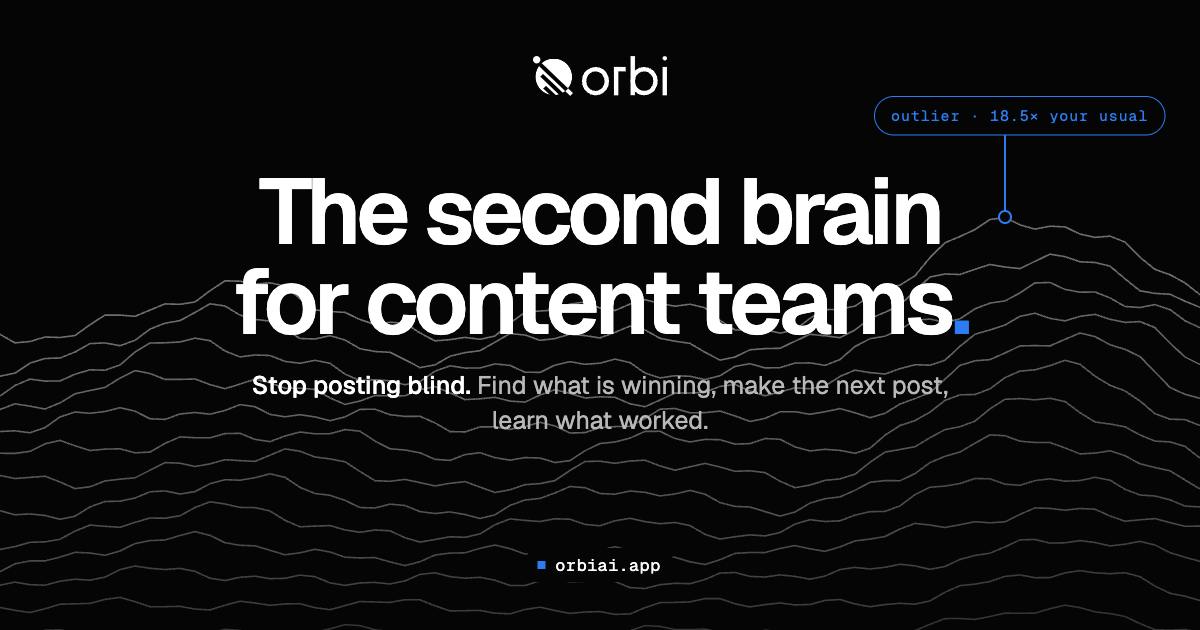
Orbi uses AI agents to build a content prediction and generation loop, tackling topic selection, consistency, and efficiency for content teams.
Orbi is a new product ranked #18 on Product Hunt, positioned as a second brain for content teams. It addresses three pain points: not knowing what content will perform well, difficulty maintaining brand consistency, and time-consuming creation. Its core mechanism scores each idea against the account's own baseline, predicts performance before creation, and rates after publishing, forming a data feedback loop. Agents can handle planning, scripting, editing, and publishing based on brand plans and assets, covering the entire workflow from ideation to distribution. Categorized under Social Media, SaaS, and AI, it has 16 votes and 2 comments — mid-tier traction. Its closed-loop design and agent execution are clear selling points, but prediction accuracy and brand voice replication still need practical validation. It's better suited for brand teams with established content workflows.
Content teams have long been plagued by three problems: not knowing what content will perform well, struggling to maintain brand consistency, and spending too much time on creation. Orbi, a new product ranked #18 on Product Hunt, aims to solve these issues with AI agents. Positioned as "the second brain for content teams," its core logic is: first find the winning content in your field, then generate your next post in your own voice, and learn from every publish.
Three Pain Points, One Closed Loop
Orbi's official description directly calls out three challenges for content teams: understanding what works, staying authentic, and time cost. To address these, Orbi provides a scoring and prediction mechanism.
It scores every idea against your own baseline, predicts performance before content is created, and rates it after publishing. This "predict–publish–rate" cycle is essentially building a quantifiable feedback system for content performance. For social media operators who rely on intuition and experience, this data-driven approach is appealing.
Baseline here refers to the reference benchmark formed by an account's or individual's past content performance, typically made up of historical averages for engagement rate, impressions, conversions, and other metrics. Orbi's "scoring against your own baseline" means it doesn't judge ideas by a universal standard across the internet, but instead compares each topic against your actual past performance to determine whether it's better or worse relative to you. The advantage is that it eliminates interference from account size and niche differences, making predictions closer to reality; but the baseline itself requires enough historical data to be stable. For new accounts or accounts with highly volatile content, the baseline may be distorted, and the predictive value will be diminished.
Brand Voice Replication and Agent Execution
Orbi emphasizes generating your next post "in your own voice," which hits a key need for brand content: not losing brand personality during scaled production. Its Agents understand your field and brand plans, and can handle planning, scripting, editing, and publishing from your assets.
This means Orbi doesn't stop at content suggestions — it attempts to take over the entire workflow from ideation to distribution. According to the official website, it targets brands that want to grow through authentic content.
AI Agents, unlike ordinary generative AI tools, typically refer to systems that can autonomously plan multi-step tasks, invoke tools, and execute actions. In Orbi's scenario, an agent isn't just "writing a piece of copy" — it can break down goals (such as planning a topic), generate scripts, invoke editing capabilities, and then complete publishing, forming an automated task chain. The key challenges for such systems lie in controllability and consistency: the more steps an agent executes, the higher the risk of deviating from brand tone or producing unusable content. Therefore, in practice, human review steps and clear brand instruction constraints often determine whether agents can truly replace manual workflows.
Market Positioning and Questions to Be Validated
Orbi is categorized under three tags: Social Media, SaaS, and Artificial Intelligence, and was launched by developer Daw-Chih Liou. On Product Hunt it received 16 votes and 2 comments, ranking #18. This level of traction is mid-tier on Product Hunt, indicating the product has attracted some attention but has not yet generated broad discussion.
The "second brain" concept is no longer novel in the productivity tool space. Orbi's differentiation lies in connecting content discovery, generation, prediction, and rating into a closed loop, and adding agent execution capabilities. However, the accuracy of predictions, the real effectiveness of brand voice replication, and the quality of automation from assets to finished product all need to be validated through actual use. For content teams, the value of such tools ultimately depends on whether they can reliably produce publishable content, not just provide inspiration.
"Second Brain" is a popular concept in the productivity space, first proposed by Tiago Forte, referring to the centralized management of notes, assets, inspiration, and other external information to form a personal knowledge base that can be accessed at any time. In recent years, such tools have gradually added AI capabilities, shifting from passive storage to proactive suggestions. Orbi borrows this concept to emphasize that it's not just a content generator, but a system that can accumulate and understand brand assets and domain knowledge. However, the barrier to a "second brain" lies in the quality of information accumulation: the more structured and rich the assets, the more relevant the system's suggestions; otherwise, it easily degrades into an ordinary copywriting interface.
Who Should Pay Attention to Orbi
If your team consistently produces content on social media and struggles to judge topic performance or needs to quickly turn assets into finished products, Orbi's design approach is worth noting. It's better suited for brand teams that already have a stable content production process and want to use data to improve efficiency and consistency, rather than content creators starting from scratch.
In today's highly competitive AI content tool landscape, Orbi's closed-loop design and agent execution are clear selling points, but product maturity and prediction credibility remain the key factors determining whether it can retain users.
One-line Summary
Orbi uses AI agents to build a content prediction and generation loop, attempting to solve content teams' challenges around topic selection, consistency, and efficiency.
Paragraph Summary
Orbi is a new product ranked #18 on Product Hunt, positioned as a second brain for content teams, targeting three major pain points: not knowing what content will perform well, difficulty maintaining brand consistency, and time-consuming creation. Its core mechanism scores every idea against the account's own baseline, predicts performance before creation, and rates after publishing, forming a data feedback loop; meanwhile, agents can handle planning, scripting, editing, and publishing based on brand plans and assets, covering the entire workflow from ideation to distribution. The product is categorized under Social Media, SaaS, and Artificial Intelligence, with 16 votes and 2 comments — mid-tier traction. Its closed-loop design and agent execution are clear selling points, but prediction accuracy and brand voice replication still need practical validation, making it better suited for brand teams with established content workflows.
Related articles

Open-Source AI Desktop Robot: Built with a Laptop + Android + Pico
Open-source AI desktop robot PAL9000: a MacBook runs MediaPipe vision and llama-cpp dialogue, an Android phone is the animated face, and a Raspberry Pi Pico W drives a 2-DOF pan-tilt head. Modular design, reproducible piece by piece, with a discussion of anthropomorphic design.

Why Did Your Backtest 'Beat' SOTA? The Weather Covariate Leakage Trap
A backtest showed Timestral's MASE dropping from 0.71 to 0.49, seemingly beating SOTA—but it was caused by weather covariate leakage. After correction, it was only 0.66. This article analyzes the leakage, the archived forecast dilemma, and provides a checklist for time series backtesting.
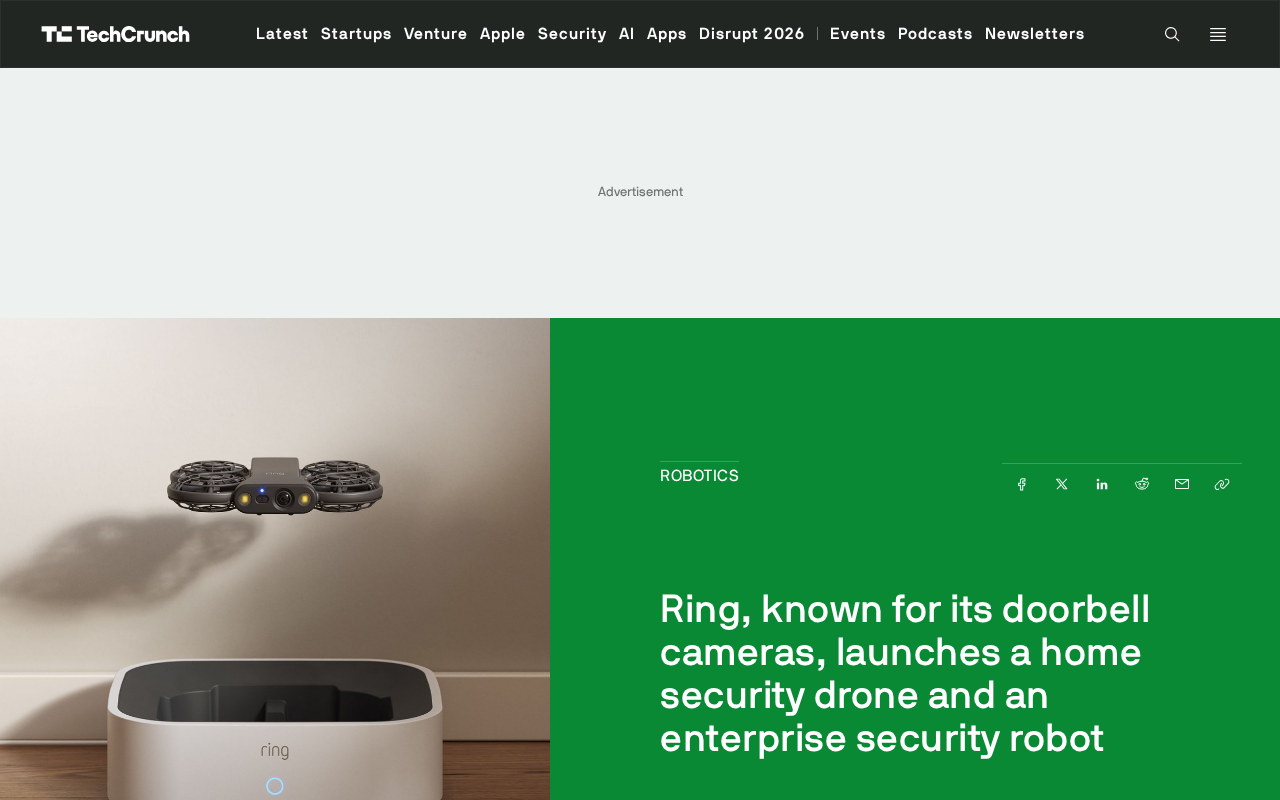
Ring Enters Robotics: Launching Home Security Drones and Enterprise Patrol Robots
Ring enters robotics with a home security drone and an enterprise rolling patrol robot. This article analyzes its product expansion logic, use cases, and practical challenges.