Oregon Police Issue $2.5 Million Bill for Officer Records

Oregon police billed a local outlet $2.5 million for one officer's records, sparking transparency concerns.
Oregon police quoted a local news outlet about $2.5 million for records on a single officer, drawing heated discussion on Hacker News after The Intercept reported it. Public records laws allow billing for search and review time, but when fees exceed what most newsrooms can afford, the right to request is effectively suspended. The report omitted the fee breakdown and police response, though the contrast between one officer and a multi-million-dollar bill hints at delay or deterrence.
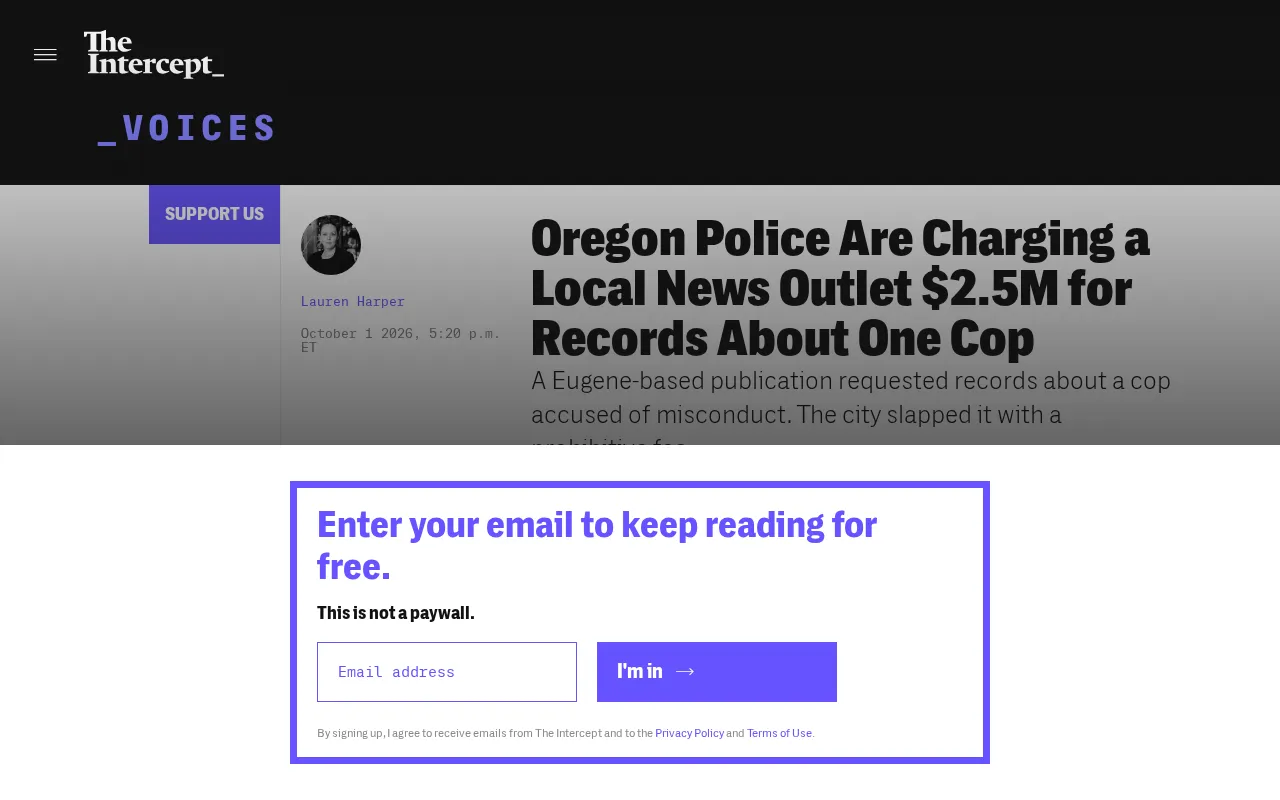
A public records request from Oregon is turning into a case study on government transparency, press freedom, and the cost of information in the digital age. According to The Intercept, local police quoted a local news outlet a fee of up to $2.5 million to access records related to a single officer. The story drew 229 points and 52 comments on Hacker News, but the report itself does not break down the fee, provide background on the officer involved, or detail the specific dispute between the parties.
The Shape of the Story: A Sky-High Bill and Missing Details
From the available information, the core fact is just one: a local news organization in Oregon was told by police that it would need to pay roughly $2.5 million to obtain records about a single officer. The headline describes the action as a "fee" rather than an outright denial, suggesting the records are theoretically still accessible—only the barrier has been raised to a level most newsrooms cannot afford.
The reason this incident draws attention is that it touches on a structural tension in public records systems: laws generally grant the public the right to inspect government documents, but implementation allows agencies to charge for "search, review, and duplication." When fees balloon from nominal costs to the millions, whether the right itself still exists becomes a practical question.
The available material does not disclose the specific composition of this fee—whether it comes from page-by-page review of a massive volume of documents, legal review of sensitive information, or some other combination of line items. This information gap is itself noteworthy: if the fee breakdown is not transparent, the public can hardly judge whether this is a reasonable pass-through of administrative costs or a de facto denial in disguise.
Why the Media Cares About "One Officer's" Records
The headline deliberately emphasizes that the records concern only "one officer," and this phrasing is the source of the story's drama. Investigative material on a single officer should, in theory, involve a limited volume of documents, creating a stark contrast with a $2.5 million fee. Unless that officer is the subject of numerous complaints, internal investigations, disciplinary proceedings, or related litigation, the figure is hard to explain through ordinary document-processing costs.
Local news organizations' persistent pursuit of a single officer's records typically points to several kinds of leads: how misconduct complaints were handled, the conclusions of internal investigations, the procedural basis for suspension or termination, and possibly systemic concealment. Such reporting often does not aim for a single bombshell but rather assembles a mosaic of records to reconstruct how an institution handles internal problems. When police respond with exorbitant fees, news organizations may interpret it as a delay or deterrence strategy.
However, absent a fee breakdown and a police response, the above can only be reasonable speculation, not established fact.
Public Records Fees: Institutional Design and Real-World Distortion
Public records laws vary considerably across U.S. states when it comes to fee provisions. Some states allow only the actual cost of duplication and postage to be charged, while others permit billing for search, review, and redaction time, especially when a request involves a large volume of documents or requires legal review. The intent is to prevent agencies from being overwhelmed by frivolous bulk requests, but in practice, hourly billing leaves room for "pricing-based denial."
For news organizations, the question is not whether they should pay but whether the fee genuinely matches the workload, whether there is a cap, and whether it can be appealed. When a bill is large enough to exceed a newsroom's annual budget, the right to request is effectively suspended—without the agency ever issuing a formal denial letter.
The digital age should have lowered the cost of accessing information—electronic search, bulk export, and automated redaction are all technically feasible. Yet fee rules in many jurisdictions still follow the logic of the paper era, charging by the page and by the hour. The disconnect between technological capability and institutional pricing methods is the deep-rooted reason such disputes recur.
U.S. public records laws (Public Records Act) trace their origins to the federal Freedom of Information Act (FOIA) of 1966, and states subsequently enacted their own versions. The core principle of these laws is that government documents belong to the public and should be disclosed unless a clear statutory exemption applies (such as privacy, ongoing investigations, or trade secrets). Fee provisions typically allow agencies to charge "reasonable" duplication costs, but what counts as "reasonable" has long been legally contested. Some states have established fee caps through case law or legislation—for example, prohibiting charges for search time—while others authorize agencies to bill by the hour, especially when legal review or extensive redaction is involved. This variation means the same request can cost dozens of times more in one jurisdiction than another. In addition, many states have public records counselors or ombudsmen responsible for mediating fee disputes, but their rulings often lack enforceability. For news organizations, remedies for fee disputes typically include administrative appeals and litigation, but litigation is costly and time-consuming, making it impractical for most routine requests.
The Multi-Party Dynamic in Transparency Disputes
Such incidents typically involve three parties: the news organization requesting the records, the police holding them, and the state-level agency or court responsible for adjudicating disputes. The news organization seeks information to complete its reporting; the police position may include protecting the integrity of investigations, privacy rights, and resource constraints; the adjudicating body must weigh statutory language against the public interest.
The level of discussion on Hacker News shows that this issue resonates in the tech community as well—it is seen as a general problem of government data accessibility, the public's right to information, and administrative costs. However, the available material does not include specific viewpoints from the comment section or any public response from the police, so a more detailed reconstruction of each party's position is not possible.
One direction worth tracking: whether the news organization will appeal the bill, and whether the state public records counselor or a court will rule on the reasonableness of the fee. Such rulings often carry more institutional significance than the individual case itself.
In public records disputes, state public records ombudsmen or similar bodies play an important role. In Oregon, for example, the Attorney General's office includes a public records counselor responsible for receiving public complaints about records requests and issuing non-binding opinion letters. Although such opinions cannot force agencies to comply, they are often cited by courts as reference and can create public pressure on agencies. If a dispute goes to litigation, courts will examine whether the fee is "reasonable and necessary" and may require the agency to provide detailed work logs. In practice, courts tend to defer to agencies' resource constraints, but if a fee is found to be used to obstruct a legitimate request, the court may order the agency to cover the requester's attorney fees. This judicial deterrent is an important mechanism against "pricing-based denial," but its effectiveness depends on the requester's litigation capacity. For resource-limited local media, support often comes only from public-interest lawyers or press freedom organizations.
What It Means for Journalists and the Public
If exorbitant fees become standard practice, it is not only large investigative reporting that suffers. Local news organizations have limited resources, and a six-figure bill is enough to make most newsrooms abandon a request. Over time, information that should be subject to oversight—officer disciplinary records, internal investigation conclusions—will retreat into opacity.
For ordinary members of the public, the barrier to public records requests is rising as well. When obtaining police records about oneself also requires bearing high fees, the right to oversight and the right to know become privileges reserved for those who can pay.
This also explains why such individual cases draw attention from both the tech community and the news industry: it is not just a local dispute but a test of whether the public records system still fulfills its original design purpose. The available information is not enough to reconstruct the full picture, but the fact of "$2.5 million for one officer's records" already raises sharp enough questions.
One-line Summary
Oregon police quoted a local outlet $2.5 million for one officer's records, sparking debate over transparency in the public records system.
Paragraph Summary
Oregon police quoted a local news outlet roughly $2.5 million to access records related to a single officer, drawing heated discussion on Hacker News after The Intercept reported it. At the core is that public records laws allow billing for search and review time, but when fees swell beyond what most news organizations can afford, the right to request is effectively suspended. The report did not disclose the fee breakdown or a police response, but the stark contrast between "one officer" and a sky-high bill suggests a possible delay or deterrence strategy. The digital age should lower information costs, yet paper-era pricing rules create an institutional disconnect. Whether the bill is appealed and how it is ruled on will carry more institutional significance than the case itself.
Related articles

LLM Application Development: A High-Paying Career Guide for Ordinary People
LLM application development offers fresh graduates up to 35K/month, with SP offers reaching 600K. This article explains the core skills, how to break in, and how ordinary people can seize AI opportunities through learning by doing.

Say Goodbye to AI Influencer Faces: A Complete Guide to Creating Visual Assets for AI Comic Dramas from Scratch
Bilibili creator shares a full workflow for zero-basics AI comic drama visual assets: use Doubao Work skills with script-first, visual references, and real-person texture to escape AI influencer faces, then lock character and scene consistency with asset sheet layouts, weapon detail images, scene nine-grids, and cinematic color palettes.

The AI Production Pipeline Behind Great Videos: From Research to Agent Validation
AI video production isn't just a model race. This article breaks down a transferable four-step pipeline: researching professional workflows, organizing a skill checklist, configuring agents, and experimental validation—and explains how general-purpose LLMs like DeepSeek can replace paid tools to run the entire process.