OTPM: A Training-Free Diagnostic Metric for Fine-Tuning Speech Separation Models

OTPM predicts SLD fine-tuning gains without training using language posteriors, but real-world correlation is only 0.23.
This article introduces a study on Spoken Language Diarization (SLD) that proposes Off-target Posterior Mass (OTPM) as a training-free diagnostic metric for predicting pre-trained speech model gains before fine-tuning. OTPM is computed from frame-level language identification posteriors, with the intuition that higher probability mass on non-target languages signals weaker discrimination and potentially larger fine-tuning gains. Correlation analysis shows 0.56 on synthetic bilingual data but only 0.23 on real-world corpora. The authors cautiously describe it as having "promising potential." The article concludes that OTPM can serve as a low-cost auxiliary reference to filter out cases clearly not worth fine-tuning, but its weak correlation and limited validation scope mean it is not yet sufficient to support decisions on its own and remains far from a standard diagnostic tool.
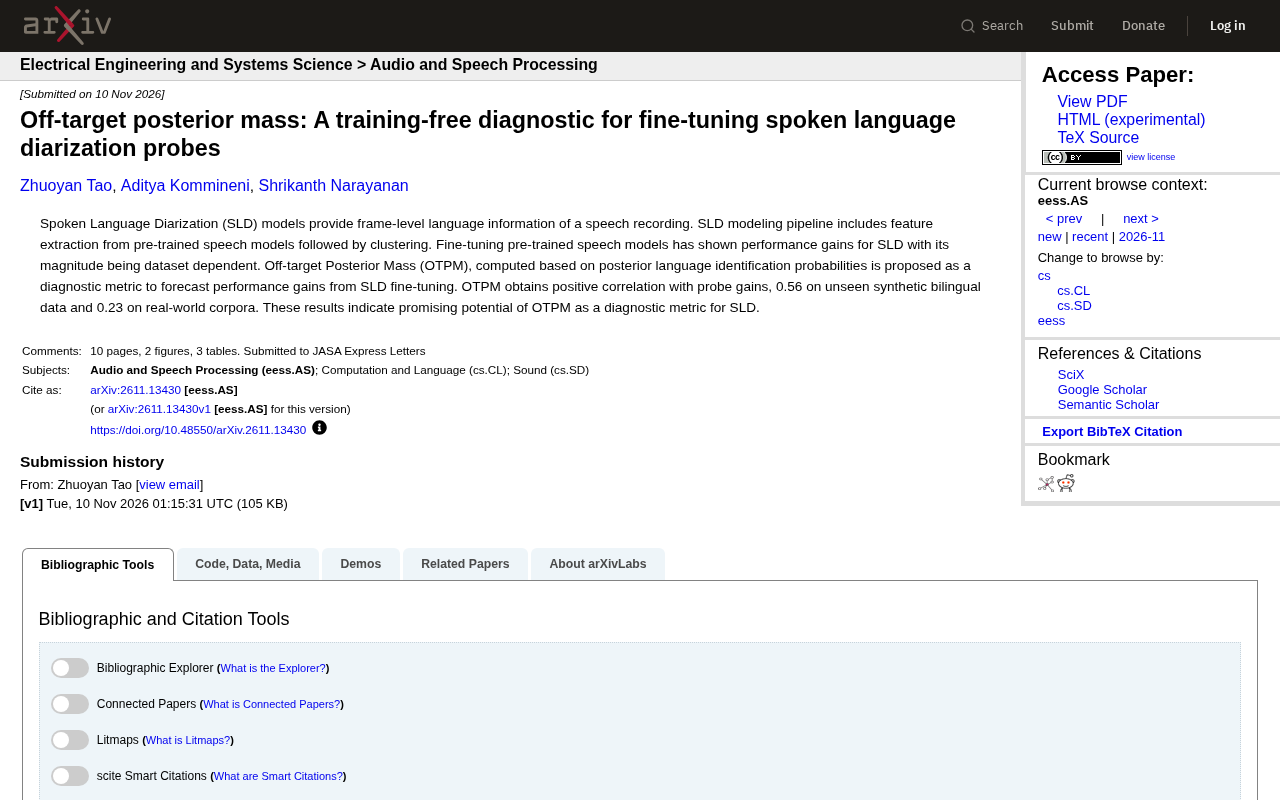
Fine-tuning pre-trained speech models can improve the performance of Spoken Language Diarization (SLD), but the magnitude of improvement varies by dataset. How to predict the gain without actually fine-tuning has long been a blind spot in practice. A recent study proposes "Off-target Posterior Mass" (OTPM) as a diagnostic metric, attempting to use language identification posterior probabilities to predict the performance gain after fine-tuning.
The SLD Pipeline and the Fine-Tuning Dilemma
The goal of SLD models is to provide frame-by-frame language information for a recording. A typical pipeline involves extracting features from a pre-trained speech model and then performing clustering. Fine-tuning pre-trained models has been shown to bring performance gains, but the paper points out that the magnitude of these gains depends on the specific dataset—meaning that researchers and engineers find it difficult to judge whether fine-tuning is worth the cost before investing in it.
The core of this dilemma is the lack of a pre-training signal: if one could read "where problems are likely to occur" from the model's existing outputs, it would be possible to decide more deliberately whether to fine-tune and on which dataset. OTPM is designed precisely for this need.
The relationship between Spoken Language Diarization (SLD) and Language Identification (LID): SLD is closely related to the Language Identification (LID) task but has a different objective. LID typically determines the language of an entire utterance or a longer segment, outputting a global label; SLD, by contrast, needs to assign language tags frame-by-frame or segment-by-segment along the time axis, making it closer to a combination of "language segmentation + language identification." SLD outputs can be directly used in scenarios such as language routing in multilingual meeting transcription and language-switch detection in bilingual conversations. Precisely because SLD relies on frame-level posteriors, the model's probability allocation between the "target language" and "non-target languages" at each frame becomes a diagnostically usable signal—this is also the premise that allows OTPM to extract information from existing outputs.
How OTPM Works
OTPM is computed based on language identification posterior probabilities and is a training-free diagnostic metric—it requires no additional training steps or labeled data and is extracted directly from model outputs. The intuition is: if the model assigns a large amount of frame-level language posterior mass to "non-target languages," it indicates that the model's ability to discriminate languages on the current data is weak, and fine-tuning may yield greater gains.
The study validates this hypothesis through correlation analysis: OTPM is positively correlated with the performance gain of fine-tuning probes. According to the paper, the correlation coefficient is 0.56 on unseen synthetic bilingual data and 0.23 on real-world corpora. The marked difference between the two values indicates that OTPM's predictive power is substantially affected by data distribution.
Posterior probabilities and frame-level language posteriors: In neural network classification models, posterior probability refers to the normalized probability distribution the model outputs over candidate classes given an input. For SLD, the model outputs a probability vector covering all candidate languages at each time frame, with components summing to 1. The so-called "non-target language" mass is the sum of probabilities assigned to non-target languages at that frame. If the model has strong language discrimination ability on the current recording, the target language component should dominate; conversely, a high accumulated non-target language component indicates that the model is "uncertain" on that data. OTPM is precisely a quantification of this accumulated mass, so it requires no additional labels or training—it can be computed simply by reading the model's existing softmax outputs.
The Signal Behind the Correlation Values
The contrast between 0.56 and 0.23 deserves close reading. The moderate positive correlation on synthetic bilingual data indicates that OTPM has some predictive power under controlled conditions; whereas the weak correlation of only 0.23 on real-world corpora suggests that in real scenarios, factors affecting fine-tuning gains go far beyond posterior mass alone.
The authors describe this result in the original text as "promising potential," a cautious choice of wording. From an engineering perspective, OTPM is better suited as an auxiliary reference than as a basis for decision-making—it can cheaply filter out cases that clearly do not warrant fine-tuning, but it is insufficient on its own to support the judgment that "fine-tuning is definitely worthwhile."
Interpreting correlation coefficients: What the paper reports is the Pearson correlation coefficient between OTPM and fine-tuning gains, ranging from -1 to 1. 0 indicates no linear relationship, and 1 indicates a perfect positive linear relationship. 0.56 is a moderate positive correlation, meaning that when OTPM rises, fine-tuning gains tend to increase, but the scatter remains fairly dispersed; 0.23 is a weak correlation, meaning it can explain only about 5% of the variance in gains, indicating limited predictive power. Note that a correlation coefficient only characterizes linear association—it does not imply causation, nor does it guarantee accurate ranking on any single dataset. Therefore, the paper's use of "promising potential" rather than "reliable predictor" is wording consistent with the strength of the statistical evidence.
Practical Significance and Limitations
OTPM's value lies in partially converting "whether to fine-tune" from an empirical judgment into a computable signal. For teams that need to allocate fine-tuning budgets across multiple datasets, this training-free diagnostic can reduce trial-and-error costs.
The limitations are equally clear: the weak correlation on real-world corpora means the metric's reliability in deployment scenarios is limited, and the data types covered by current validation (synthetic bilingual, real-world corpora) remain narrow. The paper does not provide large-scale validation across languages or domains, and whether OTPM can generalize to more complex multilingual scenarios remains an open question.
Summary
OTPM offers a lightweight perspective: using the model's own posterior distribution to predict fine-tuning gains. Its approach is worth attention, but the existing correlation data indicate that it is still at an early exploratory stage and remains far from becoming a standard diagnostic tool. For SLD researchers, it is a reproducible and extensible baseline metric; for engineering practitioners, it is advisable for now to treat it as one reference signal among several.
One-line Summary
OTPM uses language posterior probabilities to predict SLD fine-tuning gains without training, but the correlation on real-world corpora is only 0.23.
Paragraph Summary
This article introduces a study on Spoken Language Diarization (SLD) that proposes "Off-target Posterior Mass" (OTPM) as a training-free diagnostic metric for predicting the performance gain of pre-trained speech models before fine-tuning. OTPM is computed based on frame-level language identification posterior probabilities, with the intuition that the more probability a model assigns to non-target languages, the weaker its language discrimination ability and the greater the potential gain from fine-tuning. Correlation analysis shows that OTPM's correlation with fine-tuning gains is 0.56 on synthetic bilingual data and only 0.23 on real-world corpora. The authors use cautious wording, describing it as having "promising potential." The article argues that OTPM can serve as a low-cost auxiliary reference to filter out cases clearly not worth fine-tuning, but its weak correlation and limited validation scope mean it is not yet sufficient to support decisions on its own and remains far from a standard diagnostic tool.
Related articles

Open Source Movement Petitions for Jensen Huang's Return to NVIDIA: A Battle Over AI Control
The open source community petitions to reinstate Jensen Huang as NVIDIA CEO, with signatures from Elon Musk and others. This analysis examines the anxiety over AI computing power control behind the petition and its implications for the industry.

Qwen4-Max Launches: Price Cut and Benchmark Analysis
Qwen4-Max is live on QwenCloud with input at $1.50 and output at $4.50 per million tokens—25% cheaper than Qwen3.8-Max. We break down vendor benchmark limits and testing plans.
Major macOS Permission Overhaul: Device Control and Full Disk Access Become More Transparent
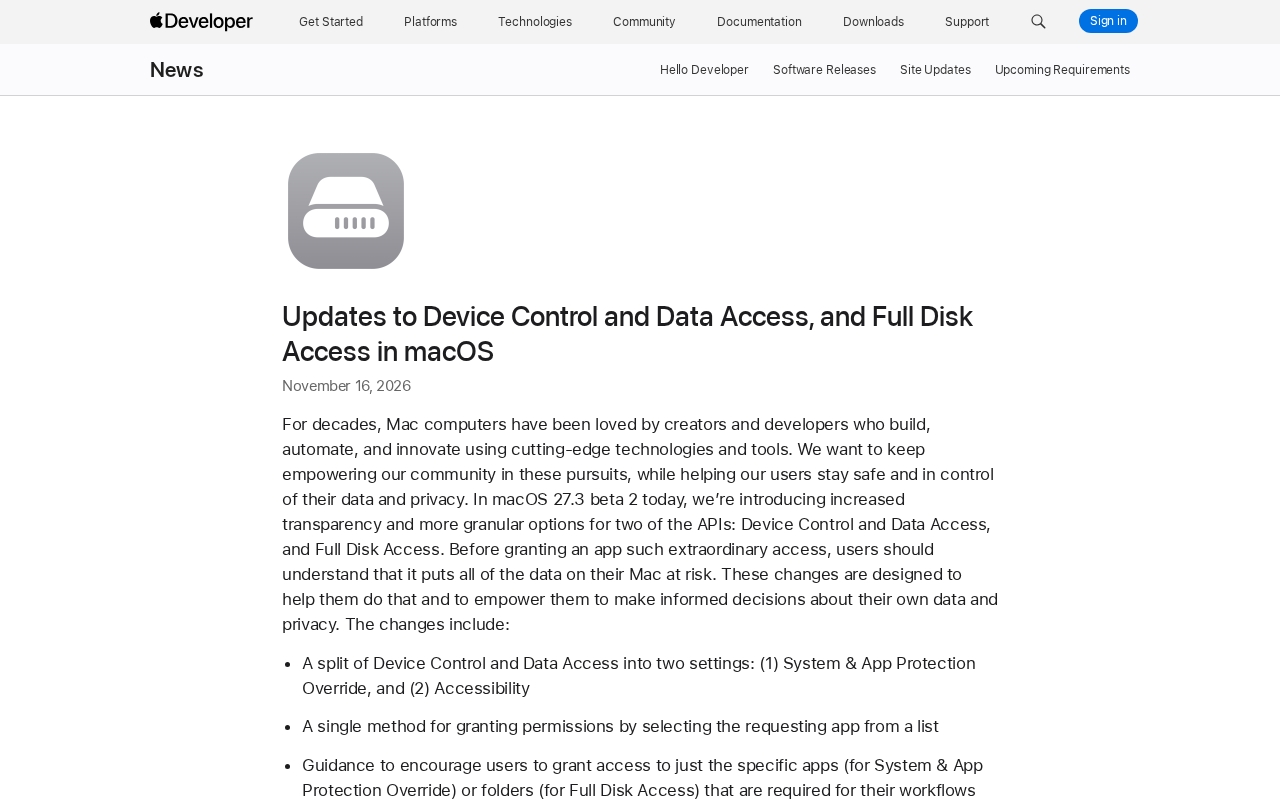
macOS 27.3 beta 2 overhauls Device Control and Data Access and Full Disk Access permissions: splitting them into System & App Protection Override and Accessibility, unifying authorization entry points, adding per-request prompts and runtime indicators, and retaining an entitlement compatibility channel.