Otter.ai Secures $320M in Funding: AI Meeting Tool Accelerates Enterprise Expansion

Otter.ai secures $320M in non-dilutive funding from General Catalyst's CVF fund, betting on enterprise and international expansion.
Otter.ai has announced $320 million in funding from General Catalyst's growth fund (CVF), to be used for enterprise growth, marketing, international expansion, and product innovation. Unlike conventional venture capital, CVF settles based on returns on marketing spend and does not dilute existing equity, but it also ties the actual financing cost to growth outcomes, making it better suited to mature teams with a clear growth path. The article argues that competition in meeting AI has moved from the product validation stage to the scale distribution stage, with enterprise customers imposing higher requirements on data security, compliance, and office suite integration, and functional advantages alone no longer sufficient. The $320 million figure is unusual for this niche segment; the size of the funding is merely an entry ticket, and whether it can be converted into enterprise market share depends on execution efficiency. This financing structure may also become a new model for AI application-layer companies.
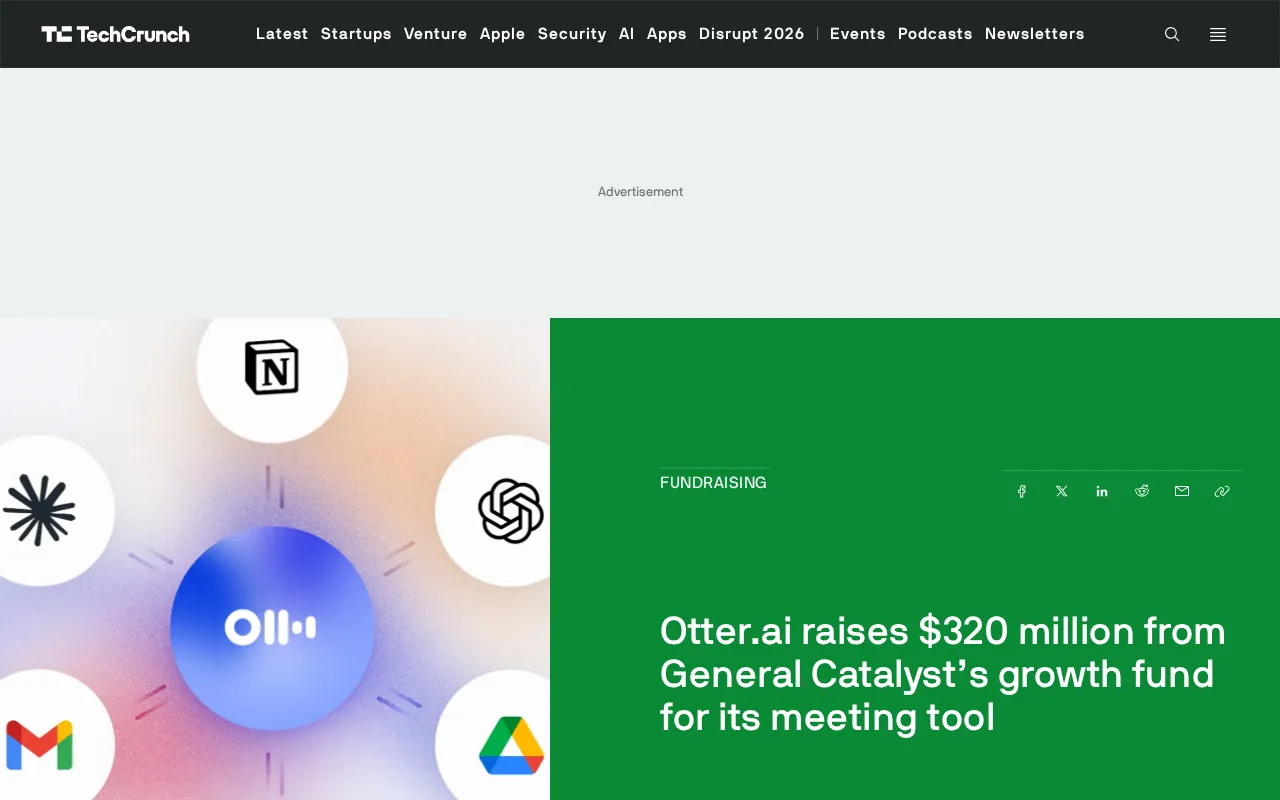
AI meeting transcription tool Otter.ai has announced $320 million in funding from General Catalyst's Customer Value Fund (CVF). The capital will be used for enterprise growth, marketing strategy, international expansion, and product innovation.
Funding Structure: Non-Dilutive Growth Capital
Unlike traditional venture capital, General Catalyst's CVF fund offers a capital model based on returns from marketing spend that does not dilute the startup's equity. This means Otter.ai can secure large-scale growth capital while maintaining its existing equity structure. This financing approach is particularly attractive to founders who want to retain control, and it also reflects the current bargaining power of AI application-layer companies in the capital markets.
In its statement, Otter.ai made clear that the funds will focus on four areas: enterprise business growth, go-to-market strategy, international market expansion, and product innovation. These four areas correspond precisely to the key stages in the transformation of AI meeting tools from "handy personal tools" to "enterprise collaboration infrastructure."
Customer Value Fund (CVF) is a structured growth capital instrument launched by General Catalyst whose core logic ties the funding amount to a company's future marketing spend: the fund provides a large sum upfront, and the company uses the returns on a agreed proportion of its future marketing budget (or a certain percentage of marketing spend) to repay it, rather than giving up equity. This type of instrument began attracting attention in 2023–2024 and is often categorized as "non-dilutive growth capital," alongside traditional venture capital and venture debt. Its pricing typically embeds assumptions about customer acquisition efficiency, and therefore places high demands on a company's growth predictability; at the same time, the repayment obligation often takes the form of contractual cash flow commitments, making it closer to a liability-type arrangement than pure equity financing in terms of accounting and cash flow management.
AI Meeting Tools Enter the Enterprise Competition Phase
Meeting transcription is one of the earliest application scenarios for generative AI. Otter.ai built its user base on real-time transcription, automatic summarization, and meeting key point extraction, but competition in this space is intensifying. Enterprise customers are imposing higher requirements on data security, compliance, and deep integration with existing office suites, and functional advantages alone are no longer sufficient to win large deals.
The $320 million figure is unusual for this niche segment, and it sends a signal: the capital markets believe that competition in meeting AI has moved from the product validation stage to the scale distribution stage. The allocation of funds to marketing and international expansion indicates that Otter.ai's priority is to capture enterprise customers and overseas markets rather than continuing to refine individual features.
Go-to-market (GTM) strategy refers to a company's overall approach to bringing products to market and converting them into revenue, typically including target customer segmentation, sales models (self-service subscription, sales-driven, channel partnerships), pricing and packaging, and customer success and renewal management. For tools like meeting AI, as they shift from individual user payments to enterprise procurement, the focus of GTM shifts from app stores and content marketing to enterprise sales, IT procurement processes, security reviews (such as SOC 2, ISO 27001), and ecosystem integration with platforms like Microsoft Teams, Zoom, and Slack. GTM efficiency directly determines customer acquisition cost (CAC) and payback period, which are also the core metrics of interest for marketing-performance-linked financing.
The Two Sides of Non-Dilutive Financing
The CVF model settles based on returns on marketing spend. For Otter.ai, this reduces the cost of equity, but it also means that growth outcomes are tied to the cost of capital. If the return on marketing investment falls short of expectations, the actual financing cost may rise. This structure is better suited to mature teams with a clear growth path and the ability to quantify marketing returns, rather than companies in the early trial-and-error stage.
For industry observers, what makes this funding noteworthy is that it could become a model for new financing structures among AI application-layer companies. As model capabilities become increasingly commoditized and distribution efficiency and customer acquisition costs become the core of competition, capital instruments tied to marketing performance will become increasingly common.
Implementation Challenges of International Expansion and Product Innovation
Otter.ai lists international expansion as one of the uses of funds, but multilingual capabilities, localized compliance requirements (such as data storage regulations in different markets), and integration with enterprises' existing collaboration ecosystems are all areas that require sustained investment for meeting transcription tools. On the product innovation front, enterprise customers are more focused on permission management, audit logs, and deep integration with CRM/project management tools. Building these capabilities takes a long time, and explosive growth is unlikely in the short term.
This funding gives Otter.ai some buffer room, but whether it can be converted into actual enterprise market share depends on execution efficiency. The window of opportunity in the meeting AI space is narrowing, and the size of the funding is merely an entry ticket.
When meeting transcription tools enter the enterprise market, compliance and audit capabilities often become a procurement barrier more readily than transcription accuracy. Typical requirements include: data residency and cross-border transfer restrictions (such as GDPR requirements in the EU for the processing and storage of personal data), legality design requiring participant consent before recording, access permissions and role hierarchies, complete audit logs, data retention and deletion policies, and identity management integrations such as single sign-on (SSO) and SCIM. In addition, integration with CRM (such as Salesforce) and project management tools means that meeting minutes must be structured into trackable customer records and task items. These capabilities typically require long-term engineering investment and third-party certifications, and cannot be compensated for in the short term by a single model capability.
One-line Summary
Otter.ai secures $320M in non-dilutive funding from General Catalyst's CVF fund, betting on enterprise-grade and international expansion.
Paragraph Summary
Otter.ai has announced $320 million in funding from General Catalyst's growth fund (CVF), to be used for enterprise growth, marketing, international expansion, and product innovation. Unlike conventional venture capital, CVF settles based on returns on marketing spend and does not dilute existing equity, but it also ties the actual financing cost to growth outcomes, making it better suited to mature teams with a clear growth path. The article argues that competition in meeting AI has moved from the product validation stage to the scale distribution stage, with enterprise customers imposing higher requirements on data security, compliance, and office suite integration, and functional advantages alone no longer sufficient. The $320 million figure is unusual for this niche segment; the size of the funding is merely an entry ticket, and whether it can be converted into enterprise market share depends on execution efficiency. This financing structure may also become a new model for AI application-layer companies.
Related articles

LangChain Retry Middleware Configuration: Practices and Selection Guide
Based on Reddit community discussion, this article analyzes LangChain ModelRetryMiddleware retry parameter configuration practices, covering the selection logic and alternatives for key options like max_retries, backoff_factor, and jitter.

Texas Senate Race in Trouble: Why Are Republicans Nervous?
Texas Senate race stirs Republican anxiety. Based on street interviews, this article analyzes the Democratic offensive in funding, organization, and running everywhere, and how Republicans are defending "Texas, Texas" amid the political pendulum effect.

Gemini Chat Now Generates and Edits Google Docs Directly, a New Breakthrough in Office Productivity
Google Gemini's chat interface now generates and edits PDF, Google Docs, Sheets, Slides, Markdown, TXT, and code files. Available to all users; web supports all formats, mobile only PDF for now.