Paxper: Visually Build Cloud Infrastructure with Every Change Reviewed
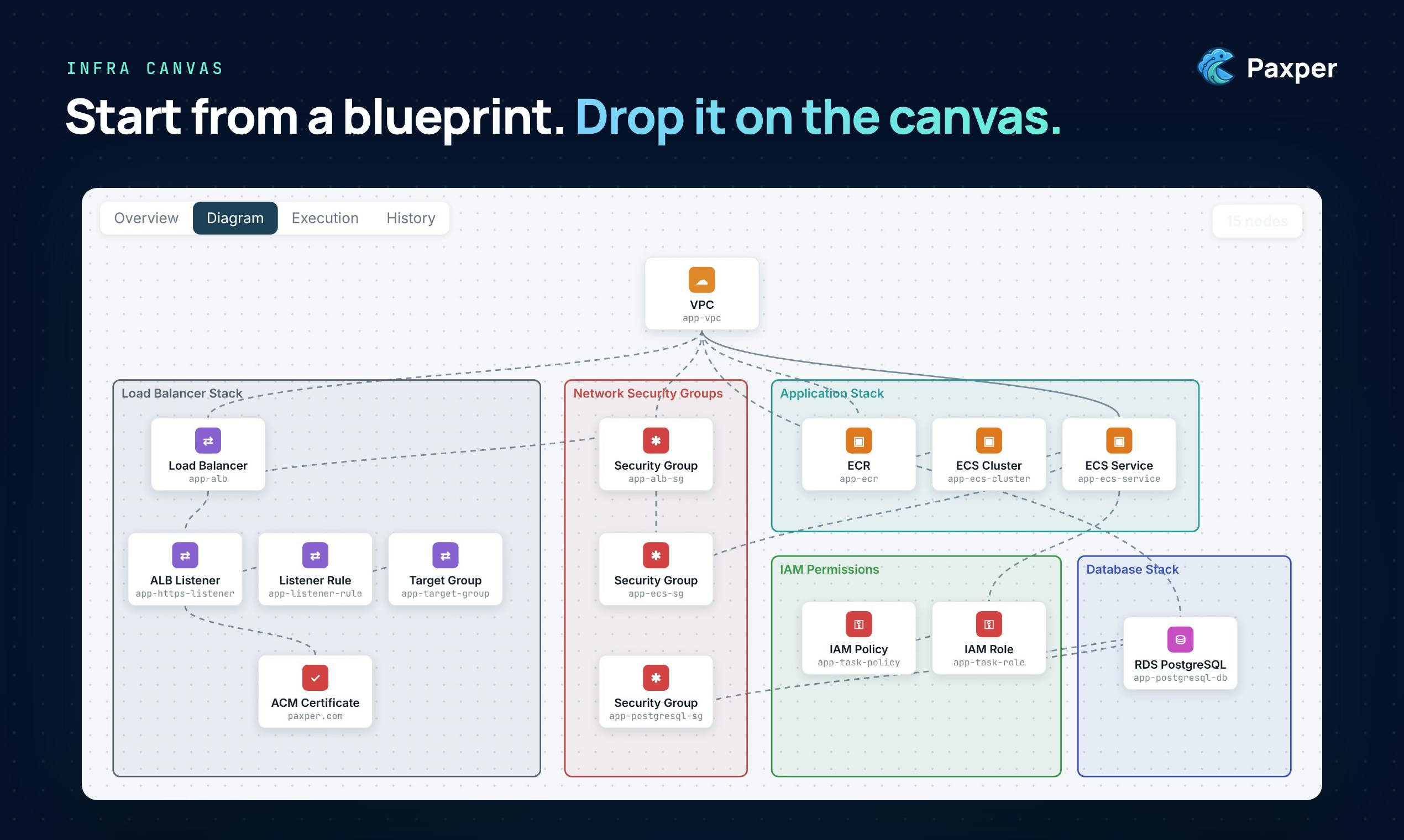
Paxper lets you design cloud resources visually, review every change, and apply it in your own AWS account—lowering the IaC barrier.
Paxper is a cloud infrastructure management tool that debuted on Product Hunt, advocating visual diagrams over plain-text configuration for designing cloud resources. Its workflow is "draw—review—apply": users drag resources onto a canvas and connect them to express dependencies, each change is presented as a diff for team review, and after confirmation it's applied in the user's own AWS account. This BYOC model keeps cloud resources owned by the user, meeting the needs of high-compliance teams. The product is also listed under AI, hinting at capabilities like automatic topology generation and risk flagging. It targets developers new to cloud architecture, teams that need to communicate architecture proposals, and operations roles focused on change auditing—positioned as a design and review layer above Terraform rather than a replacement for the underlying engine.
From Code to Canvas: A New Approach to Cloud Infrastructure Management
Traditional Infrastructure as Code (IaC) tools like Terraform are powerful, but they come with a steep learning curve, and their plain-text configuration makes it hard to visualize dependencies between resources. Paxper debuted on Product Hunt, aiming to solve this pain point with a visual diagram approach.
Its core proposition is clear: design cloud resources on a diagram, review every change, then apply it in your own AWS account. According to its Product Hunt page, the product received 83 upvotes and 12 comments, ranking 11th on the daily leaderboard and listed in three categories: Design Tools, SaaS, and Artificial Intelligence.
This positioning means Paxper isn't trying to replace low-level engines like Terraform, but rather to provide a friendlier design layer and review layer. For engineers who are used to sketching out architectures on a whiteboard, this interaction model lowers the friction from idea to implementation.
Infrastructure as Code (IaC) refers to defining and managing cloud resources declaratively through configuration files (such as Terraform's HCL or AWS CloudFormation templates), making the creation, modification, and destruction of infrastructure version-controlled, reusable, and automatable like software code. Terraform is a representative tool in this space: it connects to different cloud providers' APIs through "providers" and records the mapping between real resources and configuration in a "state file." The core value of IaC lies in eliminating the inconsistency and drift caused by manual console clicking, but the cost is that users must master a specific DSL syntax and toolchain, and plain text struggles to visually present resource topology—precisely the gap that visual tools like Paxper aim to fill.
How Visual IaC Works
Paxper's workflow can be summed up in three steps: "draw—review—apply." Users first drag the required cloud resources onto a canvas—such as compute instances, storage buckets, or network components—and express dependencies between them with connecting lines.
What this process generates is not an untraceable graphic, but a reviewable infrastructure change plan. Each modification is presented as a diff, letting teams see the scope of impact before actually applying it to their AWS account. This follows the same philosophy as code review, except the object of review shifts from configuration files to a visual model.
Worth noting is that Paxper emphasizes applying changes "in your own AWS account." This means it adopts a BYOC (Bring Your Own Cloud) model, where cloud resources always belong to the user rather than being hosted on a third-party platform. For teams with strict compliance requirements, this design principle may be a key foundation of trust.
Change plans and diffs are key steps in the IaC workflow. Take Terraform as an example: terraform plan compares configuration files, state files, and the real cloud environment, outputting a list of resources to be added, modified, or deleted, and only after user confirmation is apply executed. This "preview before execute" mechanism prevents mistakes and is an extension of code review culture into the infrastructure domain. Visual tools transform diffs from line-level text differences into highlighted nodes and add/remove markers on a diagram, enabling non-experts to quickly judge the scope of impact—though the underlying layer still needs to generate an equivalent sequence of API calls.
BYOC (Bring Your Own Cloud) is a SaaS delivery model: the software vendor provides only the control plane (interface, orchestration logic, AI assistance, etc.), while the actual compute, storage, and network resources run in the customer's own cloud account. Compared with models where the vendor hosts all resources, BYOC lets customers retain full control over data, billing, and compliance boundaries, and makes it easier to meet data residency and audit requirements. For Paxper, this means it needs to obtain limited operational permissions through mechanisms such as cross-account roles without touching customers' business data, making the trust model closer to a "tool" than a "platform."
The Potential Behind the AI Category
Product Hunt also lists Paxper under the Artificial Intelligence category, hinting that the product may integrate AI-assisted capabilities. Although the original material doesn't detail specific features, based on the "visual design + change review" scenario, it's not hard to imagine where AI could come in: automatically generating resource dependencies, flagging potential risks during the review phase, or building an initial topology from a natural language description.
If these capabilities come to fruition, Paxper's differentiation would go beyond the interface layer and extend into assistance with architectural decisions. However, public information is currently limited, and these capabilities should be judged based on official disclosures.
Who Paxper Is For
Based on its positioning, Paxper targets three groups. The first is developers new to cloud architecture—they're comfortable with code but may not be familiar with the syntax details of IaC, and a visual interface can significantly lower the barrier to entry. The second is teams that need to communicate architecture proposals frequently—graphical representations are better suited than text configurations for presentation in review meetings. The third is operations roles that value change auditing—the change-by-change review mechanism makes every cloud resource adjustment traceable.
Of course, visual tools have their limits. For highly complex production environments, whether pure graphics can support the demands of large-scale management is a test that such products commonly face. Paxper's choice of "review" as its core selling point is, in a sense, a response to this concern—the value of visualization isn't in replacing code, but in making changes more transparent.
Summary
Paxper targets a long-neglected link in the IaC experience chain: the visual expression of design intent and the reviewability of changes. The community feedback of 83 upvotes shows there's some resonance with this direction, but as an early-stage product, its long-term value depends on how deeply the visual model connects with underlying cloud APIs, and whether its AI capabilities deliver. For teams looking for a lightweight alternative to Terraform, Paxper is worth adding to the watch list.
Related articles

Van Hollen on Holding Trump Accountable: Hearings and Building the Evidentiary Record
Senator Chris Van Hollen on holding the Trump administration accountable: focused hearings to expose corruption and wrongdoing, plus building an evidentiary record now to preserve space for future criminal charges.

Generating SVG and 3D Models with the Codex Plugin: A Hands-On Guide for Developers with Zero Art Background
Codex's SVG & 3D Design plugin lets developers with zero art background generate vector graphics and 3D models via code—editable, Blender-ready, with best practices built in.

Why Recursive Self-Improvement Holds Up: Responding to Six Major Objections One by One
Dwarkesh Patel responds point by point to six major objections about recursive self-improvement and superintelligence by 2030: whether verifiable proxy metrics exist, the human-link threshold for RSI, whether the math explosion can be analogized to AI research, the experimental compute bottleneck, reward hacking and the motivation for power-seeking, and whether METR acceleration rates can be extrapolated.