Persistent Retrieval: A New Paradigm for Improving Conversational Agent Efficiency

The persistent retrieval sub-agent maintains retrieval history across turns and returns evidence, significantly reducing tokens and costs.
The article compares three architectures for conversational agent information retrieval: skill-based main-agent retrieval, non-persistent retrieval sub-agents, and persistent retrieval sub-agents. The persistent approach has the sub-agent maintain retrieval history across turns and return raw evidence rather than a synthesized response to the main agent, which evaluates the evidence and generates the answer. Experiments show that compared with skill-based retrieval, this approach reduces agent-model tokens by 43.3%, lowers API cost by 45.0%, and cuts response time by 9.1%; compared with non-persistent retrieval, it reduces response time by 15.6 seconds but increases token usage by 65.1% and cost by 29.1%. The core insight is decoupling retrieval from generation, letting the sub-agent focus on maintaining retrieval state while the main agent focuses on reasoning and generation, offering new ideas for optimizing conversational agent efficiency.
Title
Persistent Retrieval: A New Paradigm for Improving Conversational Agent Efficiency
Meta Description
A study compares three retrieval designs for conversational agents and proposes a persistent retrieval sub-agent approach that significantly reduces token usage and API costs while improving response speed, offering new ideas for optimizing conversational agent efficiency.
Article Content
When handling information retrieval, conversational agents face a key design choice: should the main agent retrieve directly, or delegate to a specialized sub-agent? Different choices affect how retrieval history is maintained, what context each model call receives, and what information subsequent questions need to re-retrieve. A recent study compared three designs and proposed a persistent retrieval sub-agent approach that finds a new balance between efficiency and cost.
Comparison of Three Retrieval Architectures
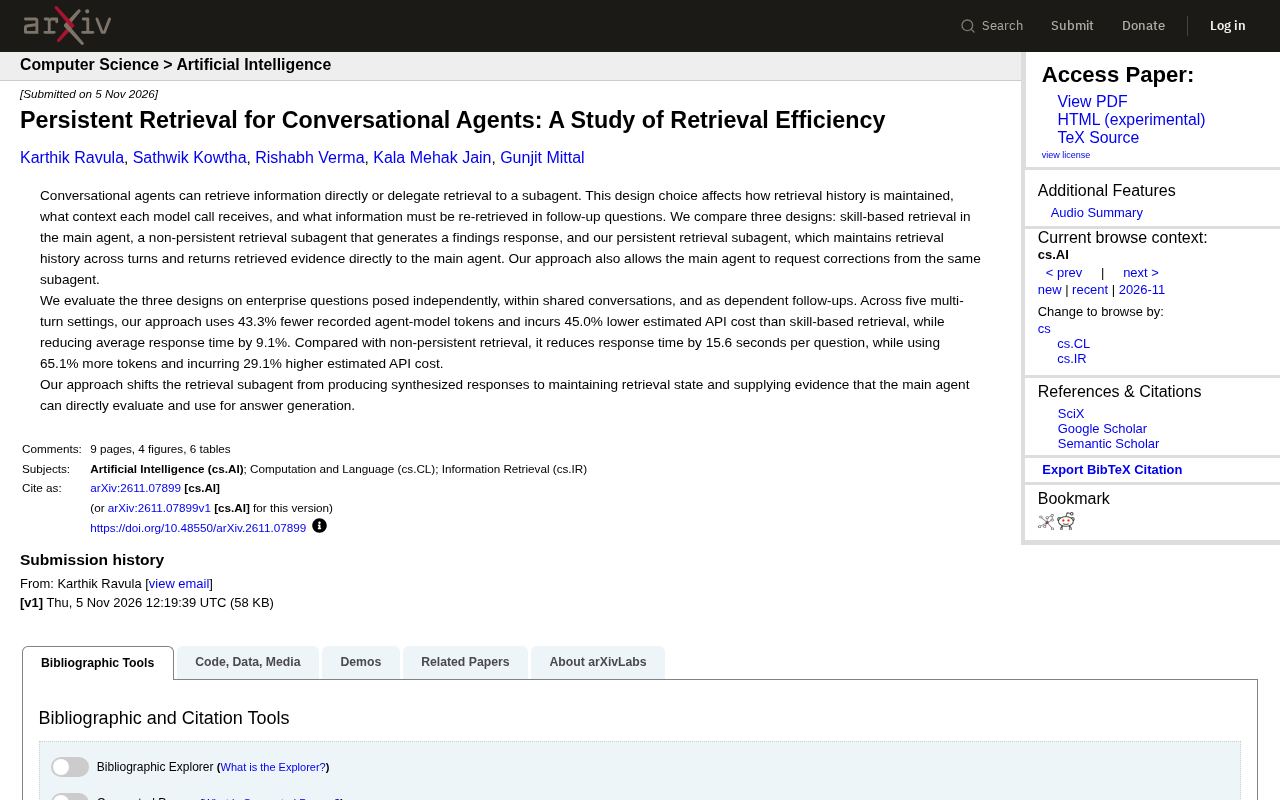
The study compared three designs: skill-based main-agent retrieval, non-persistent retrieval sub-agents (generating discovery responses), and the proposed persistent retrieval sub-agent. The core of the persistent approach is maintaining retrieval history across turns and returning retrieved evidence directly to the main agent, rather than having the sub-agent generate a synthesized response. In addition, the main agent can request corrections from the same sub-agent.
This design shift means the retrieval sub-agent's role changes from "generating answers" to "maintaining retrieval state and providing evidence," while the main agent is responsible for evaluating evidence and generating the final answer. This is akin to separating retrieval from reasoning, letting each component focus on what it does best.
Retrieval Sub-agent refers to a model instance that independently handles information retrieval tasks outside the main agent, typically obtaining external knowledge through tool calls (such as search APIs or database queries). Compared with direct retrieval by the main agent, a sub-agent can encapsulate retrieval logic and isolate context, but it also introduces inter-agent communication overhead. Persistent in this context specifically means the sub-agent retains retrieval history and state across multiple conversation turns rather than reinitializing each turn; a non-persistent sub-agent starts from scratch on every request and discards its state after outputting a "discovery response." The Main Agent is responsible for conversation management, evidence evaluation, and final answer generation, and its division of responsibilities with the sub-agent determines how the context window is occupied and how many model calls are made.
Experimental Setup and Evaluation Dimensions
The study evaluated the three designs on enterprise questions, covering standalone questions, questions within a shared conversation, and context-dependent follow-up questions. These scenarios simulate the complexity of dynamically changing information needs in real conversations. The evaluation spanned five multi-turn settings, ensuring the robustness of the results.
The core metrics of the experiment included: recorded agent-model token usage, estimated API cost, and average response time. These metrics are directly related to operational costs and user experience in actual deployment.
Agent-Model Tokens refers to the total input and output tokens consumed by the main agent and sub-agents when each calls the underlying large model in an agent architecture, rather than counting only the conversation tokens visible to end users. This metric more realistically reflects the inference overhead of multi-agent systems, because each of the sub-agent's tool-call decisions, evidence organization, and response generation incurs model calls. Estimated API Cost is typically calculated as a weighted sum based on each model's input/output price per million tokens; mixing different models (e.g., a strong model for the main agent and a lightweight model for the sub-agent) can significantly affect total cost. Average Response Time covers the end-to-end latency from user question to final answer return, including all time spent on sub-agent retrieval, inter-agent communication, and main-agent generation.
Efficiency Advantages: Fewer Tokens and Lower Cost
Compared with skill-based main-agent retrieval, the persistent retrieval approach used 43.3% fewer recorded agent-model tokens, reduced estimated API cost by 45.0%, and cut average response time by 9.1%. This result highlights the significant advantage of persistent retrieval in reducing operational overhead.
The main source of cost reduction is likely the avoidance of repeated retrieval and context reconstruction. In the skill-based approach, the main agent may need to re-acquire information on each call, whereas the persistent sub-agent retains history and reduces redundant model calls.
Trade-offs Versus Non-Persistent Retrieval
Compared with non-persistent retrieval sub-agents, the persistent approach reduced response time per question by 15.6 seconds but used 65.1% more tokens and had an estimated API cost 29.1% higher. This shows that persistent retrieval has an advantage in response speed, but at the cost of higher resource consumption.
This trade-off reflects different design goals: the non-persistent approach may focus more on the cost of a single interaction, while the persistent approach optimizes the overall efficiency of multi-turn conversations. For scenarios requiring fast responses, the persistent approach may be more suitable; for cost-sensitive applications, careful trade-offs are needed.
Non-persistent retrieval sub-agent typical workflow: in each conversation turn, the main agent passes the current question (possibly with a small amount of context) to the sub-agent, which performs retrieval and generates a comprehensive "discovery response"; the sub-agent instance is then destroyed, and retrieval history is not retained across turns. This approach has lower token overhead for standalone single-turn questions because there is no need to maintain and pass historical state; however, in multi-turn conversations, if follow-up questions depend on prior information, the main agent has to re-initiate retrieval or carry a large amount of context, leading to repeated calls. The persistent approach, by retaining retrieval state, enables incremental retrieval or correction requests for follow-up questions, thus gaining an advantage in response speed, but the storage and passing of historical state itself consumes extra tokens, which explains why the persistent approach actually uses more tokens.
Design Insight: Decoupling Retrieval from Generation
Perhaps the most important insight of this study is the shift in the retrieval sub-agent's role. Traditionally, retrieval sub-agents are expected to generate comprehensive discovery responses, but this can lead to information loss or distortion. The persistent approach lets the sub-agent focus on maintaining retrieval state and providing raw evidence, while the main agent reasons and generates based on that evidence.
This decoupling is similar to how humans handle complex problems: first collect relevant materials, then think based on those materials. It allows the main agent to flexibly evaluate the relevance and reliability of evidence and request corrections when needed, thereby improving the quality of the final answer.
Decoupling Retrieval from Generation draws on the classic architectural idea of separating information retrieval from natural language generation: the retrieval component is responsible for recalling and ranking evidence, and the generation component is responsible for reasoning and expression based on the evidence. In conversational agents, the benefit of this decoupling is that it prevents the sub-agent from prematurely compressing or synthesizing information when generating a "discovery response," thereby reducing information loss and hallucination risk; after the main agent receives the raw evidence, it can flexibly judge relevance in light of the conversation history. The cost is that the main agent must handle a longer evidence context, placing higher demands on context window management and evidence filtering. This line of thinking aligns with the "retrieve first, generate later" pipeline in retrieval-augmented generation (RAG), but extends it to multi-agent, multi-turn conversation scenarios.
Limitations and Future Directions
Although the study demonstrates the advantages of persistent retrieval, it still has limitations. The experiments focused on enterprise questions, and applicability to other domains (such as open-domain dialogue) remains to be verified. In addition, the increase in token usage under the persistent approach may pose challenges for some applications, requiring further optimization of methods for compressing and representing retrieval history.
Future research could explore how to dynamically adjust retrieval strategies, combine the advantages of persistent and non-persistent approaches, and extend persistent retrieval to multimodal scenarios.
Conclusion
By maintaining retrieval history across turns and returning evidence, the persistent retrieval sub-agent shows significant advantages in reducing token usage and API costs while also improving response speed. Although there is a cost trade-off compared with non-persistent approaches, its design philosophy—decoupling retrieval from generation—offers new ideas for optimizing conversational agent efficiency. For teams building enterprise-grade conversational systems, this study is worth in-depth reference.
One-line Summary
The persistent retrieval sub-agent maintains retrieval history across turns and returns evidence, significantly reducing tokens and costs.
Paragraph Summary
The article compares three architectures for conversational agent information retrieval: skill-based main-agent retrieval, non-persistent retrieval sub-agents, and persistent retrieval sub-agents. The persistent approach has the sub-agent maintain retrieval history across turns and return raw evidence rather than a synthesized response to the main agent, which evaluates the evidence and generates the answer. Experiments show that compared with skill-based retrieval, this approach reduces agent-model tokens by 43.3%, lowers API cost by 45.0%, and cuts response time by 9.1%; compared with non-persistent retrieval, it reduces response time by 15.6 seconds but increases token usage by 65.1% and cost by 29.1%. The core insight is decoupling retrieval from generation, letting the sub-agent focus on maintaining retrieval state while the main agent focuses on reasoning and generation, offering new ideas for optimizing conversational agent efficiency.
Related articles

Complete Guide to Building a Local RAG Knowledge Base with DeepSeek R1
A step-by-step guide to building a local private RAG knowledge base with Ollama, DeepSeek R1, Nomic, and Cherry Studio — covering RAG principles, tool selection, setup, and real test results.

Set Up Codex with DeepSeek in 3 Minutes: The Complete CCSage Configuration Guide
Learn how to connect Codex to DeepSeek in three minutes using CCSage: add DeepSeek as a provider, paste your API Key, skip the official login, plus full install steps, verification, and common pitfalls.

Liang Sheng's Open-Source Super Agent Architecture: Keeping AI Online Long-Term to Work Proactively
Liang Sheng open-sources the DeepSick Operating Prototype super agent architecture, using Router/Worker two-layer decoupling, event-driven design, and tiered inference filtering to turn AI from passively waiting for instructions into a long-term online Agent that proactively identifies problems and executes tasks. This article analyzes its engineering design and cost-control approach.