PHP 8.x Emergency Security Update: Two RCE Vulnerabilities Already Exploited

PHP 8.x fixes two RCE vulnerabilities, but the CVE IDs and a PoC video leaked in advance, creating an exposure window of about 24 hours.
The PHP team released a security update on October 21, 2026, covering the entire 8.x series and fixing two vulnerabilities that could lead to remote code execution, with a CVSS score of 9.2. The vulnerabilities were discovered by the Wiz research team with AI-assisted tools, and patches were originally scheduled for October 22. However, the CVE IDs leaked on October 20, and the security firm Calif mistakenly released a PoC video, forcing the PHP project to move up both the pre-announcement and the official release. The vulnerabilities affect mainstream CMS platforms such as Drupal and WordPress, and the actual scale of affected assets should not be underestimated. The incident exposes the fragility of the coordinated disclosure process and suggests that AI-assisted vulnerability discovery is shortening the cycle from a vulnerability's existence to its exploitation.
PHP 8.x Emergency Security Update: Two RCE Vulnerabilities Already Exploited
The PHP team released a security update on October 21, 2026, covering the entire PHP 8.x series and fixing two vulnerabilities that could lead to remote code execution. Due to a leak in the coordinated disclosure process, exploit code was already circulating online before the patches were released. This incident is not just a routine security response—it also exposes the fragility of open-source security disclosure mechanisms in the face of rapid information spread.
Vulnerability Details and Disclosure Timeline
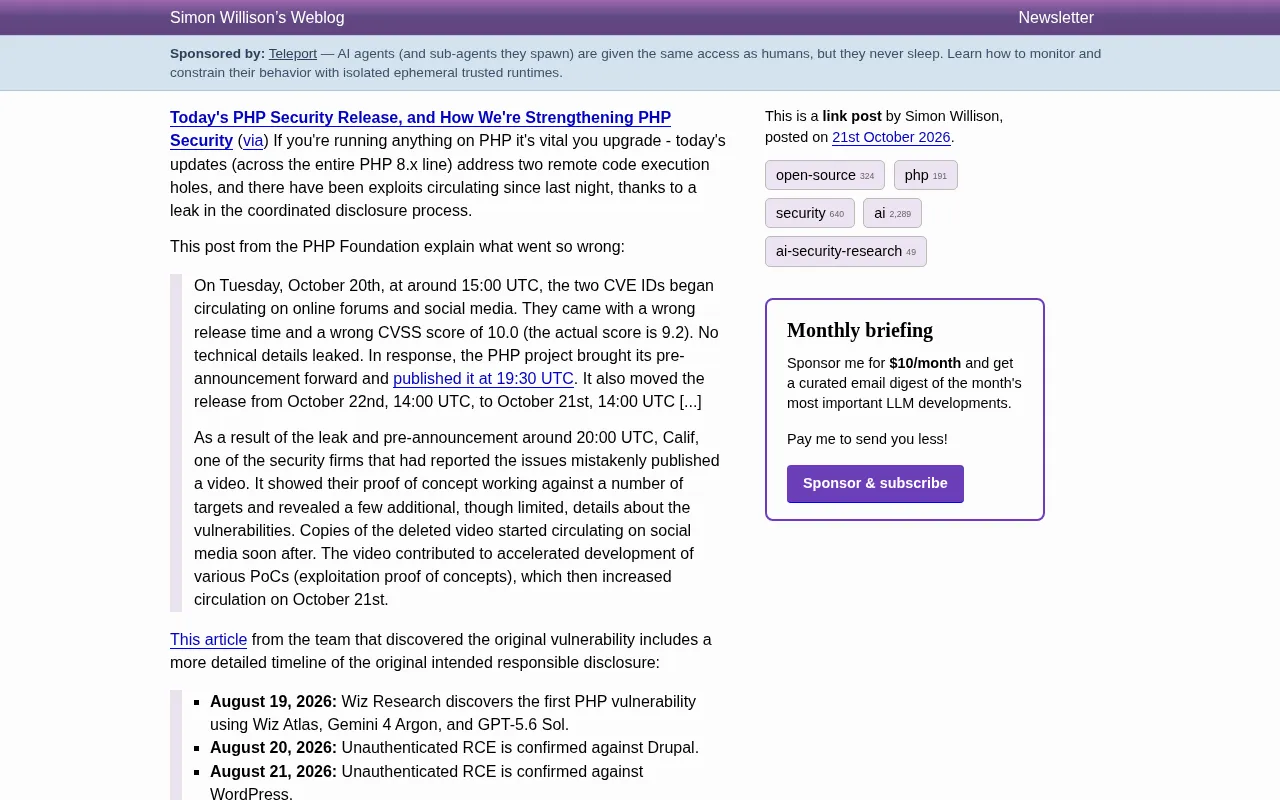
These two vulnerabilities were discovered by the Wiz research team, initially located with the help of AI-assisted tools (Wiz Atlas, Gemini 4 Argon, GPT-5.6 Sol). According to the timeline disclosed on Wiz's official blog: the first vulnerability was discovered on August 19, unauthenticated RCE exploitability on Drupal and WordPress was confirmed on August 20 and 21 respectively, and the vulnerabilities were reported to the PHP security team on August 24. The PHP project confirmed the report on September 21 and began developing fixes, with patches originally scheduled for release on October 22.
However, around 15:00 UTC on October 20, both CVE IDs began circulating on forums and social media, accompanied by an incorrect release time and an incorrect CVSS score of 10.0 (the actual score is 9.2). Although no technical details leaked, the PHP project decided to move the pre-announcement up to 19:30 UTC and to move the official release from October 22 to October 21.
CVSS Score and CVE IDs
CVSS (Common Vulnerability Scoring System) is currently the most widely used standard for quantifying vulnerability severity in the industry, with scores ranging from 0.0 to 10.0. It comprehensively considers the attack vector, attack complexity, privileges required, user interaction, and impact on confidentiality, integrity, and availability. A score of 9.2 falls into the "critical" level, typically meaning it can be exploited remotely without authentication and has a broad impact. The difference between the mentioned scores of 10.0 and 9.2 may seem minor, but in automated vulnerability management systems it often triggers different remediation priorities—an incorrect score may cause enterprises to misjudge the risk or over-respond.
CVE (Common Vulnerabilities and Exposures) IDs are coordinated and assigned by MITRE and serve as the unique public identifier for a vulnerability. The ID itself contains no technical details, but its appearance is often seen as a signal that "the vulnerability is about to be made public." Both attackers and security researchers monitor CVE assignment channels, so an early leak of the IDs is enough to start a PoC development race—which is precisely the direct cause of the exposure window in this incident.
Chain Reactions Triggered by the Leak
According to the PHP Foundation blog, at around 20:00 UTC after the pre-announcement was published, the security firm Calif mistakenly made a proof-of-concept video public. The video demonstrated the exploitation process against multiple targets and revealed a small amount of additional vulnerability details. Although the video was quickly deleted, copies had already spread on social media. This video accelerated the development of various PoCs, further expanding the spread of exploit code on October 21.
This means that between the leak of the CVE IDs and the release of the patches, there was a window of about 24 hours. For sites running PHP 8.x, the exposure risk during this period is very real.
Coordinated Disclosure and PoC Development
Coordinated disclosure is a convention between open-source projects and security researchers: researchers report vulnerabilities privately, vendors develop patches within an agreed timeframe, and both parties disclose details simultaneously to minimize user exposure time. The effectiveness of this mechanism depends heavily on "information not spreading before the patch is released."
PoC (proof-of-concept) code is a minimal program that proves a vulnerability can be exploited. Once a PoC is public, attackers can quickly weaponize it, or even use it directly for scanning and intrusion. In this incident, although the video mistakenly released by Calif revealed only a few details, the exploitation process and target types shown in the video were enough for experienced security personnel to reverse-engineer the attack path, significantly shortening the time from "knowing a vulnerability exists" to "writing usable exploit code." This also explains why the PHP project had to further advance the official release time after the video leak.
Real-World Impact on the PHP Ecosystem
The vulnerabilities affect mainstream CMS platforms such as Drupal and WordPress, meaning a large number of small and medium-sized websites may be affected. Considering PHP's long-standing share of the web hosting market and WordPress's share of websites worldwide, the actual scale of affected assets should not be underestimated.
In its announcement, the PHP Foundation said it is "strengthening PHP security," but the specific measures have not yet been detailed. From the publicly available information, the lessons of this incident center on the management of the coordinated disclosure process: when CVE IDs and scores leak before the official release, even without technical details, it is enough to draw attackers' attention and trigger a PoC development race.
Upgrade Recommendations and Follow-Up
For operations and development personnel, the top priority right now is to immediately upgrade to the latest patched version of PHP 8.x. Since exploit code is already circulating, the cost of delaying the upgrade may be high. It is also recommended to check the logs of Drupal and WordPress instances for traces of anomalous requests.
From a longer-term perspective, this incident provides a sample worth tracking: AI-assisted vulnerability discovery is shortening the cycle from a vulnerability's existence to its exploitation, and whether open-source projects' disclosure processes can keep up with this pace remains an open question. What exactly the "strengthened security" measures promised by the PHP Foundation include is worth continued attention.
One-line Summary
PHP 8.x fixes two RCE vulnerabilities, but the CVE IDs and a PoC video leaked in advance, creating an exposure window of about 24 hours.
Paragraph Summary
The PHP team released a security update on October 21, 2026, covering the entire 8.x series and fixing two vulnerabilities that could lead to remote code execution, with a CVSS score of 9.2. The vulnerabilities were discovered by the Wiz research team with the help of AI-assisted tools, and patches were originally scheduled for release on October 22. However, the CVE IDs leaked on October 20, and the security firm Calif mistakenly released a PoC video, forcing the PHP project to move up both the pre-announcement and the official release. The vulnerabilities affect mainstream CMS platforms such as Drupal and WordPress, and the actual scale of affected assets should not be underestimated. The incident exposes the fragility of the coordinated disclosure process in the face of rapid information spread and suggests that AI-assisted vulnerability discovery is shortening the cycle from a vulnerability's existence to its exploitation.
Related articles

Google Releases Gemini 4 Carbon: Its Strongest Model Yet, Debuting with a Cybersecurity Focus
Google releases Gemini 4 Carbon, calling it its strongest model, with a cybersecurity focus. It tops the third-party composite ranking at 59 points but leads by only one or two. This article analyzes its security test results, staged rollout, token pricing, and the divergence between self-reported and third-party tests on hallucinations.

LangChain Adds SchemagateRetriever: On-Demand Table Retrieval Cuts Text-to-SQL Prompts by 92.9%
LangChain docs add SchemagateRetriever: retrieves only the tables needed for text-to-SQL with permission filtering, cutting median prompt size by 92.9% on Spider 2.0 large schemas via offline BM25 selection with no model calls.

Multi-Step AI Agent Guardrail in Practice: Fact-Change Detection Drives False-Alarm Rate to 0%
Developer shares first version of a multi-step AI Agent guardrail: re-verifying dependency facts before irreversible actions cut false alarms from 50% to 17% across 23 scenarios, then to 0% via conservative normalization without lowering catch rate. Runs on local qwen2.5-7b.