Pi Agent Tutorial: How Minimalist Design Reshapes AI Agent Development

With a minimalist core and highly extensible path, Pi Agent returns control to developers.
Pi Agent's GitHub Stars continue to accelerate, reflecting developer recognition of the minimalist Agent path. The article notes that mature tools like Codex and Claude Code keep stacking features, increasing context burden and slowing requests; Pi Agent goes the opposite way, keeping only basic capabilities such as calling models, reading and writing files, and executing commands, and moving complex logic to plugins and extension mechanisms, similar to the Harness concept. Minimalist does not mean weak; it makes the Agent a buildable platform. Compared with mature tools, Pi Agent emphasizes developer autonomy and custom extensions, suitable for teams needing deep customization or embedding into their own workflows. The article also introduces the structure of the accompanying Bilibili tutorial and reminds learners to focus on the technical main line, as Star popularity does not equal production maturity.
Why Pi Agent Is Worth Watching
Recently, a project called Pi Agent has been gaining momentum on Bilibili and GitHub. According to the GitHub Star history chart shown by a Bilibili creator in a tutorial, Pi Agent's Star growth is not a fleeting viral spike but shows a sustained acceleration. From slow early accumulation, to a clear rise to the twenty-thousand range at one stage, and then approaching seventy thousand later, this curve reflects growing recognition among developers for the "minimalist Agent" approach.
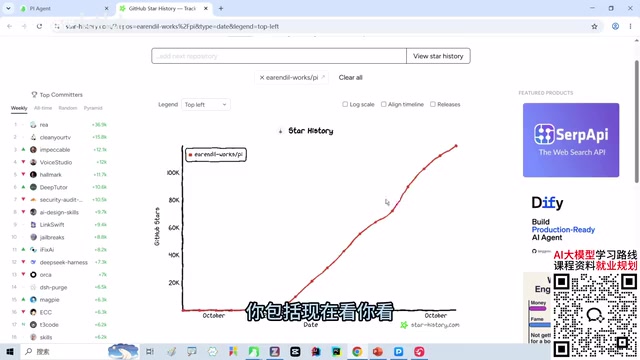
This raises a key question: with mature AI programming tools like Codex and Claude Code already occupying mindshare, why does Pi Agent still attract such high attention? The answer is not more features, but that it chooses a completely different design path—a minimalist core, high extensibility, and developer autonomy.
Minimalist Core: A Design Philosophy That Goes Against the Grain
The Context Burden of Feature Bloat
Competition among AI programming tools is fierce today, with products like Codex, Claude Code, and Cursor continuously stacking features. Tool calls, MCP, Skill, main Agent and sub-Agent, task planning, permission management, sandboxing... these capabilities are certainly useful, but the more integrated they are, the larger the context that must be passed with each interaction, and the slower the request speed. For many developers, what they really need is just a lightweight Agent that can call large models, read files, modify code, and execute commands—not a bloated all-in-one suite.
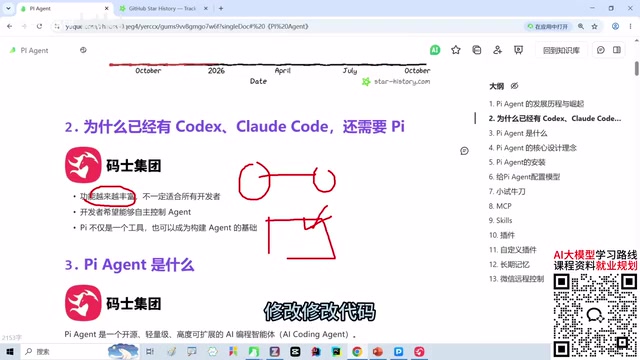
Pi Agent's approach is precisely to provide a sufficiently simple, reliable, and stable core, solidifying the basic capabilities that everyone commonly needs, while extending other capabilities on demand. This approach is in line with the Harness philosophy: keep the core lean and move complex logic out to plugins and extension mechanisms.
The Harness concept originates from the testing and evaluation field. In the context of AI Agents, it refers to a "driving framework": it does not implement specific capabilities but is responsible for connecting large models, tools, environments, and the execution loop, keeping the core stable and replaceable. A typical Harness includes a minimal closed loop such as request construction, tool scheduling, result return, and error handling, while delegating complex logic such as memory, planning, and multi-Agent collaboration to external plugins or extension layers. The benefit of this layering is a small core codebase, predictable behavior, and low upgrade costs; the cost is that extension capabilities depend on developers assembling them themselves. Pi Agent productizes this approach, so its core is more like an "Agent runtime" than an out-of-the-box all-purpose tool.
Minimalist Does Not Mean Weak
A common misunderstanding needs clarification: minimalist does not mean weak. Pi Agent moves complex things from the core to external extensible capabilities rather than simply cutting features. Developers can handle events and workflows through plugins, custom tools, and custom commands, without being limited by the product's preset capability boundaries.
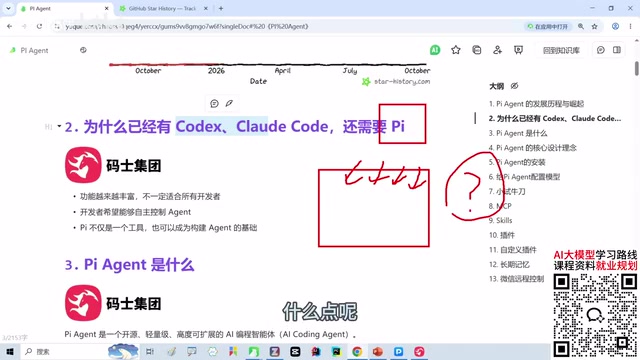
This design makes Pi Agent not just a tool but also a foundation platform for building Agents. You first have a stable base, then add what you need, rather than being forced to accept a fixed set of interaction rules.
MCP (Model Context Protocol) is a protocol that allows large model applications to access external tools and data sources in a standardized way. It decouples "tool providers" from "Agent hosts": tools only need to implement the interfaces specified by the protocol to be called by any Agent that supports MCP, without separate adaptation for each product. In feature-bloated tools, MCP is often deeply integrated into the main flow, bringing extra context and scheduling overhead; under the minimalist core approach, MCP is better suited as an optional extension layer loaded on demand. Understanding MCP helps assess an Agent's extension boundaries: whether the core is only responsible for protocol forwarding and whether complex logic is externalized.
Developer Autonomy: The Key Difference from Mature Tools
When using mature AI programming tools like Codex, developers often need to follow their established rules and extension methods, or the experience suffers. Pi Agent emphasizes developers' autonomous control over the Agent—whether they can extend plugins themselves, customize tools, or even write commands to handle the entire workflow without relying on product presets.
According to the Bilibili creator's analysis, this autonomy is the core differentiator that attracts developers to Pi Agent. It does not seek to surpass competitors on feature lists but returns control to developers. For teams that need deep customization of Agent behavior or want to embed Agents into their own workflows, this openness is more valuable than the number of features.
Skill and sub-Agent are two common extension paradigms in current AI programming tools. Skill usually refers to encapsulated prompts, tool combinations, or operational flows that are registered declaratively and called on demand by the main Agent; a sub-Agent delegates a specific task to an independently running Agent instance, which returns the result to the main flow after completion. Both can reduce the burden on the main context, but their implementation complexity differs: Skill is lighter and easier to audit, while sub-Agent is more flexible and better suited to long-task decomposition. Pi Agent places such mechanisms outside the core, meaning developers can choose whether to introduce them and how to orchestrate them, rather than being forced to accept the product's preset scheduling strategy.
What the Practical Tutorial Covers
The Bilibili tutorial is positioned as a complete set of content from installation and configuration to Agent development code practice, aimed at zero-foundation learners. The course lasts four days, with the core idea of starting with tool onboarding, then going deep into underlying principles, and finally extending to job interviews. Day two explains LangChain-related content based on Deep Agent. Day three turns to employment, outlining large-model job requirements and interview focus points to help fresh graduates or Java and front-end career changers clarify their learning path. Day four provides actionable solutions for practical pain points such as resume packaging, project experience, and resumes getting no response.
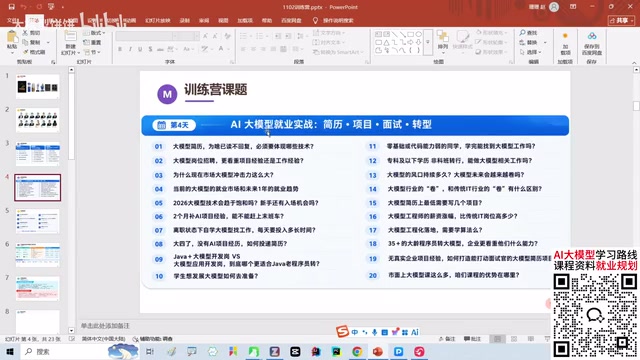
The tutorial also comes with a resource pack, including project summaries and project guides, LangGraph-related interview crash notes, an interview bible covering large models and big data, and zero-foundation Python introductions and accelerated courses. For learners aiming at large-model application directions, Python is a prerequisite language, while Java fundamentals are also useful for deeper study later.
Who It Suits, and What to Watch Out For
Pi Agent's minimalist path suits developers who want to get started with Agent development quickly without being tied to heavy frameworks. Zero-foundation learners can use the tutorial's installation, configuration, and code practice sections to build intuitive understanding, then fill in prerequisite knowledge such as Python through the resource pack. More experienced developers should pay more attention to its extension mechanisms and autonomous control capabilities, and think about how to embed Pi Agent into existing workflows.
It is worth noting that the tutorial contains a fair amount of bootcamp福利 and job-oriented promotional content; learners should focus on the technical main line and avoid being led astray by marketing pacing. In addition, the Star growth chart reflects community attention, which does not directly equate to production maturity; actual selection still requires evaluating against project needs.
Conclusion
Pi Agent's rise shows that, with AI Agent tools becoming increasingly homogenized, the path of a minimalist core plus high extensibility still has strong vitality. It strips complexity from the core and returns control to developers—a design philosophy worth the attention of every Agent developer. With systematic practical tutorials, zero-foundation entry is not out of reach, but what truly creates a gap is still the depth of understanding of extension mechanisms and workflow design.
One-line Summary
With a minimalist core and highly extensible path, Pi Agent returns control to developers.
Paragraph Summary
Pi Agent's GitHub Stars continue to accelerate, reflecting developer recognition of the minimalist Agent path. The article points out that mature tools like Codex and Claude Code keep stacking features, increasing context burden and slowing requests; Pi Agent goes the opposite way, keeping only basic capabilities such as calling models, reading and writing files, and executing commands, and moving complex logic to plugins and extension mechanisms, similar to the Harness concept. Minimalist does not mean weak; it makes the Agent a buildable platform. Compared with mature tools, Pi Agent emphasizes developer autonomy and custom extensions, suitable for teams needing deep customization or embedding into their own workflows. The article also introduces the structure of the accompanying Bilibili tutorial and reminds learners to focus on the technical main line, as Star popularity does not equal production maturity.
Related articles

Non-Coding Dad Builds 3D Earth Toy with Claude Code, Unexpectedly Goes Viral in Classrooms
A non-coding father used Claude Code to build My Earth Toy, a 3D interactive Earth with 830+ landmarks, 470+ animals, and 180+ vehicles—now used in classrooms worldwide. Discover how AI coding lowers the barrier to creation.

Meta, Google, and TikTok Sue California Attorney General: The Battle Over Youth Social Media Law
Meta, Google, and TikTok jointly sue the California Attorney General to block a state law restricting social media use by minors under 16. This article analyzes the lawsuit's background, the law's core provisions, and its potential impact on tech industry regulation.

T-Mobile Parent Company CEO on Musk's Telecom Ambitions: Welcome, But You'll Need $200 Billion
Deutsche Telekom CEO Tim Höettges responds to Musk's SpaceX Starlink Mobile plan, saying "welcome to the party" but questioning feasibility—estimating at least $200 billion needed to become a major U.S. carrier.