PSI Uses Unreleased AI Model to Crack a Two-Decade Quantum Computing Problem

PSI uses an unreleased Anthropic model to solve a 20-year quantum computing problem and explore commercializing AI science.
PSI used an unreleased Anthropic model to answer a fundamental quantum computing question that had been open for nearly two decades, and is trying to turn this capability into commercial services. The article notes that access to unreleased models is becoming a core moat in the AI scientific discovery race—whoever uses stronger models first may break through first. PSI's positioning is full of potential, with opportunities in high-value R&D markets like pharmaceuticals, materials, and energy. However, its business model, pricing, and customer structure remain undisclosed, and the result has not been peer-reviewed. IP ownership and customer trust in AI discovery remain open questions. AI for Science is moving from academic experimentation to corporate operation, but whether a single breakthrough can become a repeatable methodology—and the reliability of scientific conclusions—are key to whether the commercial story holds.
AI's role in scientific research is evolving from "assistive tool" to "discovery engine." Recently, a company called PSI used an unreleased model from Anthropic to answer a fundamental question in quantum computing that had remained unresolved for nearly two decades, and is attempting to turn this capability into a business.
From Scientific Challenge to Commercial Proposition
What makes PSI's attempt noteworthy is not just that it solved a specific problem, but that it demonstrates a new research paradigm: plugging frontier large models directly into the scientific discovery process and building a business on top of that. According to the original report, PSI used a model from Anthropic that has not yet been publicly released to provide an answer to a fundamental question in quantum computing that scientists have pursued for nearly twenty years.
There are two key pieces of information here. First, the model is "unreleased," suggesting that PSI may have obtained special access or a deep collaboration channel—which in itself constitutes a competitive moat. Second, the problem is "fundamental," meaning it is not an engineering optimization but a question that touches the very foundations of the field. If reproducible, results at this level would significantly reshape how research funding and talent are allocated.
A "fundamental problem" in quantum computing typically refers to theoretical questions concerning the nature of computational models, complexity bounds, or physical realizability—for example, lower-bound proofs for specific quantum algorithms, rigorous derivations of quantum error-correction thresholds, or decidability of whether a certain class of quantum systems can be simulated. Such problems differ from engineering optimization: their answers often require new mathematical frameworks or reformulations of physical principles, and verification cycles are long—theoretical results must undergo rigorous peer review, while experiment-related conclusions require years of repeated validation. Therefore, even if AI produces a seemingly reasonable answer, its scientific validity still depends on subsequent formal proof and independent reproduction.
Why the "Unreleased Model" Is the Core Variable
In AI-driven scientific discovery, the capability ceiling of the model directly determines the boundary of explorable problems. Publicly available models are typically subjected to safety alignment and general-purpose tuning, and may not be optimal for highly specialized scientific reasoning tasks. PSI's ability to access an unreleased model implies two possibilities: either it has a deep technical partnership with Anthropic, or its business model itself includes priority access to frontier models.
Either way, this points to a trend—AI competition in scientific discovery may no longer be just about algorithms and compute, but about "model access tiers." Whoever can use more capable models earlier may be first to cross the finish line on key scientific problems.
The "unreleased" status of a large model typically means it is still in internal testing or limited preview, possibly featuring deeper reasoning, longer context windows, or specialized training on scientific literature, but not yet fully safety-aligned or general-purpose tuned. In scientific research scenarios, such models may exhibit hypothesis-generation and multi-step reasoning capabilities that public versions lack, but they also carry higher unpredictability and hallucination risk. Therefore, obtaining access to an unreleased model is not only a resource moat but also means the user bears additional verification responsibility—the stronger the model, the higher the requirement for independent validation of its outputs.
The Promise and Skepticism of Commercializing Scientific Discovery
PSI's attempt to turn AI-driven scientific discovery into a business is full of imaginative potential. The traditional research services market is known for being labor-intensive and slow, and with AI intervention, the time cost of the exploration phase could theoretically be compressed. If PSI can prove its approach works beyond quantum computing, it would face R&D demand in multiple high-value fields such as pharmaceuticals, materials, and energy.
But skepticism exists as well. The original material did not disclose PSI's business model details, pricing, or customer structure, nor whether the quantum computing result has undergone peer review. The commercial loop of scientific discovery is far more complex than a technology demo: the verifiability of results, the ownership of intellectual property, and customer trust in "AI discovery" are all open questions.
Peer review is the core mechanism by which scientific results gain community acceptance, typically including initial editorial screening, review by multiple anonymous experts, and reproducibility checks. For AI-assisted discoveries, reviewers also focus on whether the reasoning process is transparent, whether key steps can be independently replayed, and whether model outputs have been overinterpreted. Intellectual property ownership is even more complex: if a discovery is generated by a proprietary model, rights may involve multiple parties including the model provider, the user, and funders, and existing patent and copyright frameworks have no unified provisions for "AI-generated scientific hypotheses." These institutional factors often determine whether commercialization can land more than technology demos do.
Impact on the AI Research Track
The signal this sends is clear: AI for Science is moving from academic experimentation to corporate operation. PSI's case shows that the intersection of frontier models and specialized scientific problems may spawn new service forms. For those watching this track, what's worth observing next is—whether PSI can turn a single breakthrough into a repeatable methodology, and whether special access to Anthropic's unreleased model will become an industry norm.
In hard science fields like quantum computing, the answer to a fundamental question often requires years of experimental verification. AI-generated answers must go through the same process. Whether PSI's commercial story holds will ultimately depend not on how new the model is, but on how reliable the scientific conclusions it produces are.
Related articles

Microsoft Open-Sources Token Economizer: Saving 18%-31% on AI Coding Agent Costs
Microsoft's free open-source plugin Token Economizer cuts AI coding agent costs through micro skills, tool pruning, and failure loop intervention. Tests show 18.4% to about 31% average savings with Claude Code, Codex, and more.
Running GLM-5.3 on Two DGX Stations: A vLLM Tensor Parallelism Hands-On
NVIDIA engineers show how to run the 753B-parameter GLM-5.3 locally on two DGX Stations using vLLM tensor parallelism, covering RDMA setup, launch args, NCCL checks, and performance baselines.
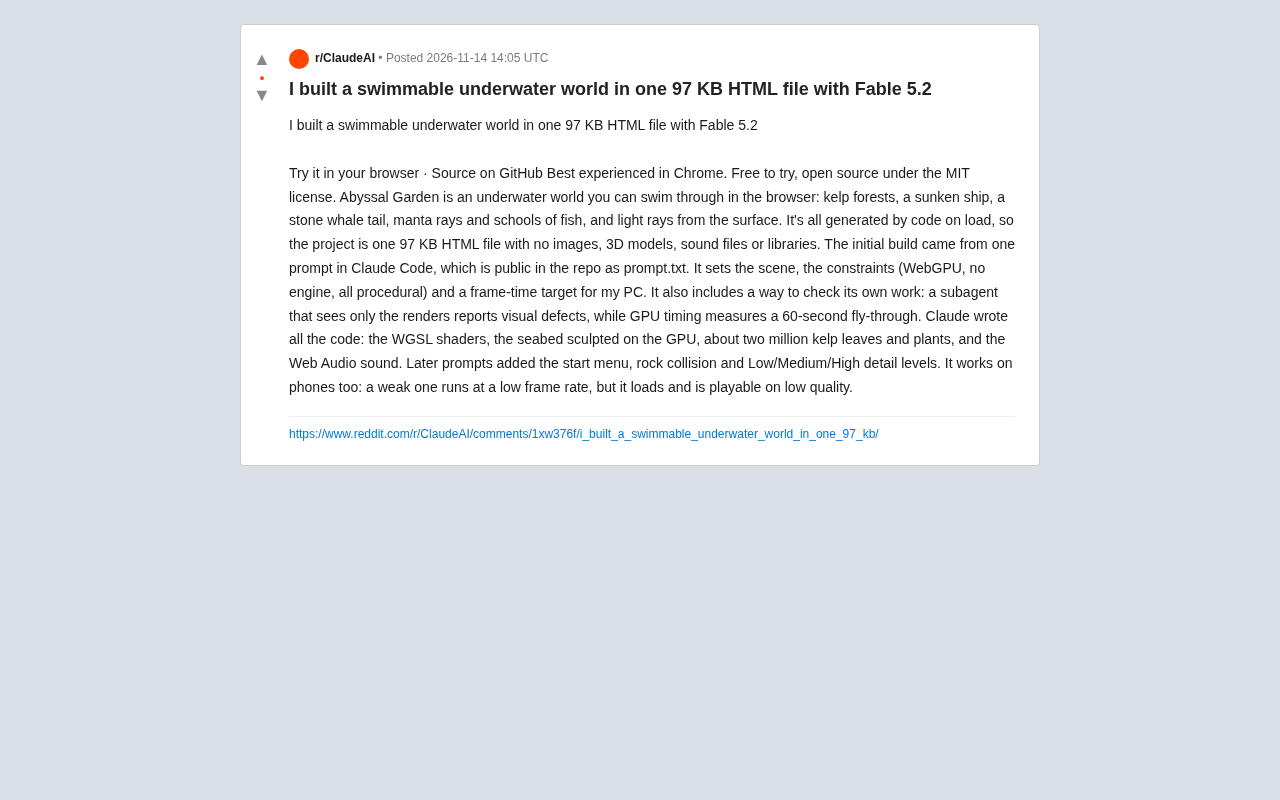
97KB Single-File HTML Underwater World: A WebGPU Experiment in AI Programming
A developer used a single prompt in Claude Code to generate a 97 KB single-file HTML underwater world, fully procedurally generated with WebGPU—kelp forests, a shipwreck, and fish, no images or model libraries, MIT-licensed, playable on mobile.