Python 3.15 Arrives as a Vercel Sandbox Hosted Image

Vercel Sandbox launches Python 3.15 hosted image; default image lags behind.
Python 3.15 is now available as a Vercel hosted image, selectable in Vercel Sandbox via `vercel/sandbox/python:3.15`. Configuration is identical across the JavaScript SDK, Python SDK, and CLI `--image` parameter—only the image changes, so migration is minimal. Meanwhile, the universal image `vercel/sandbox/universal:latest` still runs Python 3.14, with a planned switch on December 16, 2026. This "dedicated first, universal later" approach lets users opt in proactively while protecting unadapted projects from passive upgrades. Hosted images remove runtime maintenance and lower the barrier to validating new-version compatibility in isolation.
Python 3.15 is now officially available as a Vercel hosted image, letting developers select this latest version directly in Vercel Sandbox. For projects that depend on new language features, this means they can validate code behavior in a cloud sandbox without building their own runtime environment.
How to Enable a Python 3.15 Sandbox
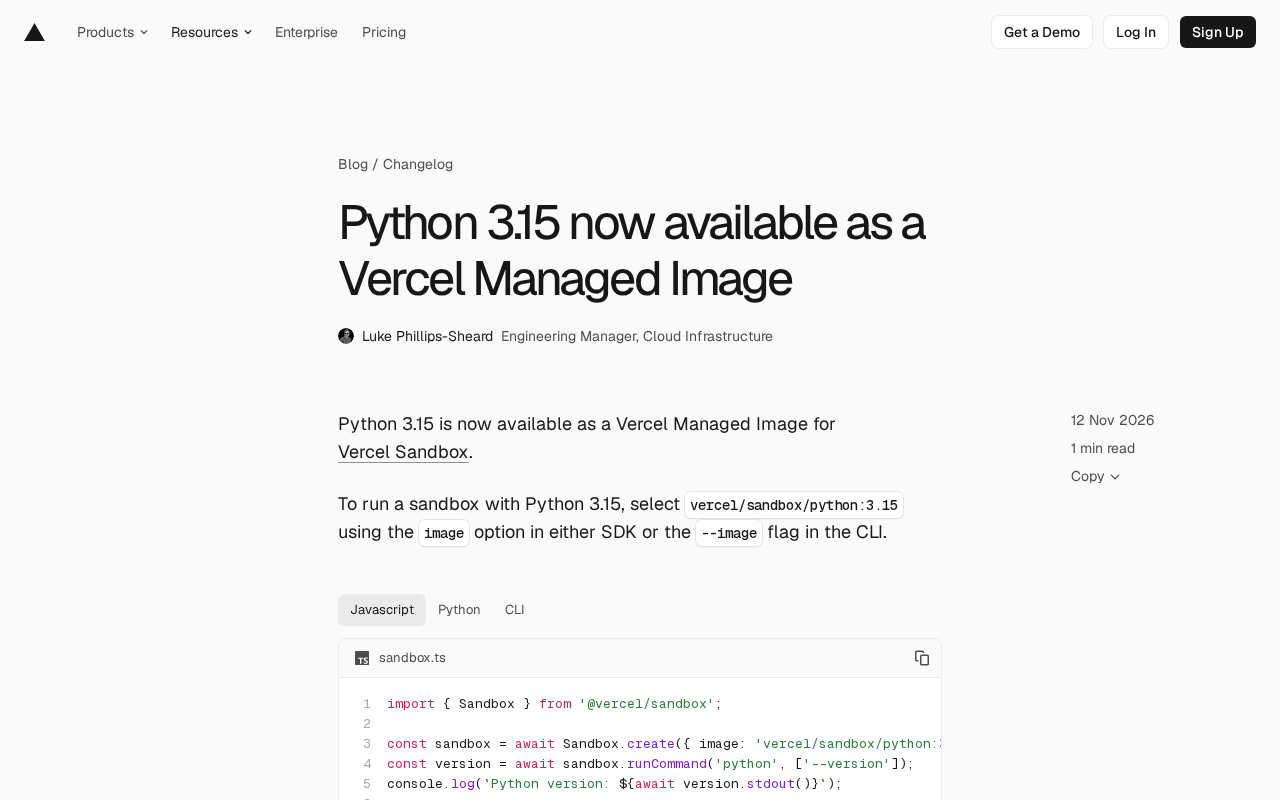
Vercel provides a unified image selection mechanism for Sandbox. To use Python 3.15, simply specify the image as vercel/sandbox/python:3.15. This configuration is consistent across all three entry points: the JavaScript SDK, the Python SDK, and the CLI's --image parameter.
Taking the JavaScript SDK as an example, pass in the image field when creating a sandbox, then run a command to print the version number to complete verification:
import { Sandbox } from '@vercel/sandbox';

const sandbox = await Sandbox.create({
  image: 'vercel/sandbox/python:3.15'
});
const version = await sandbox.runCommand('python', ['--version']);
console.log(`Python version: ${await version.stdout()}`);
This example also demonstrates the typical usage of Sandbox: create an instance, execute a command, and read the standard output. Switching images only changes one parameter—the rest of the call pattern stays the same, so migration cost is minimal.
What is Vercel Sandbox: Vercel Sandbox is a cloud-based isolated execution environment provided by Vercel, essentially an on-demand, disposable temporary compute instance. Developers can run arbitrary commands, install dependencies, and execute tests within it without worrying about the underlying host machine, container orchestration, or network configuration. It is commonly used to run untrusted code, perform integration validation in CI, or temporarily debug issues that must be reproduced in a clean environment. Sandboxes are created and destroyed programmatically via the SDK or CLI, and each instance starts from a specified image, so environment consistency and reproducibility are guaranteed by the image itself. Understanding this makes it clear why "switching images" equals "switching runtime versions"—the sandbox's OS and language interpreter version are entirely determined by the image tag, unlike local development where you depend on the Python already installed on your system.
Default Image Still on Python 3.14
It's worth noting that the universal image vercel/sandbox/universal:latest still ships with Python 3.14 and has not immediately been updated to 3.15. The official switchover date is December 16, 2026.
This arrangement reflects a cautious versioning strategy: dedicated images are made available first, allowing users with specific needs to opt in proactively; the universal image maintains a longer stability period to avoid compatibility issues from passive upgrades for projects that haven't adapted. For production environments, this "opt-in first, default later" cadence is more controllable than a blanket switch.
The difference between dedicated and universal images: Hosted images generally fall into two categories. Dedicated images (such as vercel/sandbox/python:3.15) are built for a single language runtime only—smaller in size, faster to start, and with an explicit version, making them suitable for scenarios with precise interpreter version requirements. Universal images (such as vercel/sandbox/universal:latest) come pre-installed with multiple languages and common toolchains, aiming for out-of-the-box usability but with a more conservative upgrade cadence, since a single version change affects all users relying on the default image. Floating tags like latest mean "follow the platform default version," not "newest language version," so they may remain on a stable version for an extended period. If your project is version-sensitive, explicitly pinning the image tag (rather than relying on latest) is the safer approach, avoiding unexpected changes when the platform switches its default version.
Impact on Development Workflows
The value of hosted images lies in offloading runtime maintenance to the platform. Teams no longer need to write Dockerfiles for sandbox environments, handle system dependencies, or sync patches—simply referencing an image tag yields a consistent execution environment.
From a version upgrade perspective, these hosted images also lower the barrier to trying new releases. Developers can test new interpreter behavior in an isolated sandbox without affecting their main environment, and only proceed to formal workflows after confirming third-party library compatibility. For Python 3.15 specifically, early validation typically focuses on dependency wheel availability and syntax-level changes.
For more image listings and usage details, refer to the Vercel Sandbox image documentation.
One-line Summary
Vercel Sandbox launches a Python 3.15 hosted image, with the default image not yet following suit.
Paragraph Summary
Python 3.15 is now available as a Vercel hosted image, allowing developers to select this version directly in Vercel Sandbox via vercel/sandbox/python:3.15. Configuration is consistent across the JavaScript SDK, Python SDK, and CLI's --image parameter—only the image parameter needs to change, with the rest of the call pattern unchanged, so migration cost is minimal. Meanwhile, the universal image vercel/sandbox/universal:latest still ships with Python 3.14, with a planned switch to 3.15 on December 16, 2026. This "dedicated image first, universal image later" strategy lets users with specific needs opt in proactively while avoiding passive upgrades for projects that haven't adapted. Hosted images eliminate the maintenance work of building your own runtime and lower the barrier to validating new version compatibility in isolated environments.
Related articles

Why Microsoft CEO Nadella Still Backs Nvidia After Jensen Huang's Departure
Microsoft CEO Nadella publicly expresses confidence in Nvidia interim CEO Colette Kress. This article analyzes Nvidia's power transition after Jensen Huang's departure, Microsoft's compute dependency, and the trust logic of the AI supply chain.

Nadella: Critical Infrastructure Is 'Unpatchable' as AI Cybersecurity Arms Race Escalates
Microsoft CEO Nadella addresses AI cyberattack fears, saying much critical infrastructure is unpatchable, downplaying the Outlook outage, and analyzing AI's dual role in cybersecurity.

Musk Backs Jensen Huang: Firing Him Is Like Cutting Jordan
Musk says Jensen Huang is loyal to the U.S. and likens firing him to cutting Michael Jordan—highlighting politicization anxieties in the AI chip industry and defending talent value.