PyTorch Conference 2026: 3,500 Attendees Discuss Open Intelligence

PyTorch Conference draws 3,500 attendees, marking its shift from research tool to industrial infrastructure and foundation ecosystem governance.
PyTorch Conference North America 2026 took place on October 20–21 in San Jose with over 3,500 attendees, and the scale itself shows PyTorch has evolved from a researcher's tool into infrastructure for industrial-grade AI development. The theme was "Accelerating Open Intelligence Together," with official statements repeatedly emphasizing the influence of PyTorch Foundation projects, indicating a shift from single-framework feature releases to cross-project ecosystem governance. The article argues this responds to industrial demands for stable deployment, controllable costs, and a complete toolchain, with the foundation format providing a predictable long-term maintenance commitment. However, no specific technical releases or roadmaps were disclosed, and code and performance remain the ultimate test.
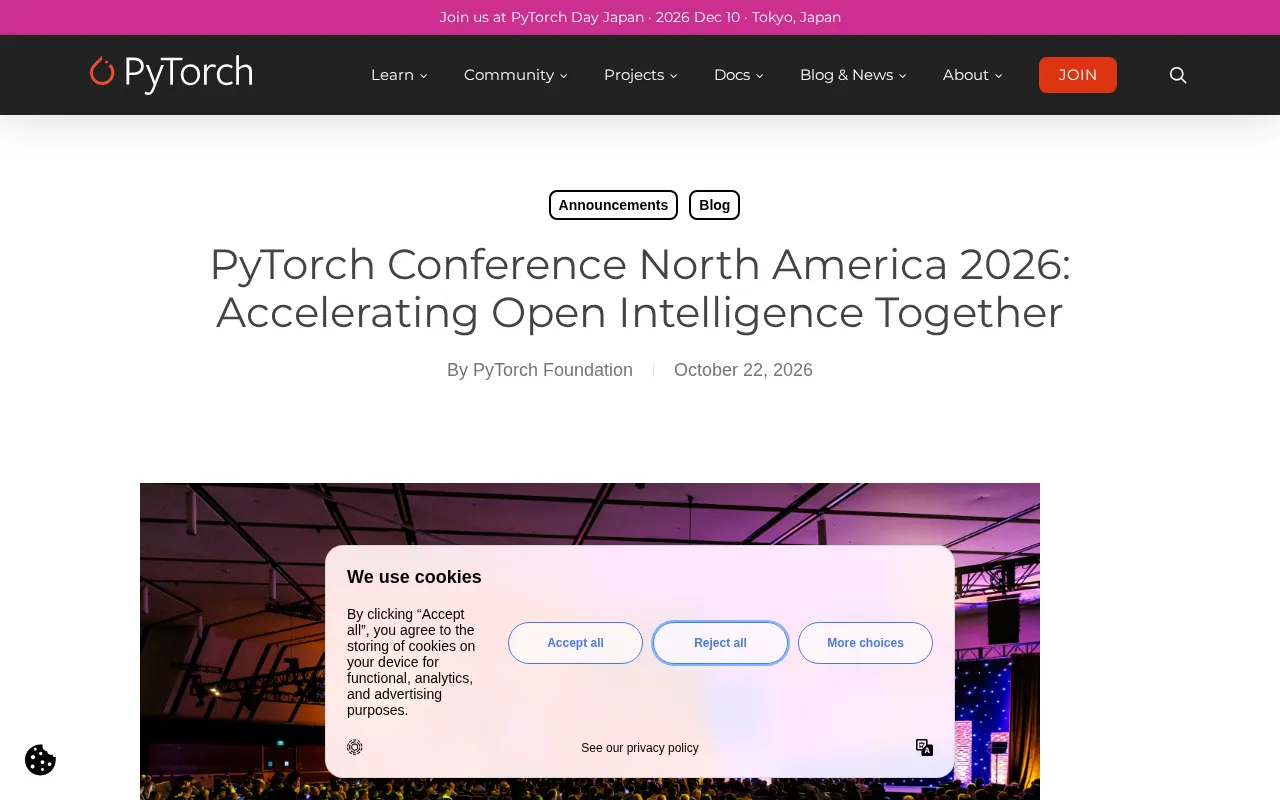
PyTorch Conference North America 2026 took place on October 20–21 in San Jose, and official figures put attendance at over 3,500 people. For a technical conference centered on an open-source deep learning framework, that scale is itself worth interpreting: PyTorch is no longer "a researcher's tool" but infrastructure carrying industrial-grade AI development, and its ecosystem conference has accordingly taken on the feel of an industry bellwether.
From Framework Conference to Foundation Narrative
The theme of this year's conference was summarized as "Accelerating Open Intelligence Together," and the official wording specifically emphasizes discussion of the influence of projects under the PyTorch Foundation. This shift in phrasing reveals key information: the conference's focus is moving from feature releases of a single framework to a broader matrix of foundation projects.
Since its establishment, the PyTorch Foundation has gradually brought peripheral projects such as compilers, inference, and distributed training under unified governance. The conference's use of "Together" as its theme word points precisely to this cross-project, cross-organization collaboration model. For developers, this means the boundaries to watch when making technology choices are expanding—not just the core PyTorch API, but also the maturity and compatibility of other projects within the foundation ecosystem.
The PyTorch Foundation was announced by the Linux Foundation in September 2022, with Meta transferring governance of the PyTorch project to the foundation and forming a governing board together with companies including AMD, AWS, Google, Microsoft, and NVIDIA. The original intent of this arrangement was to give PyTorch's neutrality institutional guarantees and avoid a single vendor dictating the direction of an open-source project. Under the foundation model, technical decisions are advanced jointly by multiple committees and Special Interest Groups (SIGs), and corporate members pay dues according to tier and receive corresponding governance seats. Since then, the foundation has successively absorbed or incubated a number of peripheral projects covering areas such as compilation, inference, and distributed training. Understanding this governance structure helps in judging the maturity differences among projects in the PyTorch ecosystem: the stability of the core framework is backed by a broad user base, while newly incorporated foundation projects are often still at a stage where interfaces change relatively frequently.
The Industrial Meaning of Open Intelligence
The term "open intelligence" appears repeatedly in official materials, but it is not merely a slogan. Combined with the 3,500-person attendance, PyTorch's user base has clearly tilted toward industry. Enterprise teams care about different questions than academic researchers: whether models can be deployed stably, whether training costs can be kept under control, and whether the ecosystem toolchain is complete.
By focusing its agenda on the influence of foundation projects, the conference responds precisely to these demands. Competition among open-source frameworks is no longer a contest of API design but a systemic competition centered on toolchains, governance models, and community activity. By choosing to consolidate resources in the form of a foundation, PyTorch is essentially offering industrial users a predictable long-term maintenance commitment.
In the context of deep learning toolchains, "compilation" and "inference" are two stages often discussed side by side but with different responsibilities. The compilation side focuses on converting dynamic-graph models into an optimizable, deployable intermediate representation, thereby gaining the performance benefits of static graphs while retaining flexibility; torch.compile introduced in PyTorch 2.x is one such example, performing graph capture and operator fusion with virtually no changes to user code. The inference side focuses more on deployment-stage latency, throughput, and memory footprint, involving engineering measures such as quantization, operator substitution, and runtime scheduling. Together, the two determine the cost of taking a model from experimental code to production service. Industrial users are far more sensitive to these two stages than academic users, because they map directly to server bills and online SLAs—which is the practical motivation for the foundation to bring related projects under unified governance.
Signals Worth Watching
Based on the information publicly available so far, the signals from this conference are relatively restrained. The official blog focuses on conference overview and theme exposition and does not disclose specific technical release details or version roadmaps. For developers following PyTorch's technical evolution, subsequent session recordings and project repository updates may be more valuable references than the conference press release.
One trend that can be confirmed: PyTorch is extending "openness" from the code licensing level to the ecosystem governance level. Whether foundation-led project collaboration can deliver substantive improvements in areas long criticized, such as inference performance and compiler optimization, will determine whether this narrative can truly be realized. The 3,500-person attendance shows the community base is solid enough, but technical communities are ultimately measured by code and performance, not conference scale.
One-line Summary
PyTorch Conference draws 3,500 attendees, marking its shift from a research tool to industrial infrastructure and foundation ecosystem governance.
Paragraph Summary
PyTorch Conference North America 2026 took place on October 20–21 in San Jose with over 3,500 attendees, and the scale itself shows that PyTorch has evolved from a researcher's tool into infrastructure for industrial-grade AI development. The conference theme was "Accelerating Open Intelligence Together," with official statements repeatedly emphasizing the influence of projects under the PyTorch Foundation, indicating that the conference's focus is shifting from feature releases of a single framework to cross-project, cross-organization ecosystem governance. The article argues that this shift responds to industrial users' demands for stable deployment, controllable costs, and a complete toolchain, and that the foundation format essentially provides a predictable long-term maintenance commitment. However, the official blog did not disclose specific technical releases or version roadmaps, and subsequent session recordings and repository updates are more worth watching. What will ultimately test this narrative is still code and performance.
Related articles

LangChain Retry Middleware Configuration: Practices and Selection Guide
Based on Reddit community discussion, this article analyzes LangChain ModelRetryMiddleware retry parameter configuration practices, covering the selection logic and alternatives for key options like max_retries, backoff_factor, and jitter.

Texas Senate Race in Trouble: Why Are Republicans Nervous?
Texas Senate race stirs Republican anxiety. Based on street interviews, this article analyzes the Democratic offensive in funding, organization, and running everywhere, and how Republicans are defending "Texas, Texas" amid the political pendulum effect.

Gemini Chat Now Generates and Edits Google Docs Directly, a New Breakthrough in Office Productivity
Google Gemini's chat interface now generates and edits PDF, Google Docs, Sheets, Slides, Markdown, TXT, and code files. Available to all users; web supports all formats, mobile only PDF for now.