QSim-Arena: How AI Agents Are Reshaping the Evaluation of Quantum Simulation Advantage

QSim-Arena uses AI agents for closed-loop validation and open exploration to dynamically evaluate quantum simulation advantage.
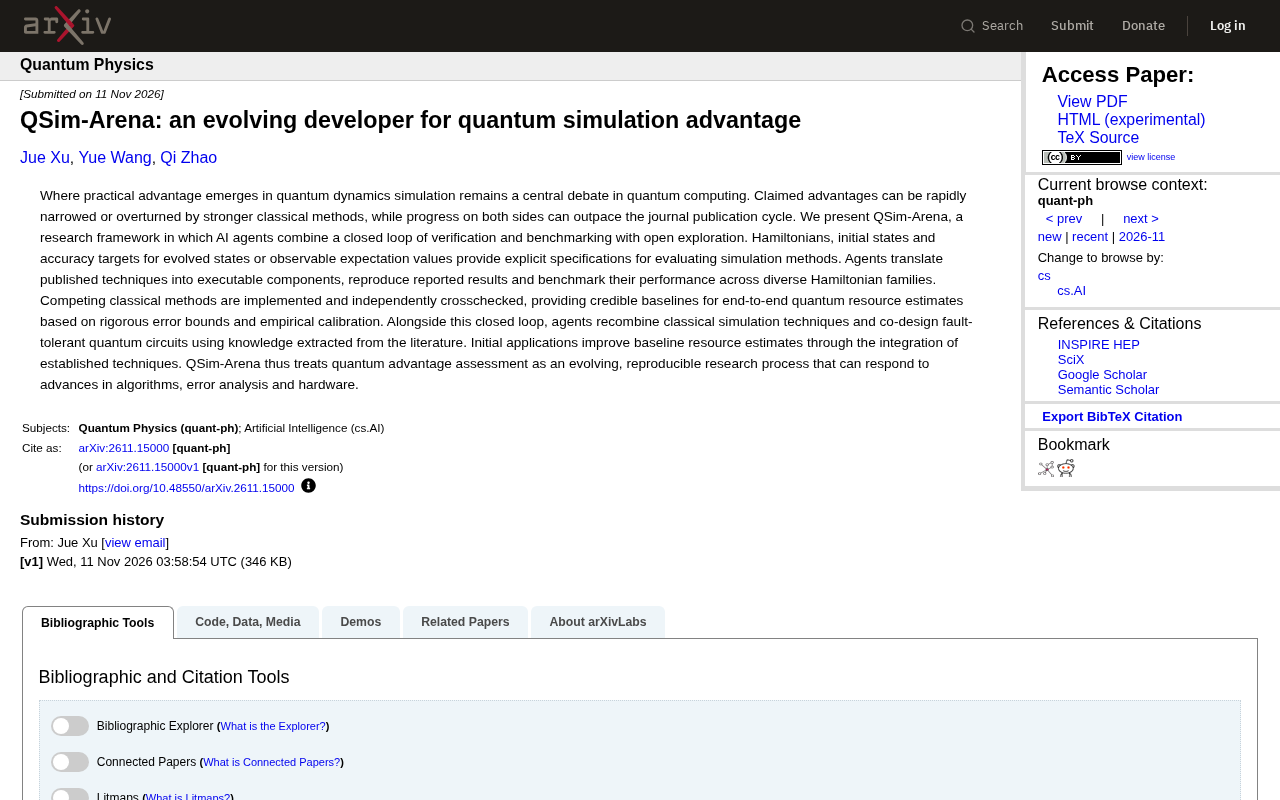
QSim-Arena is a research framework that uses AI agents to address controversies in quantum advantage evaluation. To tackle classical simulation methods rapidly catching up—causing quantum advantage claims to be frequently overturned—and academic publishing lagging behind technological iteration, it designs two parallel loops: closed-loop validation and benchmarking, and open-ended exploration. Agents convert natural-language algorithms into runnable code and independently cross-validate classical methods. The framework turns quantum advantage evaluation into a continuously evolving, reproducible research process.
Where practical advantage in quantum dynamics simulation actually emerges has long been a central controversy in quantum computing. On one hand, claimed quantum advantages can be quickly weakened or even overturned by stronger classical methods; on the other hand, quantum algorithms and classical algorithms often advance faster than the journal publication cycle. Against this backdrop, a research framework called QSim-Arena attempts to address this challenge with AI agents, turning the evaluation of quantum advantage into a continuously evolving, reproducible research process.
The Dilemma of Quantum Advantage Evaluation: The Rapid Catch-Up of Classical Methods
Quantum simulation was once held in high expectations, but advances in classical simulation algorithms continue to compress the space for quantum advantage. For example, tensor network methods and Monte Carlo techniques have demonstrated stronger-than-expected performance on certain problems, causing some early claims of quantum advantage to be quickly overturned. This dynamic competition means that any static, one-off comparison is unlikely to reflect reality.
At the same time, the academic publishing cycle often lags behind technological iteration, so conclusions in the literature may already be outdated. The authors of QSim-Arena point out that an evaluation mechanism capable of keeping pace with progress on both sides is needed, and AI agents happen to possess the ability to learn and execute quickly.
Tensor network methods are a class of classical simulation techniques that approximate quantum states by decomposing high-dimensional tensors into low-dimensional tensor networks. The core idea is to exploit the entanglement structure present in quantum states to compress an exponentially growing state space into a polynomial-scale parameter representation. For quantum systems with low entanglement or specific topological structures, tensor network methods can efficiently simulate on classical computers; for example, matrix product states (MPS) are suitable for one-dimensional systems, and projected entangled pair states (PEPS) are suitable for two-dimensional systems. This is precisely one of the important reasons why classical methods can rapidly catch up with claims of quantum advantage: many problems claimed to require a quantum computer for simulation actually have entanglement structures that fall exactly within the range that tensor networks can handle efficiently.
Monte Carlo techniques in quantum simulation mainly refer to quantum Monte Carlo (QMC) methods, which estimate the partition function and expectation values of quantum many-body systems through random sampling. QMC performs excellently on problems such as quantum spin models and the Hubbard model, but its application is limited by the "sign problem"—when a system has frustration or fermions, sampling weights may become negative or complex, causing computational complexity to grow exponentially. However, in recent years, sign-problem-free QMC variants and constrained-path approximation methods have continued to expand its applicability, which is another manifestation of the continuous enhancement of classical simulation capabilities. Understanding the progress of these classical methods is the key background for judging whether claims of quantum advantage hold.
The Core Mechanism of QSim-Arena: Closed-Loop Validation and Open-Ended Exploration
The design of QSim-Arena includes two parallel loops. The first is closed-loop validation and benchmarking: agents transform published quantum simulation techniques into executable components, reproduce reported results, and evaluate performance across diverse Hamiltonian families. At the same time, competing classical methods are also independently implemented and cross-validated, providing a trustworthy baseline for end-to-end quantum resource estimation. These estimates are based on rigorous error bounds and empirical calibration rather than rough assumptions.
The second is open-ended exploration: agents extract knowledge from the literature, recombine classical simulation techniques, and co-design fault-tolerant quantum circuits. This dual-track approach ensures that the evaluation is both rigorous and forward-looking, able to respond to advances in algorithms, error analysis, and hardware.
Fault-tolerant quantum circuits refer to quantum circuits that can operate reliably under the protection of quantum error-correcting codes. In a fault-tolerant framework, logical qubits are encoded from multiple physical qubits, and logical gates are implemented through specific gate operation sequences (such as transversal gates and magic state distillation), while error detection and correction are continuously performed. Co-designing fault-tolerant quantum circuits means considering not only gate sequence optimization at the algorithmic level but also factors such as the choice of error-correcting code, the connectivity topology of physical qubits, and the error rate threshold. This concept is directly related to QSim-Arena's quantum resource estimation: resource estimation needs to specify under which error-correction scheme and with which physical error rate as a premise in order to derive meaningful numbers of logical gates and qubits.
End-to-end quantum resource estimation refers to the complete quantification process from algorithm input to physical resource requirements, covering the number of logical qubits, the number of T gates, circuit depth, and the total number of physical qubits and runtime required. The reliability of such estimates depends on two key elements: first, rigorous error bounds, that is, mathematical guarantees on the relationship between simulation accuracy and resource consumption; second, empirical calibration, that is, using actual runtime data from small-scale instances to correct constant factors and asymptotic coefficients in theoretical models. QSim-Arena's emphasis on rigorous error bounds and empirical calibration rather than rough assumptions is precisely to avoid the optimistic bias common in resource estimation, thereby giving the evaluation of quantum advantage a comparable and trustworthy basis.
How Agents Work: From Literature to Executable Code
The core capability of the agents lies in transforming algorithms described in natural language into runnable code. They need to understand explicit specifications such as Hamiltonians, initial states, and accuracy targets, then implement simulation methods and validate results. This process requires not only correct code but also benchmarking to compare the performance of different methods on different problems.
You may not have noticed that the agents also independently implement competing classical methods and perform cross-validation. This helps avoid bias and ensures a reliable baseline. In this way, QSim-Arena can provide end-to-end quantum resource estimation, including quantified results based on rigorous error bounds and empirical calibration.
Practical Application: Improving Baseline Resource Estimates
The paper mentions that the initial application improved baseline resource estimates by integrating existing techniques. This means the framework can not only reproduce known results but also discover better combinations through agent exploration. For example, an agent might combine one error mitigation technique with another circuit optimization strategy to reduce resource requirements.
Such improvements are continuous because agents can constantly absorb new literature and update their knowledge base. As quantum hardware and classical algorithms advance, QSim-Arena can quickly adjust its evaluation and remain relevant.
Significance and Outlook: A New Paradigm for Quantum Advantage Evaluation
QSim-Arena treats quantum advantage evaluation as an evolving, reproducible research process rather than a one-time claim. This helps build community trust because anyone can reproduce and verify results. At the same time, the participation of AI agents accelerates the translation from theory to practice and shortens the evaluation cycle.
Although the framework is still in its early stages, its philosophy points to a future in which claims of quantum advantage will be based on continuously updated benchmarks and transparent code rather than isolated experiments. This is crucial for the healthy development of the quantum computing field.
One-line Summary
QSim-Arena uses AI agents for closed-loop validation and open-ended exploration to dynamically evaluate quantum simulation advantage.
Paragraph Summary
QSim-Arena is a research framework that uses AI agents to address controversies in quantum advantage evaluation. In response to the dilemma that rapid catch-up by classical simulation methods frequently overturns claims of quantum advantage and that academic publishing lags behind technological iteration, the framework designs two parallel loops: closed-loop validation and benchmarking transform published quantum simulation techniques into executable components, reproduce results, and evaluate performance across diverse Hamiltonian families, while independently implementing competing classical methods as a trustworthy baseline; open-ended exploration extracts knowledge from the literature, recombines classical simulation techniques, and co-designs fault-tolerant quantum circuits. Agents can transform algorithms described in natural language into runnable code and independently cross-validate classical methods to avoid bias. The initial application has already improved baseline resource estimates by integrating existing techniques, demonstrating the framework's practicality. The framework turns quantum advantage evaluation into a continuously evolving, reproducible research process, which is expected to build community trust and shorten the evaluation cycle.
Related articles

Why Microsoft CEO Nadella Still Backs Nvidia After Jensen Huang's Departure
Microsoft CEO Nadella publicly expresses confidence in Nvidia interim CEO Colette Kress. This article analyzes Nvidia's power transition after Jensen Huang's departure, Microsoft's compute dependency, and the trust logic of the AI supply chain.

Nadella: Critical Infrastructure Is 'Unpatchable' as AI Cybersecurity Arms Race Escalates
Microsoft CEO Nadella addresses AI cyberattack fears, saying much critical infrastructure is unpatchable, downplaying the Outlook outage, and analyzing AI's dual role in cybersecurity.

Musk Backs Jensen Huang: Firing Him Is Like Cutting Jordan
Musk says Jensen Huang is loyal to the U.S. and likens firing him to cutting Michael Jordan—highlighting politicization anxieties in the AI chip industry and defending talent value.