Qwen Image 2.1 Open Source Release Imminent: VRAM Requirements Dominate Community Discussion

Alibaba's Qwen Image 2.1 is about to go open source, with VRAM compatibility on 12–16GB GPUs as the key community concern.
Alibaba's Qwen Image 2.1 is on the verge of an open-source release, though the official team has yet to share parameter counts, architecture details, or benchmarks. Community discussion is focused not on model capabilities, but on the hardware barrier — specifically whether it can run on mainstream 12–16GB consumer GPUs. VRAM demands stem from model weight size, inference activations, and output resolution, and while quantization and block-loading techniques exist as workarounds, they come with quality or speed trade-offs. Whether the model natively supports mainstream hardware will be decisive for its real-world reach and user base.
Quick Overview
Qwen Image 2.1, the image generation model from Alibaba's Qwen series, is on the verge of a public open-source release — community reports suggest it's just hours away. For users who closely follow open-source image generation models, this is a highly anticipated milestone. The Qwen series' track record in multimodal understanding and generation has led many to expect strong image quality and fine-grained controllability from this new version.
Publicly available information remains scarce. The official team has yet to disclose the model's full parameter count, architectural details, or concrete performance benchmarks. Community discussion has largely centered on the most practical question of all: "Can I actually run this?" — rather than the model's theoretical capabilities. This reflects a defining characteristic of the open-source image model ecosystem: accessibility and hardware requirements often matter more to real-world adoption than numbers on a leaderboard.
VRAM Requirements: The Community's Top Concern
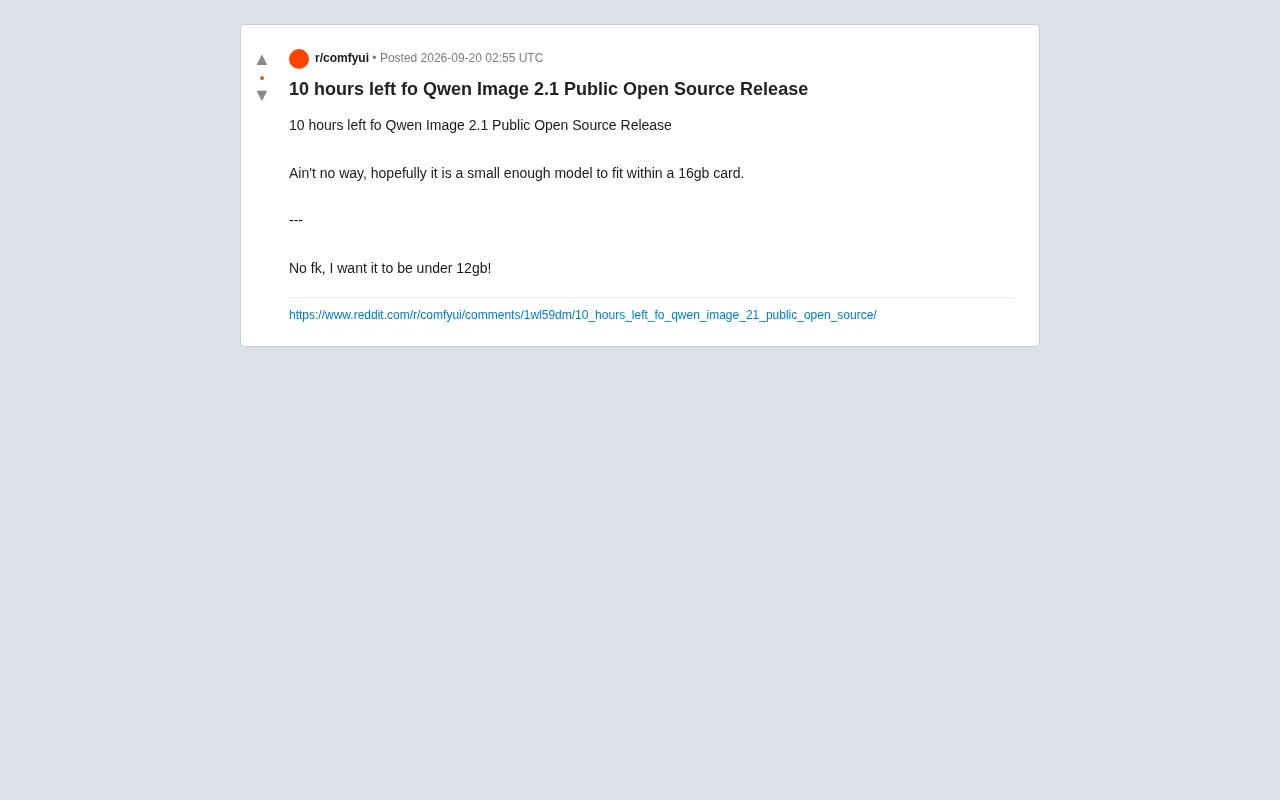
Judging by Reddit discussions, users' most pressing concern isn't how powerful the model is — it's how much VRAM it needs. One user expressed hope that the model would be "small enough to fit in a 16GB GPU," while another went further, saying they'd want it to stay "under 12GB."
This acute sensitivity to VRAM reflects the reality of consumer hardware. Today's mainstream gaming and creative GPUs — such as the RTX 3060 (12GB), RTX 4060 Ti (16GB), and RTX 3080 — typically offer between 8GB and 16GB of VRAM. A model that natively requires 24GB or more puts it out of reach for the vast majority of individual users, who would then have to fall back on quantization, CPU offloading, or other workarounds — all of which come at the cost of speed and image quality.
In other words, whether a model can fit within 12GB or less directly determines how broad its user base can be. This is exactly why, whenever a new open-source image model launches, VRAM is almost always the first topic of conversation.
Why VRAM Determines an Open-Source Model's Fate
VRAM consumption in image generation models comes from several sources: the model weights themselves, intermediate activations during inference, and the additional overhead of output resolution. The higher the resolution and the larger the batch size, the greater the memory pressure.
The community has developed a range of mitigation strategies over the years. Quantization to FP16, INT8, or even INT4 can significantly shrink model size, enabling mid-range hardware to run models that would otherwise require high-end GPUs. Techniques like block-wise model loading and attention optimization also help reduce peak VRAM usage. However, these solutions typically require secondary development and adaptation from the community. When a developer officially provides lightweight variants out of the box, the experience is far smoother.
If Qwen Image 2.1 ships with native support for the 12GB–16GB mainstream range — whether through a smaller parameter count or official quantized weights — it would dramatically boost its real-world adoption potential. Conversely, if the hardware barrier is too high, even exceptional image quality may cause it to lose a large portion of potential users right from the start.
A note on quantization: The core idea behind quantization is compressing model weights from high-precision floating-point formats (such as FP32 or FP16) to low-bit integers (such as INT8 or INT4), trading some precision for reduced memory footprint and faster inference. For a 10B-parameter model, FP16 requires roughly 20GB of VRAM; INT8 quantization cuts that to around 10GB, and INT4 can bring it down to approximately 5GB — theoretically making it runnable on consumer-grade GPUs. Popular quantization toolchains include GGUF (popularized by llama.cpp), GPTQ, and AWQ. The trade-off: the more aggressive the quantization, the greater the risk of output quality degradation — in image generation, this can manifest as loss of fine detail or color inaccuracies. CPU offloading is another compromise strategy, where some model layers are shifted to system RAM or even disk storage. The cost is a dramatic drop in inference speed, potentially stretching single-image generation from a few seconds to several minutes.
A Measured Take: The Information Vacuum Before Official Release
It's worth emphasizing that all current discussion is built on the expectation of an imminent release — the model's actual specifications have not been officially confirmed. The 12GB and 16GB figures being cited are user wishes, not known parameters. Before the official launch, critical information such as VRAM requirements, generation quality, and licensing terms all remain uncertain.
For users eager to get hands-on as soon as possible, here are the key things to watch for at launch: the model's native parameter count and weight format, whether official quantized versions are provided, the recommended minimum hardware configuration, and the specific terms of the open-source license (particularly around commercial use). This information is typically published alongside the model card and is essential for evaluating whether local deployment is feasible.
A note on open-source licenses: Licensing is a dimension that enterprises and developers often overlook, yet it's critically important when evaluating a model's usability. Common open-source AI model licenses include Apache 2.0 (relatively permissive, allows commercial use), MIT, and vendor-specific "community licenses" (such as Meta's Llama License, which imposes commercial restrictions based on user count thresholds). Alibaba's previous Qwen series language models used a relatively permissive Qwen License, but image generation models may carry different terms due to additional sensitivities around copyrighted training data. For developers looking to integrate a model into commercial products or SaaS services, carefully reviewing the license's clauses on commercial use, redistribution, and derivative works before deployment is a necessary step to avoid legal risk.
Conclusion
The countdown to Qwen Image 2.1's open-source release has begun, and the community's enthusiasm is largely focused on hardware accessibility — specifically, whether VRAM requirements can stay within a range that consumer-grade GPUs can handle. This demand reflects the open-source ecosystem's broader pursuit of democratization, and it serves as a reminder to model developers: alongside advances in image quality and capability, hardware friendliness is equally decisive in determining a model's longevity and reach. Whether Qwen Image 2.1 ultimately lives up to community expectations will have to be verified by real-world benchmarks once the official release lands.
Related articles

PC Memory Wasted? Hacker News Debates Centralized Data Centers
Hacker News users argue that personal computer memory is wasted and should be centralized in data centers, sparking debate on centralized vs. distributed computing resource allocation. This article analyzes the logic behind the claim, the costs of centralization, and new tensions in memory resource allocation in the AI era.

Why Fair Use Benefits Everyone: OpenAI Publishes Multi-Party Case Brief Analysis
OpenAI publishes excerpts from multiple court briefs featuring creators, scholars, accessibility advocates, and legal experts, explaining how fair use supports AI training and innovation, and analyzing its practical impact on developers and content professionals.
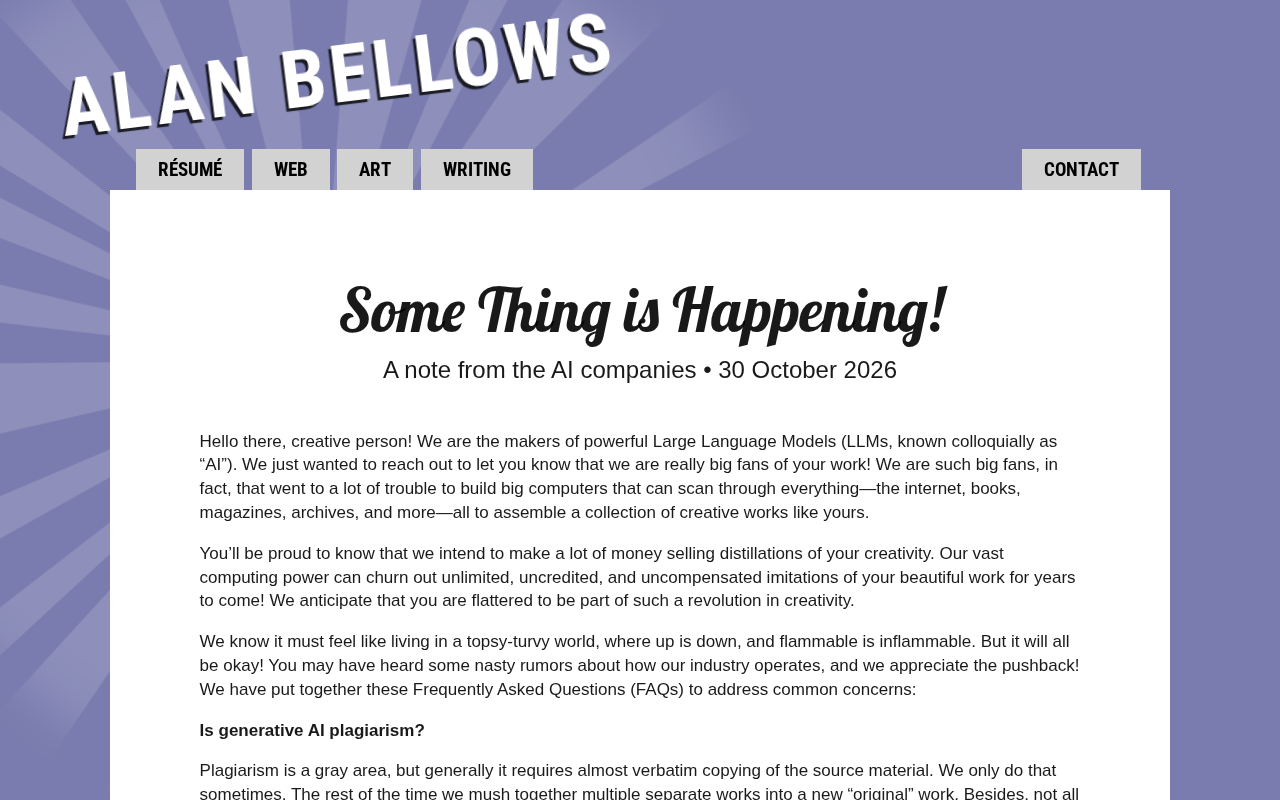
AI Companies' Joint Statement: 'Some Thing is Happening' Hints at Industry Shakeup
A Hacker News post 'Some Thing is Happening: A note from the AI companies' sparks speculation. This article analyzes the potential meaning of the joint AI company statement, industry context, and impact on developers.