RAG-CSI: Retrieval-Augmented Transformer for Channel State Prediction

RAG-CSI uses retrieval augmentation and a two-level knowledge base to overcome cross-scenario limits of purely parametric CSI prediction.
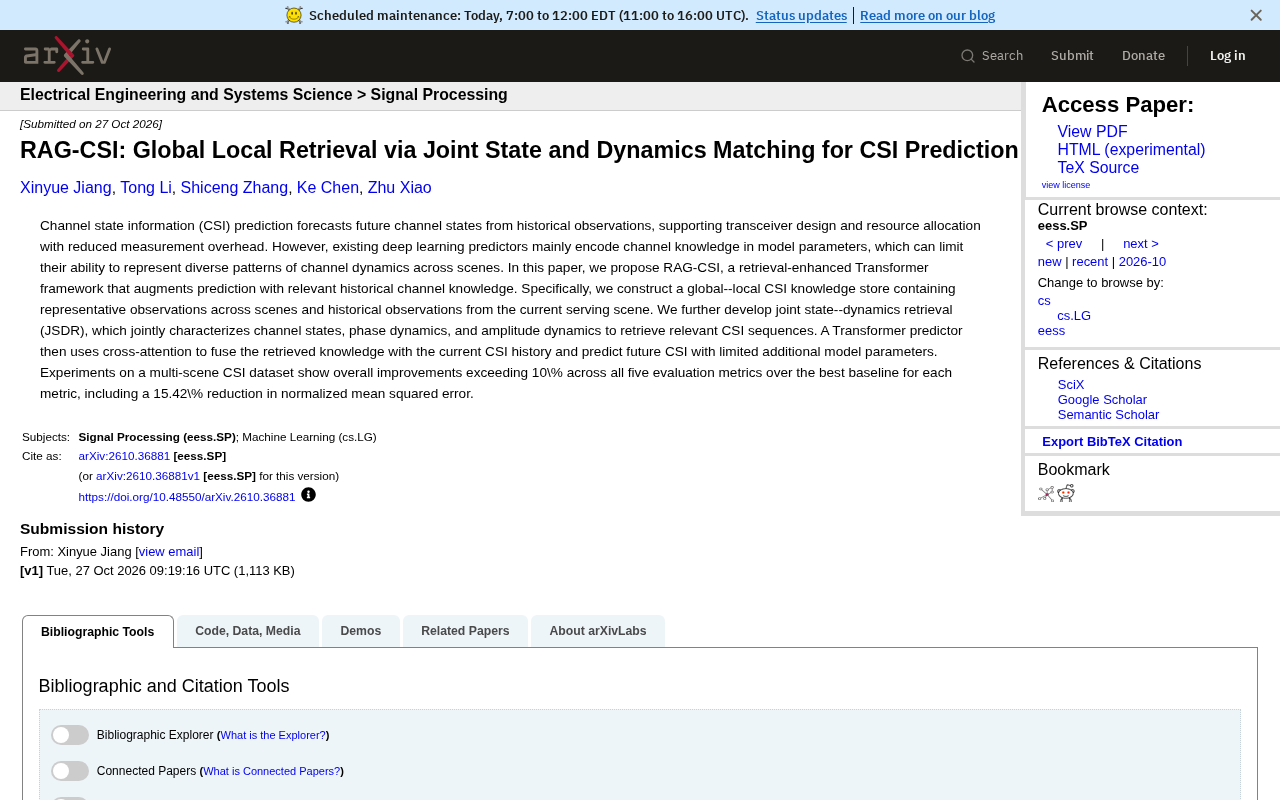
The article introduces RAG-CSI, a new paper bringing Retrieval-Augmented Generation (RAG) to Channel State Information (CSI) prediction. Traditional deep learning predictors bake channel regularities into parameters and struggle with cross-scenario channel dynamics. RAG-CSI builds a global–local two-level CSI knowledge base and uses Joint State–Dynamics Retrieval (JSDR) to match channel state, phase dynamics, and amplitude dynamics; retrieved reference sequences are fused with current history via cross-attention in a Transformer with limited extra parameters. On a multi-scenario dataset, five metrics improve by over 10% and NMSE drops 15.42%. The article views this as a reusable idea for externalizing channel knowledge as retrievable storage, while noting limitations in knowledge base construction cost, cross-scenario retrieval stability, and retrieval efficiency.
Channel State Information (CSI) prediction is a key task in wireless communications—it infers future channel states from historical observations, thereby reducing measurement overhead and aiding transceiver design and resource allocation. Most existing deep learning approaches "bake" channel knowledge into model parameters, which makes it difficult for the model to flexibly represent the diverse patterns of channel dynamics across different scenarios. A new paper proposes the RAG-CSI framework, which attempts to address this bottleneck using the idea of Retrieval-Augmented Generation (RAG).
Problem: Limitations of Parametric Encoding
Channels are strongly scenario-dependent: multipath structure, phase variation, and amplitude fluctuation patterns differ significantly across propagation environments. Traditional deep learning predictors are trained on a single or limited set of scenarios and solidify channel regularities in their parameters; once the scenario changes, the model often needs retraining or extensive fine-tuning.
The authors of RAG-CSI point out that this paradigm of "all knowledge in the parameters" limits the model's ability to represent cross-scenario channel dynamics. In other words, the model lacks an external knowledge source that can be dynamically invoked.
Channel State Information (CSI) is a digital description of the characteristics of the wireless propagation channel between transceivers in a wireless communication system, typically containing the amplitude and phase response on each subcarrier (in MIMO-OFDM systems, a complex matrix). The receiver estimates CSI via pilot signals and feeds it back to the transmitter for precoding, beamforming, adaptive modulation, and resource scheduling. The accuracy of CSI directly determines system capacity and reliability, but frequent measurement and feedback incur significant pilot overhead and uplink signaling burden. Therefore, CSI prediction—using historical CSI sequences to infer channel states at several future time instants—becomes a key means of reducing overhead: if prediction is accurate enough, pilot density or feedback frequency can be reduced while providing the transmitter with forward-looking scheduling information. The difficulty of channel prediction lies in the fact that wireless channels are both time-varying and scenario-dependent; multipath, Doppler, and blockage make future states governed by both deterministic trends and random components.
Method: Global–Local Knowledge Base and Joint Retrieval
The core of RAG-CSI is the construction of a global–local CSI knowledge base: the global part contains representative observations across scenarios, while the local part comes from historical observations of the current serving scenario. During prediction, the model retrieves historical sequences relevant to the current channel from both levels and injects them as "reference samples" into the prediction process.
The key design in the retrieval step is Joint State–Dynamics Retrieval (JSDR). It not only considers the similarity of channel states but also characterizes phase dynamics and amplitude dynamics simultaneously, thereby retrieving CSI sequences that match in both the "state" and "trend of change" dimensions. This aligns better with the needs of channel prediction than mere state matching—prediction is precisely concerned with the future direction of dynamics.
Predictor: Cross-Attention Fusion
The retrieved knowledge sequences are then processed by a Transformer predictor, fused with the current CSI history through a cross-attention mechanism, and output future channel states. The authors emphasize that this fusion approach introduces only a limited number of additional model parameters while significantly expanding the information available to the model.
Retrieval-Augmented Generation (RAG) was originally proposed for natural language processing: before generating an answer, the model first retrieves passages relevant to the question from an external document store, then feeds these passages as context into the generative model. Its core motivation is to decouple knowledge from model parameters, enabling the model to access up-to-date or domain-specific information without retraining while reducing hallucination. RAG generally consists of a retriever (often based on dense vector similarity) and a generator; retrieval quality and knowledge base coverage jointly determine the final performance. When transferring this paradigm to the physical layer of wireless communications, "documents" become historical CSI sequences, and "semantic similarity" must be replaced by matching of channel states and dynamic evolution patterns—which is precisely why RAG-CSI needs to redesign the retrieval criterion.
Cross-attention is an attention mechanism in Transformers: one sequence serves as the query, while another sequence provides the keys and values, allowing the former to selectively aggregate information from the latter. Unlike self-attention, the two inputs of cross-attention come from different sources, making it naturally suited for fusing "current observations" with "externally retrieved knowledge." In CSI prediction, the current history sequence generates the query, and the retrieved reference CSI sequences generate the keys and values; the model thereby decides at which time instants and in which dimensions to borrow the dynamic patterns of the reference samples. Compared with directly concatenating or averaging retrieval results, cross-attention can adaptively weight by content and requires only a small number of additional projection matrices, keeping parameter overhead manageable.
Experimental Results
The paper validates the approach on a multi-scenario CSI dataset. Results show that across five evaluation metrics, RAG-CSI achieves an overall improvement of more than 10% over the best baseline for each metric, with normalized mean squared error (NMSE) reduced by 15.42%. This magnitude is considerable for the CSI prediction task, indicating that retrieval augmentation indeed brings information gains beyond parametric models.
Normalized Mean Squared Error (NMSE) is the most commonly used accuracy metric in CSI prediction and channel estimation, defined as the squared norm of the difference between the predicted and true values divided by the squared norm of the true value, usually expressed in dB. It normalizes by the overall channel energy, so results under different scenarios and receive powers can be compared across conditions; lower values (more negative dB) indicate more accurate prediction. Note that a percentage reduction in NMSE often corresponds to a greater increase in actual difficulty in low-error regimes, so "reduced by 15.42%" should be interpreted in light of the baseline's absolute NMSE level and judged together with other metrics (such as phase error and cosine similarity) for a comprehensive assessment of prediction quality.
Signals Worth Noting
The migration of RAG from the language model domain to physical-layer tasks in wireless communications is a recent trend worth watching. The contribution of RAG-CSI lies in its finer-grained design of "what to retrieve" and "how to match"—joint state and dynamics matching rather than simply taking Top-K by similarity.
Limitations also exist: the construction cost of the global knowledge base, the stability of retrieval quality during cross-scenario transfer, and retrieval efficiency as the knowledge base grows are not elaborated in the paper's abstract. The specific composition of the multi-scenario dataset and the choice of baselines also require further judgment based on the full text.
For readers engaged in machine learning research for wireless communications, this work offers a reusable idea: externalize channel knowledge as a retrievable store rather than compressing it entirely into network weights.
One-line Summary
RAG-CSI uses retrieval augmentation and a two-level knowledge base to break through the cross-scenario limitations of purely parametric CSI prediction.
Paragraph Summary
This article introduces RAG-CSI, a new paper that brings Retrieval-Augmented Generation (RAG) into Channel State Information (CSI) prediction. The authors point out that traditional deep learning predictors solidify channel regularities in model parameters, making it difficult to flexibly represent channel dynamics across scenarios. RAG-CSI builds a global–local two-level CSI knowledge base and, during prediction, uses Joint State–Dynamics Retrieval (JSDR) to simultaneously match channel state, phase dynamics, and amplitude dynamics; the retrieved reference sequences are then fused with the current history by a Transformer via cross-attention, adding only limited parameters. Experiments on a multi-scenario dataset show overall improvements of more than 10% across five metrics and a 15.42% reduction in NMSE. The article argues that this provides a reusable idea for wireless communication machine learning—externalizing channel knowledge as a retrievable store—while noting that limitations such as knowledge base construction cost, cross-scenario retrieval stability, and retrieval efficiency remain to be elaborated.
Related articles

Running a PS2 Emulator in the Browser with Claude: Inside TabStationToo
TabStationToo ports the PCSX2 core to the browser with WebAssembly and WebGPU, letting a PS2 emulator run in a tab. We break down its tech, AI workflow, and optimization.

AI Customer Service Evaluation Gone Wrong: 41 Failures, 28 Were Test Bugs
A live evaluation of a Shopify AI customer service agent produced 41 failures, but 28 were test bugs. This article analyzes scorer flaws, overly strict response checks, and other evaluation pitfalls, and summarizes best practices to prevent test bugs from masking real model failures.

No API Needed! Build a WhatsApp Receptionist with a Free Claude Account
A developer shares a weekend experiment: using a free Claude.ai account and browser scripts to turn WhatsApp Web into an automated receptionist—no API required.