Reddit Content Removed: The Boundaries and Controversies of AI Content Moderation
A post removed by Reddit reflects the governance tensions of AI content moderation in transparency, misjudgment, and appeals.
The article uses a Reddit post removed by the platform for violating content policy as an entry point to discuss the governance dilemma of AI content moderation. Since the page shows only a "[ Removed by Reddit ]" placeholder, users cannot know the specific violated clause, creating information asymmetry. The author points out that mainstream platforms use AI models combined with human review, where models score based on keywords and semantic features and set thresholds to trigger takedowns, making the mechanism opaque to users; meanwhile, natural language ambiguity makes models tend to "err on the side of killing", and over-moderation suppresses valuable discussions and weakens creator trust. The article suggests improving transparency by clearly informing rule clauses, perfecting appeal channels, and adopting intermediate handling like throttling plus labeling, and reminds creators to diversify channels and keep backups.
A post removed by a platform reflects an unavoidable tension in AI content governance.
Recently, a post on Reddit was removed by the platform for violating its content policy. Both the original title and body are no longer visible, leaving only a "[ Removed by Reddit ]" placeholder. For content creators and AI practitioners, this phenomenon itself is worth discussing: when AI becomes deeply involved in content moderation, how should we balance platform standards, transparency, and creator rights?
What a "vanished" post reveals
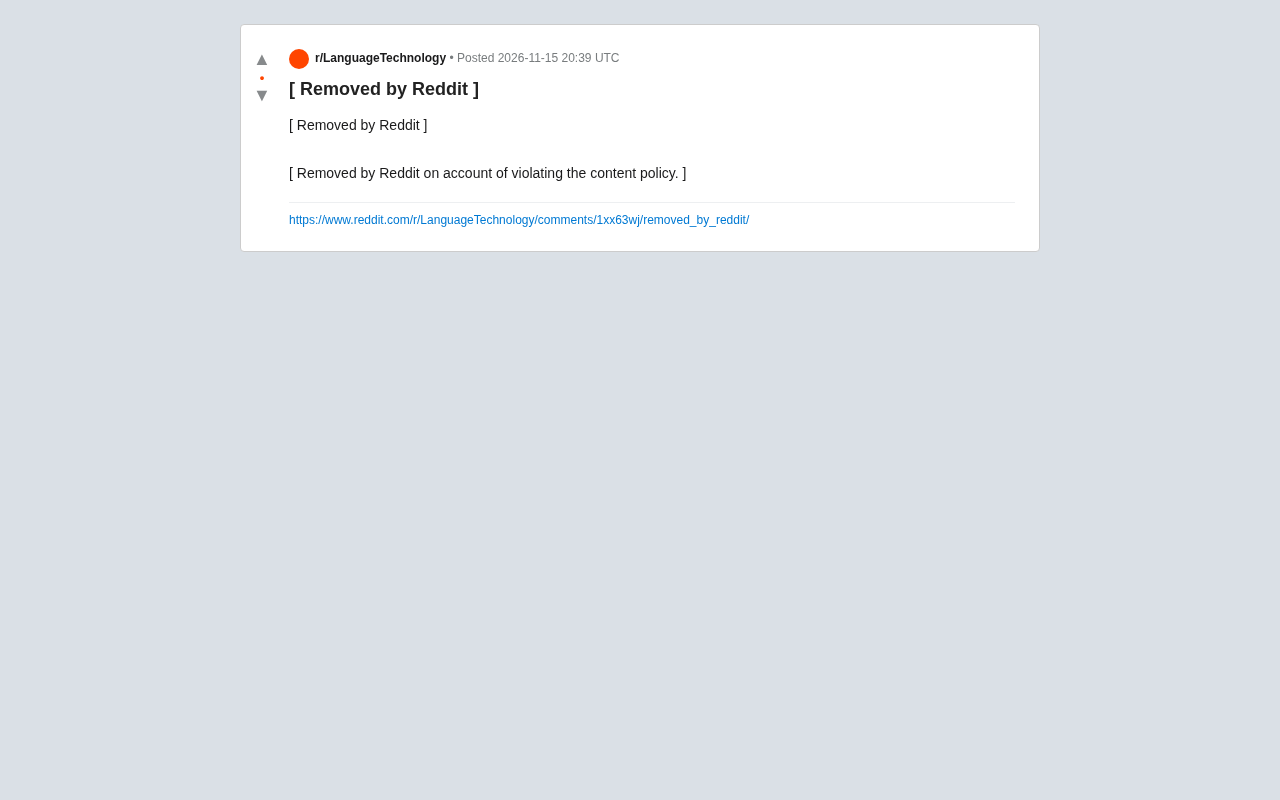
As seen in the screenshot, the post on Reddit displays only "[ Removed by Reddit ]", along with a note stating that the removal was due to a content policy violation. This is Reddit's standard way of handling violating content: taken down directly at the platform level, rather than merely deleted by subreddit moderators.
You may not have noticed that such removals typically do not disclose the specific violated clause to ordinary visitors. Users only see the result, not the basis for the decision. For those studying platform governance, this constitutes an information asymmetry—we can observe the act of "deletion" but can hardly reconstruct the full logic that triggered it.
Reddit's moderation system is divided into two layers: the platform-level Content Policy is enforced uniformly by Reddit officially, and violating content is displayed as "[ Removed by Reddit ]"; while each subreddit's rules are set and enforced by moderators, and posts removed by moderators usually display as "[removed]". The two differ in notification wording, appeal paths, and legal nature—the former represents the platform's compliance discretion as a service provider, while the latter falls under community self-governance. Understanding this layering helps determine which level of rules a removal triggered, and also explains why ordinary visitors often see only the result and not the specific violated clause.
Why AI moderation systems easily spark controversy
The "black box" feel of rule enforcement
Mainstream platforms generally adopt AI models combined with human review to screen content. The model scores content based on dimensions such as keywords, semantic tendencies, and contextual features, and triggers takedown once a threshold is exceeded. The problem is that this scoring mechanism is not transparent to users.
When a post is judged to be in violation, the author often receives only a general explanation. Whether the wording triggered a sensitive-word lexicon or the overall semantics were judged harmful, outsiders have no way to tell. This opacity easily makes creators feel "inexplicably deleted" and also weakens the predictability of platform rules.
Content moderation systems are usually composed of classification models, keyword matching, and human review. Classification models are generally trained on large-scale labeled data and output a risk probability between 0 and 1; the platform then sets different thresholds corresponding to different handling actions: below the threshold, content is allowed; in the middle range, it may be downranked or annotated; above the threshold, it is directly taken down. The choice of threshold is essentially a product and compliance decision rather than a purely technical judgment, so the same content may be handled very differently across platforms and time periods. In addition, models have inherent limitations such as adversarial evasion, contextual misreading, and uneven multilingual coverage, which is also why the human review step cannot be fully replaced.
Misjudgments and over-moderation
Another controversial point of AI moderation is misjudgment. Natural language is highly ambiguous; the same sentence may express completely different meanings in different contexts. When facing scenarios such as irony, quotation, and academic discussion, models tend to "err on the side of killing rather than letting go".
The cost of over-moderation is real: valuable discussions are suppressed, and creators' trust in the platform declines. The cost of under-moderation is equally obvious: harmful content spreads, and community atmosphere deteriorates. Platforms are always seeking a balance between the two, and this balance point has no once-and-for-all answer.
In the fields of information retrieval and content moderation, misjudgments are usually divided into two types: false positives refer to normal content being incorrectly judged as violating, and false negatives refer to violating content being missed. There is an inherent trade-off between the two—lowering the false-positive rate often means raising the false-negative rate, and vice versa. Common reconciliation methods used by platforms include tiered handling (downranking, throttling, adding labels rather than direct deletion), increasing the proportion of human review, and introducing secondary judgment after author appeals. For creators, understanding the trade-off logic between false positives and false negatives helps them view occasional misjudgments more rationally, rather than simply attributing them to platform stance.
Transparency is the key to solving the problem
From a product design perspective, improving moderation transparency is an effective path to alleviating controversy. Specifically, this can include: clearly informing authors of the specific rule clauses triggered; providing convenient appeal channels and giving review results; and adopting an intermediate state of "throttling + labeling" rather than direct deletion for controversial content.
Some platforms have begun trying alternatives to "shadow banning", such as attaching fact-check labels next to content, or limiting recommendations without affecting direct access. These practices preserve space for expression while reducing potential risks.
For content creators, understanding the realistic logic of platform moderation mechanisms is equally important: rules will continue to adjust, and visibility on a single platform is not stable. Diversifying content across multiple channels and keeping original backups is a basic strategy for reducing the risk of "content disappearing".
A related governance concept is often called the extension of "procedural justice" in platform governance: even if the substantive rules are reasonable, if the parties involved cannot know the basis and cannot defend themselves, the legitimacy of the rules will still be damaged. Improvement directions widely discussed in the industry include: disclosing to authors the specific policy items triggered, providing an appeal process with time commitments, and publishing transparency reports (disclosing metrics such as removal volume, appeal success rate, and misjudgment correction rate). At the regulatory level, the EU's Digital Services Act (DSA) already requires very large platforms to explain the reasons for content restrictions and provide internal appeal mechanisms. Such external constraints are pushing platforms to shift from "giving only results" to "explaining reasons".
Conclusion
A removed post itself leaves no content available for analysis. But the phenomenon it represents—the invisibility of AI moderation, the risk of misjudgment, and the appeal dilemma—is a real issue in the current content ecosystem. Technology can improve moderation efficiency, but the construction of transparency and appeal mechanisms is the prerequisite for making rules trusted.
(This article discusses a content removal incident on the Reddit platform. The original post content is no longer visible, and the relevant analysis focuses on the platform moderation mechanism itself.)
Related articles

GitHub Project 'GIF Factory' Nears 2K Stars: One Sentence Lets AI Batch-Create 12 Animated Stickers
A Chinese open-source GitHub project 'GIF Factory' with nearly 2,000 stars and an MIT license lets AI batch-generate animated stickers, transition cards, posters, and signatures from a single sentence.

DeepSeek Harness Plugin "Footprints": Turn Your Photo Album into a 3D Earth
DeepSeek Harness plugin "Footprints" projects album photos onto a 3D Earth by GPS location, auto-generates travel storylines, and supports natural language photo search, "that day in years past," and landmark recognition, with a local read-only index for privacy.

Quiver Launcher + Game List: One-Stop Management for PC Ported Games
Learn how the open-source Quiver launcher (localized) and game project list work together: the list discovers PC port and recompilation projects, while the launcher handles installation, version updates, and tag management, with full workflow and manual import options.