Reddit Player Builds RISK Game Environment and Trains an AI That's Nearly Impossible to Beat
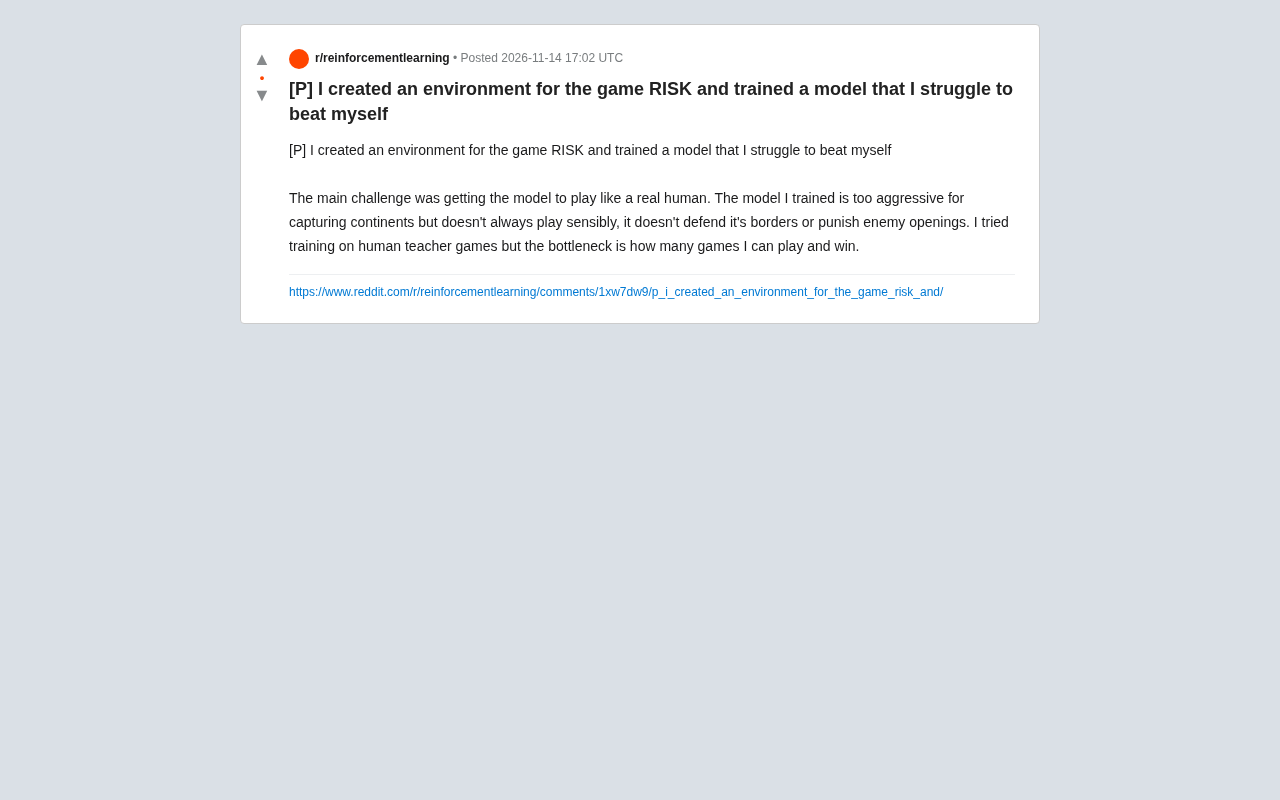
Reddit player builds RISK environment from scratch, trains an AI that's hard to beat but plays with obvious tactical imbalances.
A Reddit user built a RISK game environment from scratch and trained a reinforcement learning model that's strong enough to be nearly unbeatable. But the model is clearly imbalanced: overly aggressive in grabbing territory, weak at defense, and lacking awareness to punish opponents' mistakes—more like a "brute" than a tactically disciplined human. The author tried supplementing training with human match data to correct this, but hit a data bottleneck due to limited high-quality winning games. The article discusses the game AI balancing challenge—pure RL tends to produce "superhuman but inhuman" strategies while imitation learning is constrained by data costs—and summarizes lessons in environment design, reward tuning, and human data usage.
A Reddit user shared their process of creating a training environment for the classic strategy game RISK and training an AI model on it—only to find the resulting model so strong that they struggle to beat it themselves. But the author admits that while the model is fierce, it doesn't quite play like a human—it grabs territory with excessive aggression, often neglecting defense and failing to punish opponents' mistakes.
Training Environment and Core Challenges
The player built the RISK game environment from scratch and trained a reinforcement learning model on top of it. RISK is a tabletop game centered on turn-based play, territorial expansion, and probabilistic combat, with a massive state space and long decision chains—no small challenge for AI. The author didn't disclose the specific tech stack but emphasized that environment construction is the foundation of the entire process.
The real difficulty lies in making the model "play like a human." The current model shows extremely strong aggression in grabbing territory, expanding at a remarkable pace, but it is sluggish when it comes to defending borders and identifying and punishing opponents' weaknesses. In other words, it excels at offense but lacks tactical discipline.
Reinforcement Learning (RL) is a machine learning paradigm in which an agent learns a policy by interacting with an environment through trial and error, aiming to maximize cumulative reward. In game AI, the agent observes the current state (such as territory distribution, troop counts, and turn information in RISK), takes actions (deploy, attack, transfer), and receives feedback based on game outcomes or intermediate rewards. RISK's challenge lies in the combinatorial explosion of the state space as the number of players and territories grows, along with the randomness of combat outcomes, which makes credit assignment (determining which step led to the final win or loss) exceptionally difficult. It typically requires deep neural networks to approximate value functions or policy functions.
Imitation Learning is a class of methods that learn policies from expert demonstrations, with behavior cloning (Behavior Cloning) being the typical form—treating expert "state-action" pairs as supervised learning samples to train a model. Its advantage is quickly obtaining readable, human-like behavior, but it suffers from distribution shift: once the model enters states not covered by expert data, errors accumulate and amplify. Additionally, the ceiling of imitation learning is constrained by expert skill level and data coverage—this is precisely the technical root of the human teacher data bottleneck mentioned in the article.
Behavior Analysis: Fierce but Not Smart Enough
The author points out that the model's current behavior patterns have obvious imbalances:
- Overly aggressive: The model will fight for continental control at all costs, even forcing battles when it shouldn't.
- Weak defense: It doesn't prioritize border defense and is easily flanked by opponents.
- Lack of punishment awareness: When opponents make opening mistakes or leave defensive gaps, the model often fails to seize the opportunity to deliver a fatal blow.
While this "brute-force" style can sometimes overwhelm opponents through sheer momentum, its flaws are quickly exposed against experienced human players. The author notes that although they struggle to win, it's not because the model is invincible—it's because it doesn't follow conventional logic, making its rhythm hard to predict.
The Bottleneck of Human Teacher Data
To correct the model's imbalances, the author attempted to use human match data for supervised learning or auxiliary training. The idea was to have the model imitate high-level players' decisions, thereby learning more reasonable attack-defense rhythms. However, this direction hit a clear bottleneck: the number of high-quality matches won by the author themselves that could be obtained was limited, and the scale and diversity of training data couldn't keep up.
This actually reflects a common dilemma in game AI: pure reinforcement learning tends to produce "superhuman but inhuman" strategies, while imitation learning is constrained by data acquisition costs. How to find a balance between the two is key to improving a model's human-likeness.
Reward Function is the core mechanism in reinforcement learning that defines "what constitutes good behavior," and the agent's policy evolves directly toward reward maximization. If the reward only includes territory captured or final win/loss, the model easily learns aggressive expansion while ignoring long-term value behaviors like defense. Common improvements include reward shaping—adding intermediate signals beyond sparse terminal rewards, such as border stability, troop preservation, and gains from punishing opponent mistakes—with multiple sub-rewards weighted to guide more balanced tactical discipline.
Implications for Game AI Development
Although this project is still in its early stages, it has already surfaced several development lessons worth noting:
- Environment design determines the ceiling: RISK's complex rules require the environment to accurately model combat probabilities, turn order, and territorial connections—any simplification may cause the model to learn incorrect strategies.
- Reward functions need fine-tuning: If rewards only focus on capturing territory, the model will naturally neglect defense. The author needs to design multi-objective rewards that balance expansion, defense, and opportunity capture.
- Human data is a double-edged sword: Imitating humans can improve readability, but insufficient data may actually limit the model's ceiling.
For developers wanting to try similar projects, this Reddit player's experience offers a pragmatic starting point: get the environment working first, then gradually tune behavior—there's no need to pursue perfection from the start.
Conclusion
Building a RISK environment from scratch and training an AI that can beat yourself is already a fairly hardcore achievement. The model's current "imbalances" precisely illustrate that making AI perform both powerfully and human-like in complex strategy games remains an open problem. The author says they will continue adjusting the training approach, and future progress is worth following.
One-line Summary
A Reddit player built a RISK environment from scratch and trained an AI that's nearly unbeatable but plays with obvious imbalances.
Paragraph Summary
A Reddit user built a RISK game environment from scratch and trained a reinforcement learning model on it, achieving results so strong they struggle to beat it themselves. But the model's behavior is clearly imbalanced: it aggressively grabs territory, defends weakly, and lacks the awareness to punish opponents' mistakes—more like a "brute" than a tactically disciplined human player. The author tried using human match data to supplement training and correct these imbalances, but hit a data bottleneck due to insufficient high-quality winning matches. The article discusses the balancing challenge in game AI—pure reinforcement learning tends to produce "superhuman but inhuman" strategies, while imitation learning is constrained by data costs—and summarizes lessons in environment design, reward function tuning, and human data usage.
Related articles
Anthropic Model Benchmarking: Fable 5 vs 5.1 vs 5.2 Comparison
Based on Reddit community comparison material, this analyzes benchmark differences among Anthropic models Fable 5, 5.1, and 5.2, and discusses the practical implications of version iterations for developers and model selection advice.

Jensen Huang Steps Down as Nvidia CEO, Asian Governments Scramble to Respond to Chip Supply Shifts
Jensen Huang's departure as Nvidia CEO triggers chain reactions across Asian governments: some confirm chip supply commitments, others monitor local AI project impacts and handle related investigations. This article analyzes supply chain stability, project risks, and compliance uncertainty.
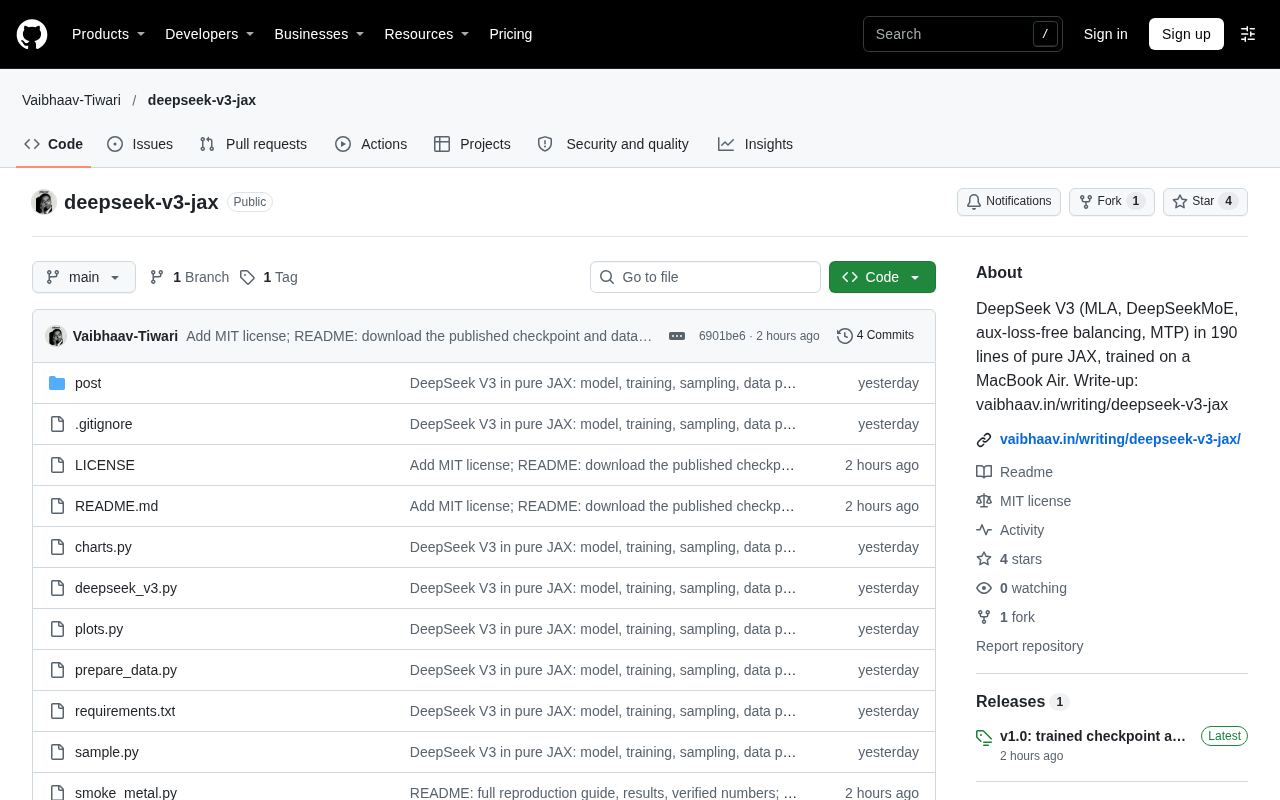
200 Lines of Pure Jax Reimplements DeepSeek V3: Minimalist Open-Source Project Hits HN
A Hacker News project reimplements DeepSeek V3 in ~200 lines of pure Jax, showcasing the model's core architecture in minimalist form for learners and researchers. This article analyzes its value and offers getting-started tips.