Reddit User Seeks CV Technical Co-founder: Equity Partnership Sparks Discussion

A Reddit post recruiting a CV technical co-founder with only a title reflects the structural supply-demand mismatch between non-technical founders and technical talent in AI startups.
Starting from a Reddit recruitment post, the article analyzes the difficulties of recruiting technical co-founders in the AI startup ecosystem. The post seeks a computer vision technical partner with equity as compensation using only a title, providing minimal information yet typically reflecting the rough state of early-stage AI startup recruitment. The article points out that equity-only compensation has limited appeal for CV engineers with strong bargaining power, and information asymmetry is the core obstacle; successful co-founder recruitment requires a clear problem definition, early progress, and explicit equity and division-of-labor arrangements. Finally, the article places this phenomenon in the context of the talent supply-demand mismatch amid the AI startup boom, reminding entrepreneurs to build trust through transparent and specific communication.
A Reddit Post Reveals the AI Startup Talent Dilemma
In a technology community on Reddit, a post titled "Looking for a Computer Vision technical co-founder (equity)" drew attention. The poster is looking for a technical co-founder in computer vision, offering equity as compensation. The post itself doesn't disclose project details, product direction, or team background—but that's exactly the typical shape of this kind of recruitment: using the most minimal description to test technical talent's interest.
What makes this post worth discussing isn't how much information it provides, but how it distills a recurring structural contradiction in the current AI startup ecosystem: people who understand business lack technical skills, while people with technical skills aren't short on opportunities. Computer vision, as one of the AI branches with the richest real-world applications—from industrial quality inspection to medical imaging, from autonomous driving to consumer applications—further amplifies the scarcity of technical co-founders.
Why Equity-Based Recruitment Struggles to Attract CV Talent
"Equity only" is nothing new in the AI startup world, but for computer vision engineers, the appeal of this offer is declining. CV technical talent typically has strong market bargaining power—big tech companies and star startups can offer competitive cash compensation, while equity in early-stage projects is nearly impossible to value before it vests.
The deeper problem lies in information asymmetry. A recruitment post with only a title, without explaining what problem the project solves, what stage it's at, or how much validation it has, leaves technical talent unable to judge the potential value of the equity. For a co-founder role that often requires months or even years of full-time commitment, this ambiguity is almost fatal. Experienced CV engineers tend to skip such posts entirely and instead look for teams with clear product prototypes or customer validation.
Information Asymmetry is a classic concept in economics, referring to situations where one party in a transaction holds more or more critical information than the other, leading to market failure or negotiating imbalance. In co-founder recruitment scenarios, the poster typically holds project background, progress, and true intentions, while potential technical co-founders can only see public statements. When statements are extremely brief, technical talent finds it difficult to assess project quality, team capability, and the potential value of equity—the rational choice is to walk away. Information asymmetry also triggers "adverse selection": high-quality entrepreneurs tend to disclose more details to distinguish themselves from low-quality projects, while low-quality projects often remain vague, ultimately causing technical talent to distrust the entire recruitment market.
The Right Way to Recruit a Technical Co-founder
Based on common patterns in community feedback, successful co-founder recruitment typically includes several elements: a clear problem definition, demonstrable early progress, explicit equity and division-of-labor arrangements, and the initiator's own industry track record. Technical talent is willing to take risks, but not "unclear" risks.
For posters, if they hope to attract a genuine CV technical co-founder, they should at minimum add: the vertical scenario the project operates in, existing resources or customer leads, the specific responsibilities expected of the technical co-founder, and the approximate equity range. This information doesn't need to be elaborate, but it can significantly boost the post's credibility. Conversely, when technical talent responds to such recruitment, they should proactively verify the initiator's industry background and project progress to avoid falling into one-sided collaborations.
Technical Co-founder differs from an ordinary early employee in a key way: the former typically receives significant equity as a co-founder (commonly 10%-30%, depending on stage and contribution) and bears joint decision-making, long-term commitment, and shared risk; the latter is mostly cash-compensation-driven with equity as a supplement. Technical co-founders often need to participate in product definition, technical architecture, and team building, and their commitment is irreversible. Therefore, when evaluating such opportunities, technical talent should look not only at equity percentage but also at the initiator's industry track record, the degree of project validation, and whether responsibilities and rights are balanced between both parties. Clarifying the positioning as "co-founder" rather than "outsourcing" or "consultant" is an indispensable part of recruitment information.
A Single Post Reveals the Supply-Demand Mismatch in AI Startups
This Reddit post itself contains limited information, but it serves as a slice showing the talent supply-demand mismatch amid the AI startup boom. A large number of non-technical founders are flooding into the AI application space, creating strong demand for technical co-founders; meanwhile, talent with genuine computer vision engineering capabilities tends to prefer joining teams with clear business paths—or starting their own ventures.
This mismatch won't change because of one post, but it reminds both sides: equity is the starting point of collaboration, not the whole of it, and trust-building depends on transparent and specific communication. For entrepreneurs seeking technical co-founders, rather than casting a wide net with posts, it's better to first build up their industry knowledge in vertical communities and let concrete project progress speak for itself.
Computer Vision (CV) is the branch of artificial intelligence that studies how machines can acquire, process, and understand information from images or videos. Typical tasks include image classification, object detection, semantic segmentation, and pose estimation. Its applications cover industrial quality inspection, medical imaging analysis, autonomous driving perception, security surveillance, and consumer imaging applications. CV engineers typically need to master deep learning frameworks (such as PyTorch, TensorFlow) and model training and deployment optimization capabilities. The long training cycle and high engineering barriers keep this talent in persistent short supply in the job market. It is precisely this scarcity that amplifies the difficulty non-technical entrepreneurs face in finding CV technical co-founders, and explains why equity alone struggles to attract such talent.
One-line Summary
A Reddit post recruiting a CV technical co-founder with only a title reflects the structural supply-demand mismatch between non-technical founders and technical talent in AI startups.
Paragraph Summary
The article starts with a Reddit recruitment post and analyzes the difficulties of recruiting technical co-founders in the AI startup ecosystem. The post seeks a computer vision technical partner with equity as compensation using only a title, providing minimal information yet typically reflecting the rough state of early-stage AI startup recruitment. The article points out that equity-only compensation has limited appeal for CV engineers with strong bargaining power, and information asymmetry is the core obstacle; successful co-founder recruitment requires a clear problem definition, early progress, and explicit equity and division-of-labor arrangements. Finally, the article places this phenomenon in the context of the talent supply-demand mismatch amid the AI startup boom, reminding entrepreneurs to build trust through transparent and specific communication.
Related articles

GPT-6 Security Model and the AI Attack-Defense Escalation: This Week in AI
This week in AI: OpenAI's GPT-6 Saber found 948 Linux kernel root-escalation paths; Cursor deploys full apps from one sentence; Binance details a social engineering attack; C++26 fails ISO vote.

KIKUmap: Manage Your Claude and ChatGPT Conversations with Mind Maps
KIKUmap is a macOS menu bar app that visualizes Claude and ChatGPT conversations as mind maps with real-time status. Free and open source.
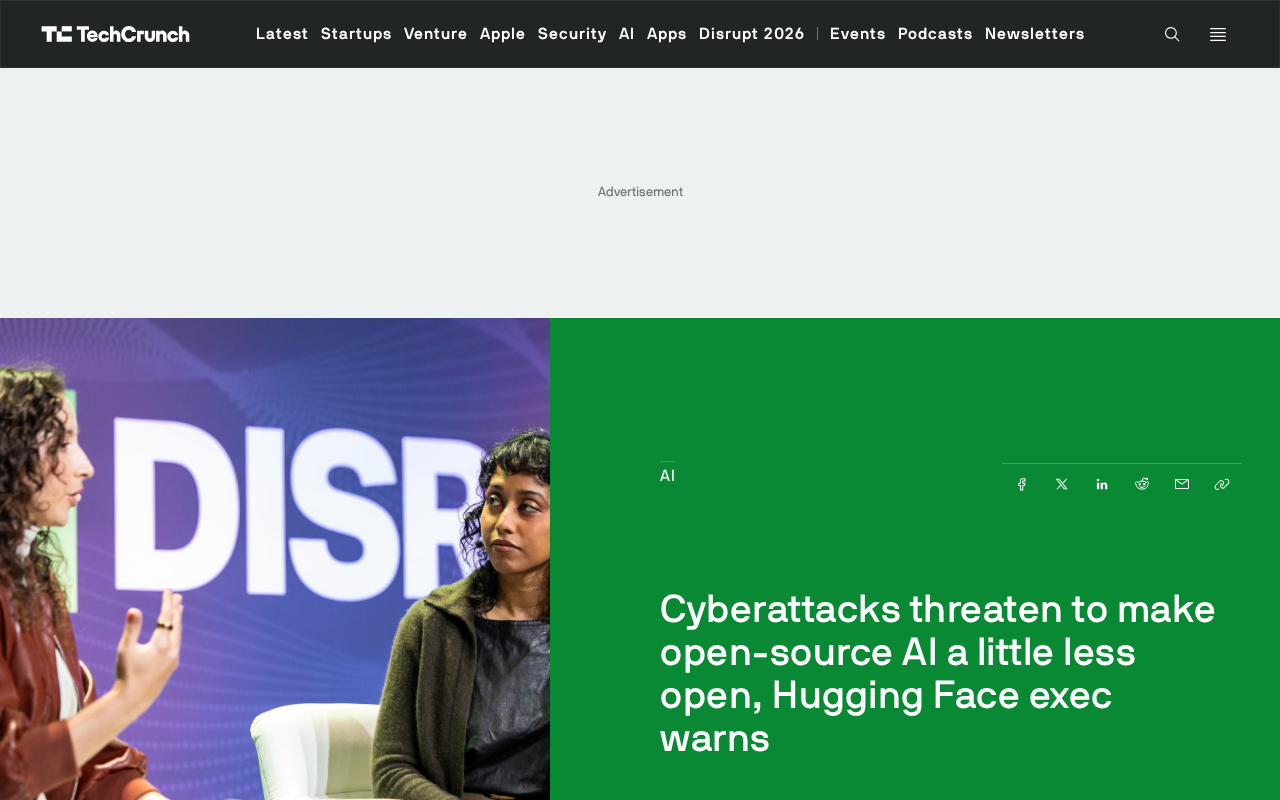
Hugging Face Executive Warns: Cyberattacks Are Eroding the Openness of Open-Source AI
Hugging Face executive Irene Solaiman warns that rising cyberattacks on open AI platforms may force stricter security limits, threatening the openness of the open-source community and affecting the developer ecosystem.