Reinforcement Learning Achieves a Win-Win for Wind Farm Noise Reduction and Power Generation
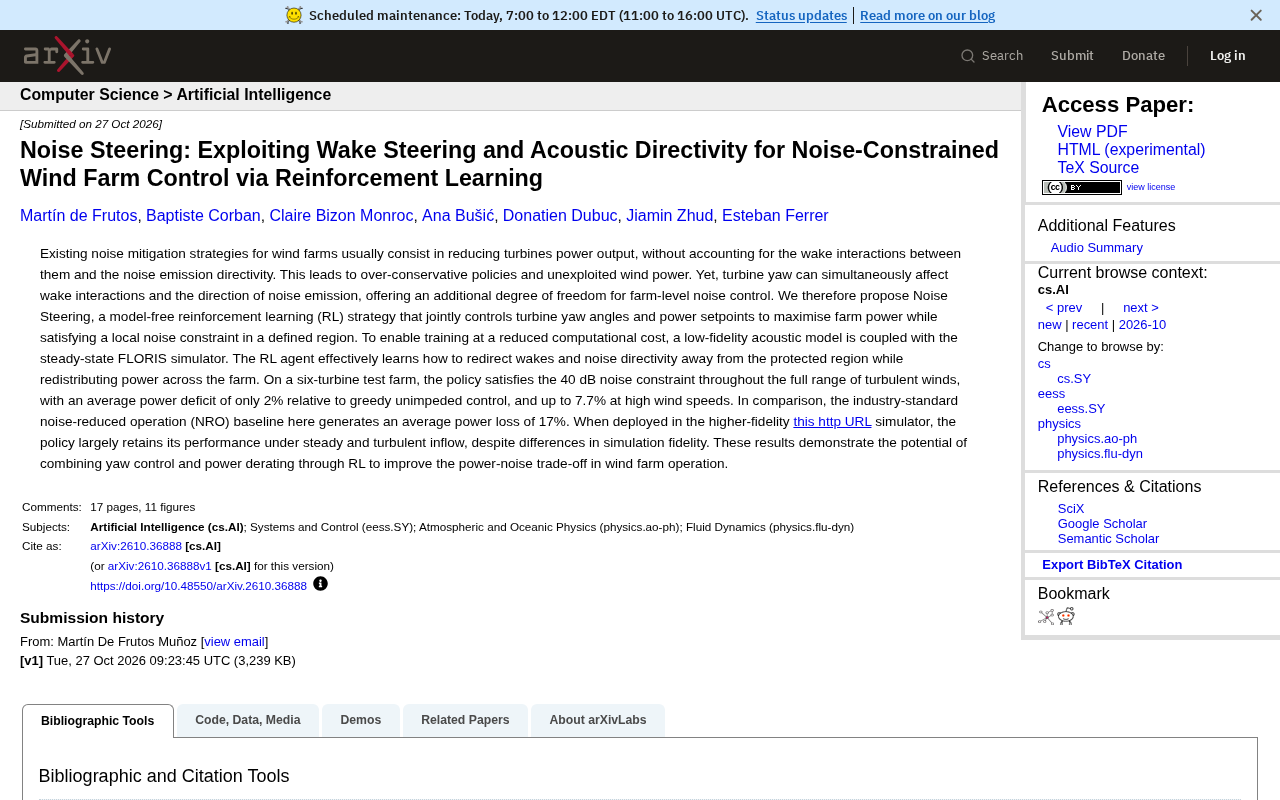
Reinforcement learning jointly controls yaw and power, cutting power loss from 17% to 2% while reducing noise.
Wind farm noise mitigation has long relied on reducing turbine power, with the industry-standard NRO causing an average 17% power loss in a six-turbine test wind farm. The Noise Steering study proposes that yaw angle can both alter wake propagation and adjust noise emission directionality, thus integrating yaw angle and power setpoints into a unified reinforcement learning framework to maximize total wind farm power while meeting 40 dB local noise constraints. Using a low-fidelity acoustic model coupled with the FLORIS simulator, the policy achieved only 2% average power loss (7.7% at high wind speeds), far better than the NRO baseline, and largely maintained performance when deployed to the high-fidelity FAST.Farm simulator, showing cross-model generalization.
Wind farm noise mitigation has long relied on the conservative approach of reducing turbine power output, overlooking the potential value of wake interactions and noise directivity. A study called Noise Steering proposes jointly controlling yaw angle and power setpoints via reinforcement learning, which can greatly reduce power generation losses while satisfying noise constraints.
Industry Pain Point: The Zero-Sum Game Between Noise Reduction and Power Generation
Existing wind farm noise mitigation strategies typically directly curtail turbine output power, neither considering wake interactions between turbines nor the directionality of noise emission. This one-size-fits-all approach to noise reduction leads to overly conservative policies, leaving a large amount of wind energy resources underutilized. According to the study, the industry-standard Noise Reduced Operation (NRO) mode causes an average power loss of 17% in a six-turbine test wind farm.
The root of the problem is that traditional methods treat noise as a byproduct of power rather than a dimension that can be actively managed through intelligent control.
Noise directivity refers to the fact that noise radiated by wind turbines is not uniform in all directions but varies significantly with propagation direction. Due to factors such as blade rotation, nacelle geometry, and tower shielding, the sound pressure level of a turbine can differ by several decibels between downwind and lateral directions. This characteristic means that by adjusting the yaw angle to change the turbine's orientation, the noise "beam" can be steered away from protected areas such as residential neighborhoods, without simply reducing power. Traditional noise reduction standards (such as NRO) do not exploit this degree of freedom, thus incurring unnecessary power generation costs.
Core Idea: Yaw Control Simultaneously Adjusts Wake and Noise Direction
Turbine yaw angle is an underappreciated degree of freedom—it not only changes the propagation path of wakes within the wind farm but also affects the directionality of noise emission. Noise Steering leverages this dual effect by incorporating yaw angle and power setpoints into a unified reinforcement learning framework to maximize total wind farm power while satisfying local noise constraints in designated areas.
To achieve low-cost training, the researchers coupled a low-fidelity acoustic model with the steady-state FLORIS simulator, allowing the reinforcement learning agent to learn a policy in the simulated environment: how to steer wakes and noise directivity away from protected areas while reallocating power output among turbines.
Wake effect is the phenomenon in which upstream turbines extract energy from the wind, creating a low-speed, high-turbulence wake region downstream that reduces the incoming wind speed and power generation of downstream turbines. In multi-turbine wind farms, wake losses can account for 10%-20% of total power generation. Yaw control can adjust wakes because when a turbine is misaligned with the incoming wind direction, its wake deflects laterally, thereby "yielding" some wind resources to downstream turbines. This mechanism has been used in wind farm coordinated control research, and Noise Steering further incorporates noise directivity into the same framework.
FLORIS (Flow Redirection and Induction in Steady State) is a steady-state wind farm control simulation tool developed by the National Renewable Energy Laboratory (NREL). It uses engineering wake models to quickly compute wind farm power and loads at a computational cost far lower than large-eddy simulation or CFD, making it suitable as a training environment for reinforcement learning. Its limitation lies in the simplification of turbulence and transient effects, necessitating validation with high-fidelity tools such as FAST.Farm.
Measured Performance: Average Power Loss of Only 2%
In experiments on a six-turbine test wind farm, the Noise Steering policy satisfied the 40 dB noise constraint across the full range of turbulent wind speeds. Compared with unconstrained greedy control, the average power loss was only 2%; even under high wind speed conditions, the loss remained within 7.7%. By contrast, the industry-standard NRO baseline had an average power loss of up to 17%—a gap of nearly an order of magnitude.
More importantly, when the policy was deployed to the higher-fidelity FAST.Farm simulator, despite differences in simulation fidelity, the policy largely maintained its original performance under both steady-state and turbulent inflow conditions, indicating a degree of cross-model generalization capability.
FAST.Farm is a multi-turbine aeroelastic simulation framework developed by NREL, based on the FAST single-turbine model coupled with wake dynamics. It can simulate turbulent inflow, wake meandering, and turbine structural response, with fidelity significantly higher than FLORIS but at a computational cost several orders of magnitude greater. In the study, FAST.Farm was used for deployment validation to test whether a policy trained on a low-fidelity model could maintain performance in a more realistic physical environment—this is precisely the core challenge of transferring reinforcement learning from simulation to reality.
Implications and Limitations
This study demonstrates the potential of jointly optimizing yaw control and power derating via reinforcement learning, offering a new approach to the power-noise trade-off in wind farm operation. However, the current validation is still based on a small-scale six-turbine test wind farm. The gap between the low-fidelity acoustic model and real sound propagation, as well as the complexity of wake coupling in larger-scale wind farms, are questions that need to be addressed in future work.
From a methodological perspective, the value of Noise Steering extends beyond the wind energy sector—it exemplifies how reinforcement learning can coordinate multiple physically coupled control variables to approach optimal economic output while satisfying environmental constraints.
One-line Summary
Reinforcement learning jointly controls yaw angle and power, reducing power loss from 17% to 2% while reducing noise.
Paragraph Summary
Wind farm noise mitigation has long relied on reducing turbine power, with the industry-standard NRO causing an average power loss of 17% in a six-turbine test wind farm. The Noise Steering study proposes that yaw angle can not only change wake propagation paths but also adjust noise emission directionality, thus incorporating yaw angle and power setpoints into a unified reinforcement learning framework to maximize total wind farm power while satisfying 40 dB local noise constraints. The study trained the policy using a low-fidelity acoustic model coupled with the FLORIS simulator. In the six-turbine wind farm test, the average power loss was only 2%, and 7.7% under high wind speeds, far outperforming the NRO baseline. After deployment to the high-fidelity FAST.Farm simulator, the policy largely maintained its performance, demonstrating cross-model generalization capability. This work provides a new approach to the power-noise trade-off in wind farms, but still requires validation under larger-scale wind farms and real sound propagation conditions.
Related articles

Last Week Tonight Exposé: The Dangerous Ties Between Politicians and White Supremacy
Last Week Tonight investigates Georgia Senate candidate Mike Collins and Florida candidate Marshall Rawson, exposing their multiple ties to white supremacists and the Republican Party's silent response.
AI Buzz Weekly: GPT-6.5 Leak, New Claude Model, and MiniMax's Cost-Effectiveness
This week's AI buzz roundup: suspected GPT-6.5 leak, Microsoft configs showing GPT-6.1 Tera, Anthropic's new model that can identify entire classes of bugs, disappointing early Gemini 4 Carbon results, and MiniMax M3.1 Flash beating Claude Opus 5 and GPT-5.6 Sol in benchmarks at extremely low cost.

AI Briefing: Gemini 4 Carbon Released, Ant Open-Sources Ling-3.1
AI Briefing: Google releases Gemini 4 Carbon qubit model, claiming to surpass Opus 5.5 with half-price tokens; Ant open-sources Ling-3.1-1019 for real-task Personal Agents; domestic AI drug discovery succeeds in 18 of 19 projects, hitting all 6 GPCR targets; zero-revenue company valued at $20B raises another $1B; Sichuan convenience store robot sales fail.