Replit Agent Lands on Slack: Write Code and Build Projects Right in Your Channels

Replit Agent comes to Slack, shifting the AI coding entry point from the IDE to the team chat stream.
Replit has officially announced that Replit Agent is now available on Slack. Users can call on this AI coding assistant directly in all channels to advance tasks around projects, connect to already-integrated tools, and get instant answers. The article argues that this marks a shift in the main battlefield of AI coding from editors and terminals to the everyday team collaboration interface, shortening the path from proposing a requirement to seeing a runnable result and lowering the barrier for non-engineering members to initiate technical tasks. The historical discussions accumulated in Slack channels provide the Agent with natural context and are expected to alleviate the pain point of repeatedly explaining background. However, the announcement does not disclose key details such as permission boundaries, conflicts from multi-user calls, and operational traceability, which will determine its stability in real teams. Overall, competition in AI coding is extending from model capability to distance from the workflow.
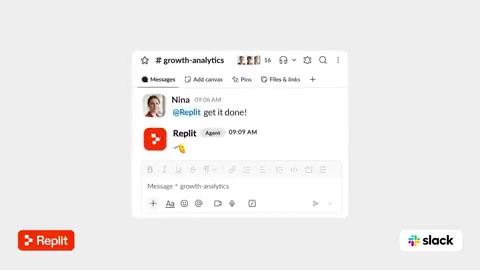
Replit has officially announced that Replit Agent is now available on Slack. Users can call on this AI coding assistant directly within Slack channels to handle project tasks, connect to already-integrated tools, and get instant answers. This move pushes AI coding capabilities from the browser-based IDE into the main battleground of everyday team collaboration.
From IDE to Chat Window: The Entry Point for AI Coding Is Shifting
Over the past year, the main battlefield for AI coding tools has been the editor and the terminal. Replit Agent itself is an agent capable of understanding natural language instructions and automatically generating and running code. Bringing it into Slack means that "writing code" now starts to appear in the same interface where requirements are discussed and progress is synced.
According to Replit's official announcement on X (formerly Twitter), users can interact with the Agent directly in all #channels, without having to switch back and forth between different tabs. The official announcement used the phrase "No more circling back," pointing precisely at the long-standing problem in team collaboration of repeated confirmation and passing context back and forth.
Putting the Agent into the chat stream is essentially about shortening the path from "proposing a requirement" to "seeing a runnable result." For members without an engineering background, this lowers the psychological barrier to initiating a technical task; for engineers, it turns fragmented discussions directly into executable actions.
What It Can Do: Projects, Tools, and In-Channel Q&A
The official announcement outlines three core capabilities:
- Advance projects within channels: The Agent can work around specific projects, rather than only answering isolated code questions.
- Connect to already-integrated tools: Replit mentions the ability to "link connected tools," i.e., bringing already-connected tools into the Agent's scope of work.
- Get answers directly: Ask a question in any channel and get a reply without leaving the current conversation.
Combined, these three points sketch out a scenario: a team discusses a feature in Slack, casually @-mentions the Agent, and asks it to check project status, call relevant tools, propose an implementation, or just go ahead and do it. The whole process stays within the same context, and the discussion record and the execution record naturally align.
The Value of Context Continuity
AI coding tools have long suffered from a pain point: every conversation requires re-explaining the background. Slack channels themselves accumulate a project's historical discussions, decision processes, and division of labor—information that forms a natural context. Once the Agent is embedded in a channel, it can in theory get closer to the team's real project context and reduce repetitive descriptions.
However, the official announcement does not specify which channel history the Agent actually reads or how permission boundaries are drawn. For enterprise users, this is a key detail that needs to be confirmed before deployment.
Slack's channel history effectively forms a continuously evolving team knowledge base, containing unstructured information such as requirement changes, technical decisions, and incident retrospectives. For an AI Agent to leverage this information, it usually needs to rely on retrieval-augmented generation (RAG) mechanisms: splitting channel messages into segments by time, participant, and topic, building a vector index, and then recalling relevant segments as context when a user asks a question. This process involves controlling the visibility scope of messages—the Agent can only read channels that the caller has permission to access; otherwise it would cause unauthorized disclosure. In addition, Slack's message formats (threads, emoji reactions, file attachments) also need to be parsed into semantic units that the model can understand. Replit's announcement does not disclose the specific approach it uses, but it can be inferred that achieving "context continuity" while safeguarding enterprise data boundaries involves engineering complexity far greater than simple message forwarding.
Impact on How Teams Collaborate
Putting an AI Agent into an instant messaging tool is not just adding another entry point—it changes how tasks are initiated.
In the traditional process, the requester writes a document, engineers schedule the work, and then they enter the development environment to start. Once the Agent is available within channels, some small tasks can be started right on the spot during discussion, compressing the feedback cycle. This is better suited to lightweight needs such as prototype validation, script writing, and data queries, rather than large changes that require strict review.
For Replit, this is a channel expansion: embedding the product into tools users already use frequently, rather than requiring users to migrate to a new workbench. This kind of "parasitic" integration is becoming increasingly common in the collaboration software ecosystem, and Slack itself is continuously bringing in various AI applications.
"Parasitic" integration (also called embedded integration or in-workflow embedding) refers to a product that does not require users to switch their primary work interface, but instead takes up residence in the high-frequency tools users already have in the form of an app, bot, or plugin. The core advantage of this model is lower adoption cost: users do not need to change habits or sync data across multiple systems. Slack's App Directory already contains a large number of such applications, covering scenarios such as project management, CI/CD notifications, and customer service. For AI coding tools, embedding into chat tools brings an additional benefit—natural language conversation is itself Slack's native interaction mode, so users do not need to learn new commands or interfaces. But the cost is deeper dependence on the host platform, with functional boundaries constrained by Slack's API capabilities and review policies; once the platform changes its strategy, the integrator must adapt passively.
Questions to Watch
This announcement contains limited information, and several questions remain unanswered: how the Agent's permissions within channels align with Slack's member permission system; how task conflicts are avoided when multiple people call it at the same time; and whether generated code and operation records are traceable. These details determine whether it can run stably in real teams, rather than just being smooth at the demo level.
What is certain is that competition in AI coding has expanded from "whose model is stronger" to "who is closer to the workflow." By choosing to send the Agent into Slack channels, Replit is betting on one judgment: in the future, more and more code will be born in conversation.
When multiple people call the same Agent at the same time, task conflict is a typical multi-agent collaboration problem. If two channel members simultaneously ask the Agent to modify files in the same project, write overwrites or state inconsistency may occur. Common mitigation measures include: allocating an independent session sandbox for each call, locking project resources, or adopting an isolation strategy based on Git branches. Operational traceability requires that every step of the Agent's actions (which messages were read, which tools were called, what code was generated) be recorded as audit logs and bound to Slack user identities. In enterprise environments, such logs often also need to meet compliance retention requirements. If Replit wants to promote this in medium and large teams, these mechanisms are no less necessary than the model's capabilities themselves.
One-line Summary
Replit Agent comes to Slack, shifting the entry point for AI coding from the IDE to the team chat stream.
Paragraph Summary
Replit has officially announced that Replit Agent is now available on Slack. Users can call on this AI coding assistant directly in all channels to advance tasks around projects, connect to already-integrated tools, and get instant answers. The article argues that this marks a shift in the main battlefield of AI coding from editors and terminals to the everyday team collaboration interface, shortening the path from proposing a requirement to seeing a runnable result and lowering the barrier for non-engineering members to initiate technical tasks. The historical discussions accumulated in Slack channels provide the Agent with natural context and are expected to alleviate the pain point of repeatedly explaining background. However, the announcement does not disclose key details such as permission boundaries, conflicts from multi-user calls, and operational traceability, which will determine its stability in real teams. Overall, competition in AI coding is extending from model capability to distance from the workflow.
Related articles

FastAPI Learning Path: From Beginner to AI Project Practice
A Bilibili creator recommends *FastAPI Web Development: From Beginner to Advanced with Practical Projects*. This article outlines the FastAPI learning path: target audience, the 15-chapter six-part structure, project-driven learning, and practical directions from web backend to AI Agents, helping beginners avoid detours.

Reverse-Engineering Taobao's sign Signature Parameter with AI in 10 Minutes: A Practical Walkthrough
Based on a Bilibili hands-on demo, this article explains how to combine DeepSeek with vision models to automatically reverse-engineer Taobao's sign signature parameter, track dynamic titter and token values, and successfully scrape product data within ten minutes—while analyzing the capability boundaries and compliance risks of AI Agents in crawler reverse engineering.

LangChain+MCP from Beginner to Practice: A Deep Dive into the Bilibili Tutorial
A deep dive into a Bilibili LangChain+MCP tutorial: framework positioning, agent abstraction, and MCP protocol basics. Why not hand-build frameworks, and how beginners can follow the code-practice path.