Replit Launches Conversation Sharing: Team Collaboration Without Copy-Paste

Replit launches conversation sharing, letting teammates see the full work process instead of a summary.
Replit has introduced a new feature that allows users to share a complete conversation with teammates in the same workspace, replacing the old practice of copying and pasting conclusions. The article notes that in AI-assisted development, conversations themselves have become important project assets, containing reasoning chains, trial-and-error records, and decision rationale that are lost when only a summary is shared. Sharing is limited to the workspace as controlled internal sharing, suitable for task handoffs, code reviews, and multi-person relay work. The author also offers a calm assessment: officials have not yet detailed permission granularity, revocability, or history management, and widespread conversation sharing may change team expression habits, so security details should be confirmed before use.
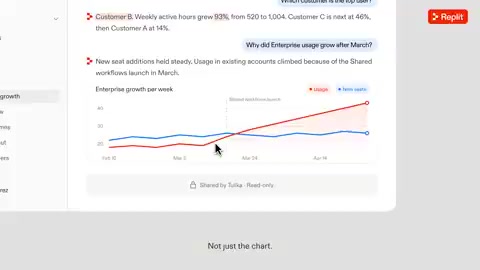
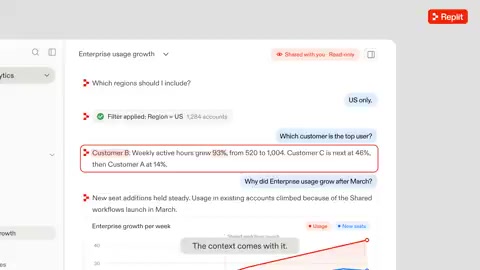
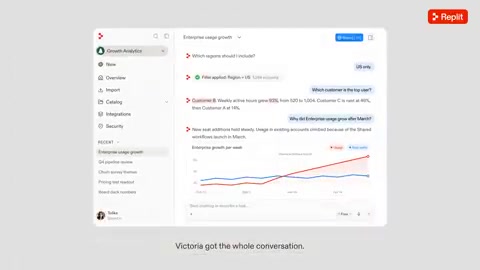
Replit recently rolled out a feature that looks minor but has far-reaching implications for team collaboration: users can now share a Replit conversation directly with workspace teammates, letting them see the complete work process rather than just a summary. The official statement on social media was blunt—"Now you can give your teammates the full context, not just a summary."
From "Pasting Conclusions" to "Seeing the Process"
In the past, collaborating in Replit usually meant copying key conclusions into a chat tool and sending them to colleagues. The problem: the reasoning chain behind a conclusion, the trial-and-error record, and the decision rationale often remain scattered across the original conversation. The recipient only sees the result, not the process.
The new feature changes that. After sharing a conversation, teammates can read the complete trail of work behind your findings, decisions, and next-step plans—no more copying entire chat logs. The official announcement specifically emphasizes that sharing is limited to teammates within the workspace, making it controlled internal team sharing.
Why "Process Visibility" Deserves Its Own Feature
The positioning of this feature isn't complicated, but it addresses a real collaboration pain point in AI-assisted development. As programming increasingly relies on AI conversations, the conversation itself becomes an important project asset: why this approach was chosen, which ideas were rejected, where things got stuck—this information is extremely valuable to whoever takes over.
Sharing only a summary compresses that asset into a one-line conclusion; sharing the full conversation lets teammates judge for themselves whether your reasoning holds and makes it easier to build on it. For tasks involving handoffs, reviews, or multi-person relay work, the difference is striking.
AI-assisted programming refers to a way of working in which developers use conversational tools driven by large language models to complete code generation, debugging, solution design, and other tasks. Unlike traditional IDE autocomplete tools, the output of these tools depends heavily on conversation context—the quality of the model's suggestions is closely tied to how questions are asked, the number of iterations, and the alternatives that were rejected. A complete AI conversation therefore actually records a reasoning trajectory from problem definition to solution convergence, and its intermediate steps (such as a failed attempt) often contain the information most valuable to a new person taking over. The industry typically calls this reusable context generated through conversation "context assets," which is distinct from the final code and constitutes procedural knowledge.
Impact on Team Workflows
From a workflow perspective, conversation sharing shifts the "communication cost" from the recipient back to the original context. Teammates no longer need to ask "What were you thinking at the time?" or guess to fill in missing pieces.
Its use cases are clear: getting someone up to speed quickly during a task handoff, reviewing the decision process before code review, and clarifying which discussion each person's judgment was based on during multi-person collaboration. Limiting sharing to the workspace also avoids the risk of accidentally making internal discussions public.
Permission granularity refers to the smallest unit of authorization that can be controlled for a shared object. In conversation sharing, this may involve: whether to share the entire conversation or only certain turns, whether the recipient can continue asking follow-up questions on top of the conversation, whether sharing can be revoked at any time, and whether sharing records are logged and auditable. The finer the granularity, the better teams can balance "letting teammates see enough context" with "avoiding exposure of sensitive discussions." For conversations involving customer information, key discussions, or unreleased product plans, coarse-grained whole-conversation sharing may introduce compliance risks, so confirming the permission model before formal adoption is a necessary practice.
A Calm Assessment
It's worth noting that currently public information is limited to a description of the feature itself. Officials have not detailed the permission granularity after sharing, whether conversations can be revoked, or how history records are managed. For teams that value information security, these are questions worth confirming before actual use.
Another point worth watching is whether conversation sharing will make team communication "heavier"—when every conversation may be shared, people's way of expressing themselves in conversations may also change. This is both an improvement in collaboration efficiency and potentially a new habit adjustment.
Overall, this is a small feature pointing in the right direction: it acknowledges that AI conversations themselves are part of the work output and turns them from private drafts into reusable team knowledge. For teams collaborating on Replit, it's worth trying right away.
Related articles

Last Week Tonight Exposé: The Dangerous Ties Between Politicians and White Supremacy
Last Week Tonight investigates Georgia Senate candidate Mike Collins and Florida candidate Marshall Rawson, exposing their multiple ties to white supremacists and the Republican Party's silent response.
AI Buzz Weekly: GPT-6.5 Leak, New Claude Model, and MiniMax's Cost-Effectiveness
This week's AI buzz roundup: suspected GPT-6.5 leak, Microsoft configs showing GPT-6.1 Tera, Anthropic's new model that can identify entire classes of bugs, disappointing early Gemini 4 Carbon results, and MiniMax M3.1 Flash beating Claude Opus 5 and GPT-5.6 Sol in benchmarks at extremely low cost.

AI Briefing: Gemini 4 Carbon Released, Ant Open-Sources Ling-3.1
AI Briefing: Google releases Gemini 4 Carbon qubit model, claiming to surpass Opus 5.5 with half-price tokens; Ant open-sources Ling-3.1-1019 for real-task Personal Agents; domestic AI drug discovery succeeds in 18 of 19 projects, hitting all 6 GPCR targets; zero-revenue company valued at $20B raises another $1B; Sichuan convenience store robot sales fail.