Replit Launches Government Edition: How AI Coding Is Reshaping Public Sector Software

Replit launches a government edition, using AI to turn government knowledge into software tools
Replit announced "Replit for Government," a service for governments at all levels in the US and internationally, covering national, state, local, tribal, and territorial governments. Its core proposition is using AI coding to turn shared knowledge like documents and processes into runnable tools, bypassing long procurement cycles and high customization costs. The direction addresses real needs, but details on data security, FedRAMP compliance, pricing, and customer cases are undisclosed.
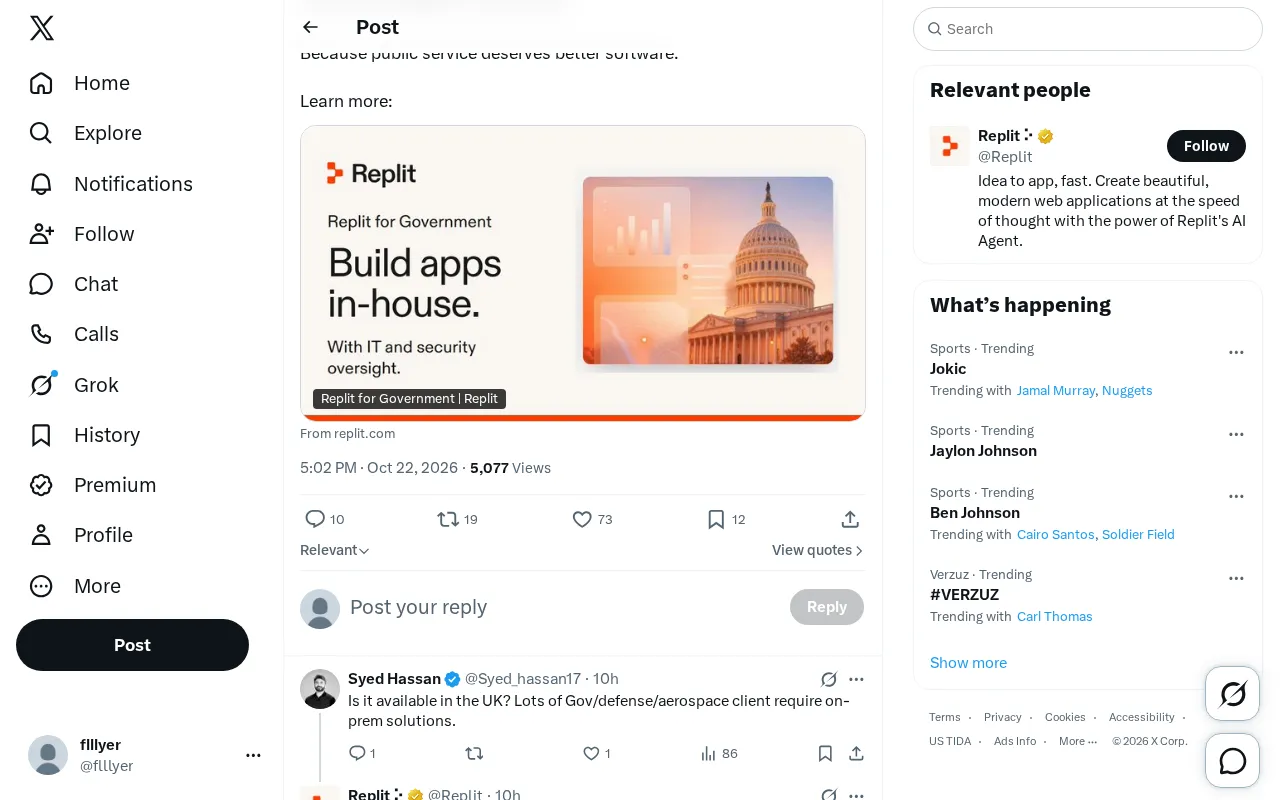
Replit recently announced the launch of "Replit for Government," a service offering AI-powered coding capabilities to government agencies at all levels in the US and internationally. The news came from Replit's official social media account. The core information is thin, but the signal is worth noting: AI coding tools are moving from developer communities into the public sector.
From Developer Tool to Government Infrastructure
Replit was originally an online coding platform for developers, known for running code instantly in the browser, collaborative editing, and AI-assisted programming. With this government-specific edition, it's no longer content to serve individual developers or startup teams—it's aiming at national, state, local, tribal, and territorial governments.
The headline selling point in the official tweet is "super intelligence"—using AI to help civil servants turn shared knowledge into useful tools. In other words, the vast accumulation of documents, processes, and domain knowledge inside government can be rapidly transformed into runnable software applications through AI coding tools.
This positioning hits a long-standing pain point: government software procurement cycles are long and customization is expensive, so many internal needs never make it onto the IT department's priority list. If civil servants can describe requirements in natural language and have AI generate usable internal tools, the software delivery path would be dramatically shortened.
The difference between low-code/no-code and AI-assisted programming is worth clarifying. Low-code platforms let non-technical users build applications through visual drag-and-drop and pre-built components, but flexibility is limited to the modules the platform provides. AI coding tools generate real code from natural language, and the output is typically a program written in a standard programming language that can run independently of the platform and be further developed. Replit's positioning is closer to the latter: civil servants describe requirements in natural language, and AI generates runnable code and applications. Compared with low-code, this approach offers greater customization depth, but it places higher demands on correctness review of generated output, security vulnerability scanning, and ongoing maintenance—in government scenarios, a single logic error in an approval tool could directly create compliance risk.
Government software procurement has long been constrained by government procurement processes (such as the US GSA Schedule, SAM.gov registration, and the bidding and contract award mechanism). Under the traditional model, a custom system goes from requirements initiation, budget approval, and tendering to delivery, often taking years, and requires scheduling by a dedicated IT department. This leaves a large number of department-level small tool needs on hold. In recent years, US initiatives such as "Civic Tech" and USDS (United States Digital Service) have sought to shorten this chain through agile development and internal technical teams. If Replit's government edition truly delivers, it would be targeting exactly this long-tail market of "department-level small tools" that traditional procurement overlooks—but procurement compliance, vendor qualifications, and contract frameworks remain external constraints it must adapt to.
Coverage: From Federal to Tribal Governments
The tweet explicitly lists the target audiences: national, state, local, tribal, and territorial governments. This coverage is quite comprehensive, and particularly interesting are tribal and territorial governments—these institutions typically have extremely limited IT resources, making their need for low-barrier development tools all the more urgent.
The phrase "in the US and internationally" suggests Replit intends to expand its government business beyond the US. However, the tweet provides no specific international customers or partnership cases, so this can only be viewed as strategic intent rather than a realized outcome.
Core Proposition: Public Service Deserves Better Software
The tweet closes with "Because public service deserves better software." It's a classic brand statement, but it also points to the real predicament of government software: dated interfaces, poor experiences, and slow updates. Replit is trying to position itself as the tooling layer that changes this.
The phrasing of turning "shared knowledge" into "useful tools" points to a specific application scenario for AI coding—a closed loop from knowledge management to tool generation. What government agencies have in abundance is regulations, operating manuals, and case libraries; what they lack is the ability to turn that knowledge into automated tools. If AI coding can genuinely lower the barrier to that transformation, the value is indeed significant.
What to View with Caution
The currently public information consists of just one tweet and a landing page link, lacking several key details: how the government edition differs from the standard version in data security, compliance certifications (such as FedRAMP), and deployment method (cloud or on-premises); what the pricing model is; and whether there are any signed government customer cases.
Public sector software procurement has far higher security and compliance requirements than commercial customers. AI coding tools involve code generation and data processing, so the compliance bar is only higher. Whether Replit has completed the relevant certifications is not mentioned in the tweet.
Additionally, "super intelligence" is a marketing-heavy term; the actual capability boundaries need to be assessed through product documentation and real cases, not slogans.
FedRAMP (Federal Risk and Authorization Management Program) is a cloud service security certification framework launched by the US federal government in 2011. Any vendor wishing to provide cloud services to federal agencies must obtain FedRAMP authorization, demonstrating that its system meets the NIST SP 800-53 series of security controls in areas such as access control, data encryption, continuous monitoring, and incident response. Authorization is divided into three impact levels—low, moderate, and high—and the process typically takes 12 to 18 months, involving extensive documentation and audits by third-party assessment organizations (3PAOs). For AI coding tools, the code generation process touches government data, source code, and business logic, making data residency and isolation of model training data key review points. Without FedRAMP authorization, federal agencies basically cannot procure the service; state and local governments often refer to similar frameworks such as StateRAMP. If Replit is serious about the government market, this certification is an unavoidable prerequisite.
Significance for the AI Coding Sector
Replit's move is an attempt at verticalization in AI coding tools. Over the past year or so, competition in the AI coding sector has centered on individual developers and enterprise R&D teams. The government market has been seen as a tough nut to crack due to high compliance barriers and long sales cycles. Replit proactively opening a government-specific line suggests it believes the purchasing power and demand in this market are real.
If this path works, other AI coding platforms will likely follow with public-sector editions. The inefficiency of government software has existed for a long time, and whether AI coding can be the cure depends on compliance capabilities and actual delivery results—not the volume of a launch event.
For now, this is a product launch with a clear direction but details still to be filled in. Worth watching, but not yet time to draw conclusions.
One-line Summary
Replit launches a government-specific edition, using AI to turn government knowledge into software tools
Paragraph Summary
Replit announced "Replit for Government," a service for governments at all levels in the US and internationally, covering national, state, local, tribal, and territorial governments. Its core proposition is to use AI coding capabilities to turn shared knowledge accumulated inside government—documents, processes, and more—into runnable tools, thereby bypassing the pain points of long procurement cycles and high customization costs in traditional government software. The article argues that this direction addresses real needs; tribal and territorial governments have limited IT resources and a particularly urgent need for low-barrier tools. However, the launch information comes only from a single tweet and a landing page; data security, compliance certifications such as FedRAMP, pricing model, and actual customer cases are all undisclosed, so real-world results remain to be seen. This move is an attempt at verticalization in AI coding tools, and if successful, it could prompt other platforms to follow suit.
Related articles

AI Comic Drama with WorkBuddy from Scratch: A Step-by-Step Skill Pack Installation Guide
Learn how to create AI comic dramas with WorkBuddy from scratch. This guide covers installation, Skill pack import and invocation, plus a script generation demo with manual revision tips to get you through the first step from script to storyboard.

WorkBuddy Agent Runs the Entire GEO Database Mining Pipeline with a Single Prompt
WorkBuddy agent automates GEO database mining: from data search and curation to batch correction, differential analysis, co-expression networks, feature gene screening, and immune infiltration—a single prompt generates a complete bioinformatics report, greatly lowering the barrier to bioinformatics analysis.

PC Memory Wasted? Hacker News Debates Centralized Data Centers
Hacker News users argue that personal computer memory is wasted and should be centralized in data centers, sparking debate on centralized vs. distributed computing resource allocation. This article analyzes the logic behind the claim, the costs of centralization, and new tensions in memory resource allocation in the AI era.