RIFT: An Open-Source Audio Visualization Tool Using GLSL Shaders Seeks Performance Optimization
Open-source audio visualization tool RIFT seeks community help to optimize shaders, components, UI, and performance.
Self-taught designer Revanth developed RIFT, a desktop audio visualization tool that combines audio tracks with clips, overlays sound-responsive GLSL shader effects, supports 4K ProRes export, and integrates MediaPipe body tracking. Built on Python, PyQt6, ModernGL, and GLSL, it is open source on GitHub. Though functional, it falls short of professional standards. Revanth seeks community collaboration on four fronts: shader optimization (fixing stuttering and export failures), improving professional visualization components like oscilloscopes and spectrum analyzers, UI/UX polishing, and preview/export performance. He doesn't need anyone to solve everything, and offers design expertise in return.
A self-taught designer, Revanth, is developing a desktop tool called RIFT that turns audio into dynamic visuals. Users simply load an audio track and video clips, overlay GLSL shader effects that respond to sound, and export video up to 4K ProRes. RIFT also integrates MediaPipe body tracking, adding more possibilities for visual creation.
RIFT is currently functional, and Revanth has used it to create visualizations for his own tracks. But he wants to take the project to a professional level and is publicly seeking community help, focusing on four areas: shader optimization, visualization components, UI/UX, and performance.
Tech Stack and Current State
RIFT is built on Python and PyQt6, with graphics rendering relying on ModernGL and GLSL, body tracking via MediaPipe, and some features also incorporating C#. The developer tests on a GTX 1650 GPU. This combination of technologies is fairly common in desktop creative tools, balancing development efficiency and rendering performance.
The project is open source on GitHub (repository: rogueexxxx-del/RIFT), making it easy for interested developers to review the code and provide feedback.
ModernGL is a lightweight Python wrapper around OpenGL that offers a cleaner API and less boilerplate than PyOpenGL, and is commonly used in Python graphics applications that need GPU acceleration. It allows developers to write GLSL shaders directly and manage GPU resources such as buffers and textures, while maintaining good interoperability with scientific computing libraries like NumPy. GLSL (OpenGL Shading Language) is the shader language that runs on the GPU; common audio visualization effects such as waveforms, particles, and glows are typically generated by fragment shaders computing pixel by pixel. Understanding GLSL's parallel execution model—each pixel computes independently, branching is costly, and texture sampling has latency—is a prerequisite for optimizing shader performance.
Four Major Optimization Directions
Revanth clearly lists the areas where help is needed, and community members can choose the part they are best suited for.
1. Shader Optimization
Some shader effects run slowly and cause the application to stutter when switching, and some effects fail to export correctly. The developer wants to make these effects faster and cleaner, and to replace older versions with new shaders that offer better visuals. This involves GLSL code optimization, reducing GPU state changes, avoiding unnecessary computation, and more.
2. Improving Visualization Components
RIFT plans to implement more professional visualization tools, including an oscilloscope, spectrum analyzer, spectrogram, and vectorscope. These components are standard fixtures in the audio visualization field, helping users analyze audio characteristics more precisely and generate corresponding visual feedback.
3. UI/UX Polishing
Although the core functionality works, the interface and interactions still have room for improvement. Revanth wants to fully implement the details from the design mockups in the application and create a unified, coherent visual style. As a designer, he has high standards for aesthetics and consistency.
4. Performance Improvements
Preview frame rate and export rendering speed are key to the user experience. Optimization directions may include multithreaded rendering, adjustments to GPU acceleration strategy, memory management, and more. A higher preview FPS makes the creative process smoother, while faster exports directly improve work efficiency.
Open-Source Collaboration and Giving Back
Revanth says he doesn't need anyone to solve all the problems—help with any one area is valuable. He welcomes feedback on the code and architecture, and is willing to give back with his design expertise—providing branding, UI, or visual design support for contributors' projects. This kind of skill-exchange model is fairly common in open-source communities and can effectively foster cross-disciplinary collaboration.
For developers interested in audio visualization, GLSL shaders, or desktop application performance optimization, RIFT is a project worth following. Its tech stack and challenges are representative, and contributing can both help the project grow and build relevant experience.
Background Notes
The four types of components mentioned in the article originate from standard measurement tools in professional audio engineering and broadcasting. An oscilloscope displays the instantaneous change in amplitude over time as a time-domain waveform; a spectrum analyzer uses FFT to decompose the signal into the frequency domain and show the energy distribution across frequency bands; a spectrogram is a three-dimensional representation of time, frequency, and energy, commonly used to observe how timbre evolves over time; and a vectorscope, originally used for video color phase analysis, is often borrowed in audio visualization to present the phase and correlation relationship between the left and right stereo channels. These components not only have analytical value—their graphics are also often used directly as visual elements.
In Python desktop applications, the GIL (Global Interpreter Lock) limits the parallel computing capability of multithreading, so performance optimization of the rendering pipeline often relies more on offloading computation to the GPU, using multiprocessing, or handing hot loops to libraries like NumPy that are backed by C. Regarding GPU acceleration strategies, common bottlenecks include repeatedly uploading textures every frame, shader compilation and switching overhead, and synchronization waits between the CPU and GPU. For export rendering, off-screen framebuffers (FBOs) combined with frame-by-frame readback can bypass the screen refresh rate limit, but this requires weighing VRAM usage against readback bandwidth.
One-line Summary
Open-source audio visualization tool RIFT seeks community help to optimize shaders, components, interface, and performance.
Paragraph Summary
Self-taught designer Revanth has developed RIFT, a desktop audio visualization tool that combines audio tracks with video clips, overlays GLSL shader effects that respond to sound, supports export up to 4K ProRes, and integrates MediaPipe body tracking. The project is built on Python, PyQt6, ModernGL, and GLSL, and is open source on GitHub. Although the tool is functional, it is still short of professional standards. Revanth is publicly seeking community collaboration focused on four directions: shader optimization (addressing stuttering and export failures), improving professional visualization components such as oscilloscopes and spectrum analyzers, UI/UX polishing, and improving preview and export performance. He doesn't need anyone to solve everything, and is willing to give back to contributors with his design expertise.
Related articles
AI Buzz Weekly: GPT-6.5 Leak, New Claude Model, and MiniMax's Cost-Effectiveness
This week's AI buzz roundup: suspected GPT-6.5 leak, Microsoft configs showing GPT-6.1 Tera, Anthropic's new model that can identify entire classes of bugs, disappointing early Gemini 4 Carbon results, and MiniMax M3.1 Flash beating Claude Opus 5 and GPT-5.6 Sol in benchmarks at extremely low cost.

AI Briefing: Gemini 4 Carbon Released, Ant Open-Sources Ling-3.1
AI Briefing: Google releases Gemini 4 Carbon qubit model, claiming to surpass Opus 5.5 with half-price tokens; Ant open-sources Ling-3.1-1019 for real-task Personal Agents; domestic AI drug discovery succeeds in 18 of 19 projects, hitting all 6 GPCR targets; zero-revenue company valued at $20B raises another $1B; Sichuan convenience store robot sales fail.
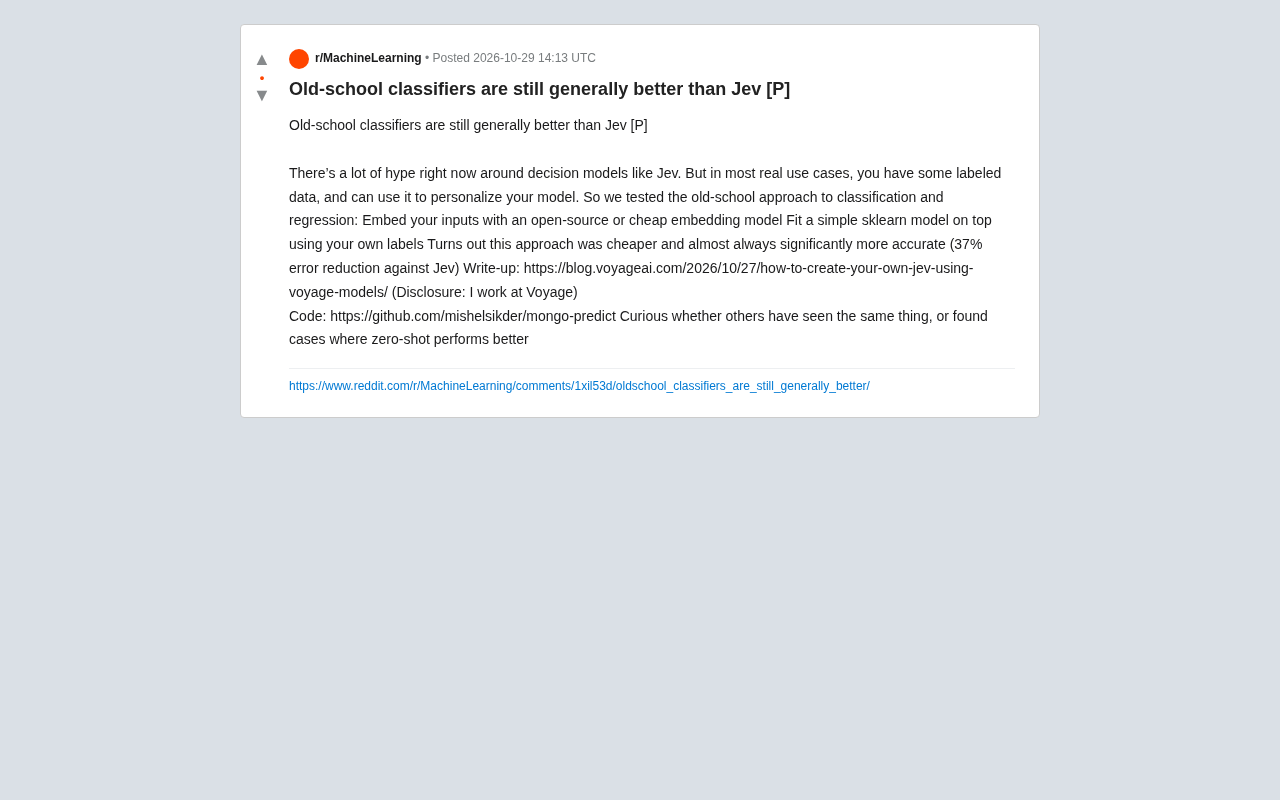
Old-School Classifiers Still Beat Jev: Embeddings + sklearn Cuts Error by 37%
Voyage AI engineers found that an old-school approach using open-source embedding models plus sklearn classifiers is cheaper and cuts error by 37% versus the popular decision model Jev. Discussing whether traditional methods are undervalued when labeled data exists, and the boundaries between zero-shot and supervised learning.