Row-Bot Demo: Give It a Goal and Step Away — How Multi-Turn AI Autonomy Works in Practice

Open-source local-first desktop AI assistant Row-Bot demonstrates goal-driven multi-turn autonomy in a three-turn fall launch task.
This article introduces the Row-Bot Demo from Reddit — a free, open-source, local-first desktop AI assistant for Windows, macOS, and Linux. In a fall launch scenario for a fictional shop, the user gives a goal with three subtasks (build a landing page, ask for the launch date, write an X post) constrained to 12 turns and 1 hour. Row-Bot designs the page, proactively asks for the date, then writes and self-checks the post, finishing in three turns. The article analyzes its restrained "stop and ask" behavior, human confirmation before publishing, and its core value in the orchestration layer, while noting that robustness, self-check accuracy, and tool-failure handling still need more testing.
Introduction: From Q&A to Goal-Driven Interaction
Most AI assistants work in a question-and-answer loop: the user gives an instruction, the AI responds, and so on. But the Row-Bot Demo recently shared on Reddit proposes a different approach — give it a goal, then walk away. This open-source, local-first desktop AI assistant attempts to complete tasks through multiple rounds of autonomous work, without continuous prompting from the user.
According to the original Reddit post, Row-Bot is a free, open-source, local-first desktop AI assistant that supports Windows, macOS, and Linux. Its core capability isn't single-shot responses but making progress toward a goal across multiple turns.
Local-first is a software architecture philosophy that prioritizes keeping data and computation on the user's device, with the cloud serving only as an optional sync or backup mechanism. The opposite is the "cloud-first" model, where an app's core logic and data are hosted on remote servers. Typical local-first characteristics include offline availability, user data sovereignty, low-latency response, and reduced privacy risk through end-to-end encryption or local storage. In the AI assistant context, local-first means that model inference — or at least task orchestration and context management — can run on the local machine, so the user's workflow data doesn't have to be uploaded to a third party. However, local-first is not the same as fully offline: in the Row-Bot demo, accessing a cloud model through a ChatGPT subscription represents a hybrid of "local orchestration + cloud inference."
How Row-Bot Works: A Complete Fall Launch Demo
Goal Setting and Three-Turn Execution
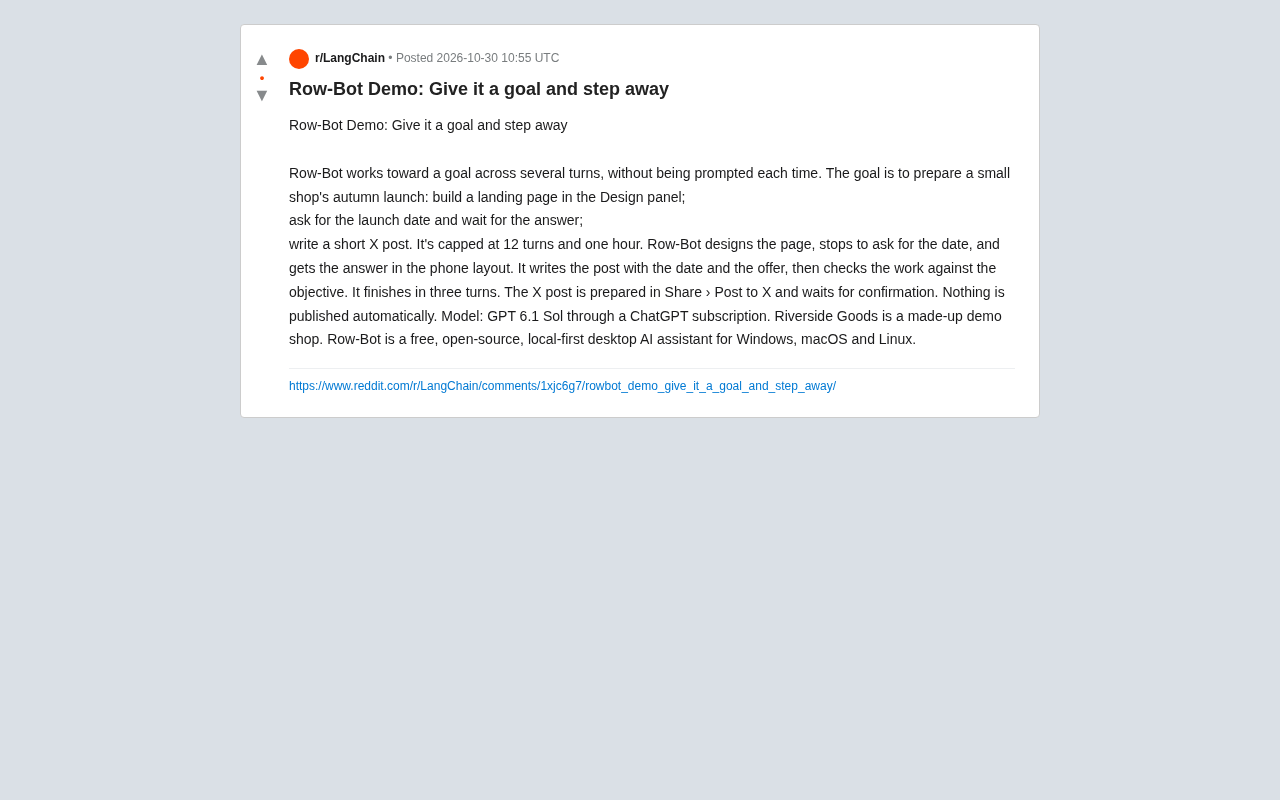
The demo scenario is a fall launch preparation for a fictional shop called "Riverside Goods." The goal given to Row-Bot contains three subtasks: build a landing page in the Design panel; ask for the launch date and wait for an answer; and write a short X post.
The entire task is constrained to 12 conversation turns and 1 hour. Row-Bot first designs the page, then proactively stops to ask for the date, receiving the answer through the mobile layout. It then writes a post containing the date and offer information, and finally checks its work against the goal. In the end, it completes the task in three turns.
The most noteworthy aspect of this process isn't speed — it's the behavior of "stopping to ask." Traditional AI assistants tend to guess everything at once, whereas Row-Bot demonstrates restraint by actively waiting for user input when uncertain.
Multi-turn autonomy refers to an AI system executing multiple steps in succession around a high-level goal without the user prompting it turn by turn, managing its own state and deciding what to do next along the way. What fundamentally distinguishes it from single-turn Q&A is that the system must maintain task context, decompose sub-goals, assess current progress, and decide — when information is insufficient — whether to keep reasoning or ask the user for help. Core challenges of multi-turn autonomy include turn-budget control (avoiding infinite loops or runaway costs), state consistency (remembering what's done and what's pending across turns), and self-checking capability (evaluating output against the original goal). The 12-turn/1-hour limit set in the Row-Bot demo is precisely an explicit constraint on the turn budget, forcing the system to converge to an acceptable result within limited resources.
Human Confirmation at the Publishing Step
The X post is prepared in Share › Post to X but sits in a waiting-for-confirmation state. Nothing is published automatically. This design choice reveals Row-Bot's product philosophy: the boundary between autonomous execution and ultimate control.
The combination of local-first and human confirmation is a meaningful balance point for users concerned about data privacy and operational risk.
Technical Details and Openness
According to the original post, the demo uses the GPT 6.1 Sol model, accessed through a ChatGPT subscription. Row-Bot itself isn't tied to any specific model; as an open-source project, its value lies more in the orchestration layer — how it manages multi-turn state, judges when to ask questions, and self-checks against the goal.
The 12-turn and 1-hour limits are also worth pondering. They serve both as a cost constraint and as an implicit classification of task complexity: if a goal can't be advanced to an acceptable state within 12 turns, it may need to be decomposed or redefined.
The orchestration layer is the software component in an AI assistant architecture that sits above the underlying model and coordinates the task flow. It doesn't generate text directly; instead, it decides when to call the model, what context to pass in, how to parse the output, and what to do next. Typical responsibilities include prompt assembly, tool/function call scheduling, multi-turn state storage, error retry and fallback strategies, and progress checks against the goal. The design quality of the orchestration layer often determines the success of multi-turn tasks more than the model itself — the same model under different orchestration strategies can exhibit vastly different levels of autonomy and reliability. As an open-source project that is "not tied to a specific model," Row-Bot's value proposition lies precisely in the orchestration layer: users can swap out the underlying model while reusing the multi-turn management, question-judgment, and self-check logic.
The Boundaries and Implications of Multi-Turn Autonomy
When to Stop
The most instructive detail in the Row-Bot demo is "stopping to ask for the date." The key challenge for multi-turn autonomous systems isn't how many steps they can execute in a row — it's identifying information gaps and proactively seeking input. If this judgment is poorly calibrated, the system either falls into guessing or interrupts the user too frequently.
The Practical Significance of Local-First
The open-source, local-first positioning means users can run the assistant on their own machines without handing workflow data over to the cloud. For small teams handling sensitive business information, this could be the deciding factor in adoption.
Questions That Remain
A single demo can't answer a few key questions: when tasks are more complex and sub-goals depend on each other, is Row-Bot's turn management still robust? How accurate is the self-check step? When a tool call fails, does it retry, degrade, or give up? These all require more public testing to verify.
Conclusion
The Row-Bot Demo doesn't showcase an all-purpose assistant but rather a shift in interaction paradigms: from "step-by-step command" to "goal delegation." Completing fall launch prep in three turns, proactively asking for missing information, and waiting for confirmation before publishing — combined, these behaviors sketch the outline of a restrained yet practical autonomous assistant. For those following AI application deployment and open-source tools, this project is worth keeping an eye on.
One-line Summary
Open-source local-first desktop AI assistant Row-Bot demonstrates goal-driven multi-turn autonomy, completing a fall launch task in three turns.
Paragraph Summary
This article introduces the Row-Bot Demo shared on Reddit — a free, open-source, local-first desktop AI assistant supporting Windows, macOS, and Linux. The demo is set as a fall launch preparation for a fictional shop called "Riverside Goods." The user gives a goal with three subtasks — build a landing page, ask for the launch date, and write an X post — constrained to 12 turns and 1 hour. Row-Bot designs the page first, proactively stops to ask for the date, then writes the post and self-checks against the goal after receiving the answer, completing the task in three turns. The article highlights its restrained "stop and ask" behavior, the human confirmation required before publishing, and the fact that its core value lies in the orchestration layer rather than model binding. It also notes that the robustness of multi-turn autonomy on complex tasks, self-check accuracy, and tool-failure handling still need more testing to verify.
Related articles

LLM Application Development: A High-Paying Career Guide for Ordinary People
LLM application development offers fresh graduates up to 35K/month, with SP offers reaching 600K. This article explains the core skills, how to break in, and how ordinary people can seize AI opportunities through learning by doing.

Say Goodbye to AI Influencer Faces: A Complete Guide to Creating Visual Assets for AI Comic Dramas from Scratch
Bilibili creator shares a full workflow for zero-basics AI comic drama visual assets: use Doubao Work skills with script-first, visual references, and real-person texture to escape AI influencer faces, then lock character and scene consistency with asset sheet layouts, weapon detail images, scene nine-grids, and cinematic color palettes.

The AI Production Pipeline Behind Great Videos: From Research to Agent Validation
AI video production isn't just a model race. This article breaks down a transferable four-step pipeline: researching professional workflows, organizing a skill checklist, configuring agents, and experimental validation—and explains how general-purpose LLMs like DeepSeek can replace paid tools to run the entire process.