RRF Constant k=60 Hurting Retrieval? SchemaGate Author Tests and Corrects
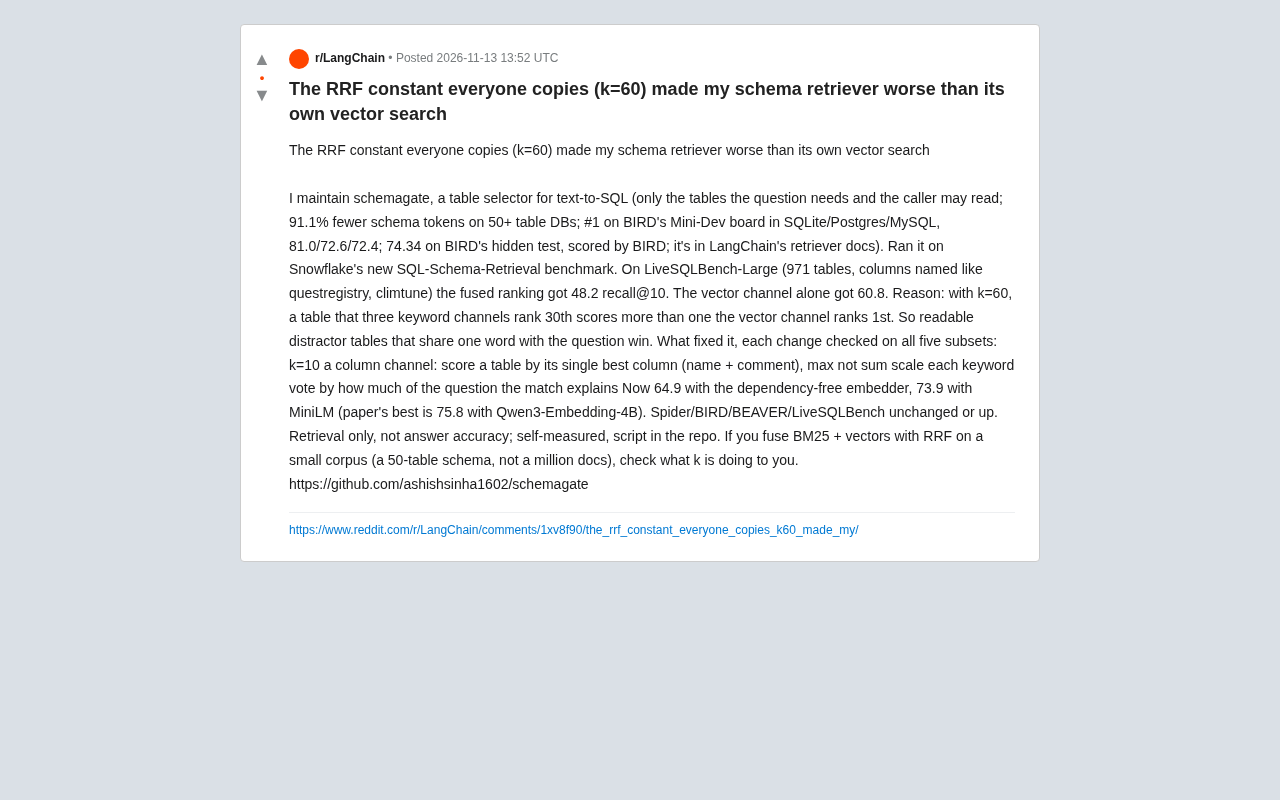
RRF's default constant k=60 actually degrades schema retrieval; after tuning, it surpasses pure vector retrieval.
SchemaGate's author shared a counterintuitive tuning experience on Reddit: the widely used RRF constant k=60 caused fused retrieval (recall@10=48.2) to underperform the pure vector channel (60.8) in text-to-SQL schema retrieval. The root cause is that k=60 over-rewards low ranks across multiple channels, letting distractor tables that share only a single word win. Through three corrections—lowering k to 10, adding a column channel with max aggregation, and scaling keyword votes by explanatory power—recall@10 rose to 64.9 (dependency-free embedder) and 73.9 (MiniLM), close to the paper's best of 75.8. This case reveals that default parameters may fail when transferred to structured schema retrieval and reminds developers to check the impact of k when using RRF fusion on small corpora.
When RRF's Default Constant k=60 Becomes a Retrieval Bottleneck
In text-to-SQL tasks, accurately selecting the database tables required by a question is a core challenge. The author of the open-source project SchemaGate shared a counterintuitive tuning experience on Reddit: the widely copied Reciprocal Rank Fusion (RRF) constant k=60 actually made his schema retriever perform worse than pure vector retrieval on a particular benchmark.
According to the author, SchemaGate is a table selector whose goal is, in a database of 50+ tables, to return only the tables relevant to the question that the caller has permission to read, and it claims to reduce schema tokens by 91.1%. The project ranks first on the SQLite/Postgres/MySQL subsets of BIRD's Mini-Dev leaderboard with scores of 81.0/72.6/72.4, scores 74.34 on the BIRD hidden test set (scored by BIRD officially), and has been included in LangChain's retriever documentation.
Reciprocal Rank Fusion (RRF) is an unsupervised algorithm for fusing multi-channel retrieval results, commonly used in hybrid retrieval (e.g., BM25 + vector). Its formula is: for each document, compute the sum of the reciprocals of its ranks across channels, i.e., score(d) = Σ 1/(k + rank_i(d)), where rank_i(d) is the rank of document d in channel i (starting from 1), and k is a smoothing constant. The role of k is to weaken the absolute advantage of top-ranked documents: the larger k is, the smaller the score difference between different ranks, and the more the fused result favors documents that rank highly across multiple channels; the smaller k is, the more important a high rank in a single channel becomes. k=60 originates from the empirical value in the original paper on the TREC dataset and was later widely copied as the default.
Unexpected Results on the New Snowflake Benchmark
The author ran SchemaGate on Snowflake's newly released SQL-Schema-Retrieval benchmark. On the LiveSQLBench-Large subset (971 tables, with column names like made-up words such as questregistry and climtune), the fused ranking achieved a recall@10 of only 48.2, while the vector channel alone reached 60.8. Fusion was more than 12 percentage points worse than a single channel.
The root cause lies in the smoothing effect of k=60. The author explains: when k=60, a table ranked 30th by all three keyword channels will have a higher fused score than a table ranked 1st by the vector channel. This means distractor tables that share only a single word with the question but are highly readable win out, because they can be hit by multiple keyword channels simultaneously.
LiveSQLBench-Large is a subset of Snowflake's released SQL-Schema-Retrieval benchmark, specifically designed to evaluate schema retrieval capability in text-to-SQL tasks. This subset contains 971 tables, and the table and column names are mostly made-up words (such as questregistry and climtune), with low lexical overlap with natural language questions, thus placing higher demands on the retriever's semantic matching ability. The benchmark provides metrics such as recall@10, which measures whether the top 10 tables returned by the retriever include all the tables required by the question.
Three Corrections and Effect Validation
The author tested three changes one by one, each checked across all five subsets:
- k=10: Reduce the RRF constant from 60 to 10, weakening the excessive reward for low ranks across multiple channels.
- Add a column channel: Score a table using its best single column (name + comment), taking the maximum rather than the sum, to avoid inflated scores from stacking multiple columns.
- Scale keyword votes by explanatory power: The vote weight of each keyword channel is scaled according to how much of the question the match can explain, rather than treating all equally.
After the adjustments, recall@10 increased to 64.9 with a dependency-free embedder and reached 73.9 with MiniLM. The author notes that the best result in the paper is 75.8, using Qwen3-Embedding-4B. Other benchmarks such as Spider, BIRD, BEAVER, and LiveSQLBench remained unchanged or improved.
Column channel is a newly added retrieval channel in SchemaGate, motivated by the idea that table-level retrieval may miss relevant tables because table names do not match the question's vocabulary, but the name or comment of a certain column in the table may be highly relevant to the question. This channel computes the match score between all columns (name + comment) of each table and the question, and takes the maximum as the table's score rather than the sum. Taking the maximum avoids inflation caused by stacking multiple columns and ensures that only genuinely relevant columns can boost a table's score.
Key Caveats and Applicable Scenarios
The author clarifies several boundaries: this is a retrieval metric, not answer accuracy; the results are self-measured, and the scripts have been placed in the repository. He specifically cautions that if you use RRF fusion with BM25 + vector on a small-scale corpus (e.g., a schema of 50 tables rather than millions of documents), you should check the actual impact of the k value on your results.
The value of this case lies in revealing a common misconception: default parameters widely validated in the document retrieval domain may completely fail when transferred to structured schema retrieval. The RRF k value essentially controls the fusion weight between top-ranked and lower-ranked results, and corpus size, number of channels, and noise distribution all change the optimal value. For developers building RAG or text-to-SQL pipelines, blindly copying k=60 may obscure the fact that a single channel could have performed better.
Project address: https://github.com/ashishsinha1602/schemagate
BM25 is a classic sparse retrieval algorithm based on term frequency and inverse document frequency, commonly used for keyword matching. In RRF fusion, BM25 is usually one of the keyword channels, combined with a vector channel (dense retrieval). BM25 is sensitive to lexical overlap and easily hits distractor documents that share only a single word; the vector channel is based on semantic similarity and is more robust to made-up words or vocabulary mismatches. When fusing the two, the choice of k value significantly affects the final ranking, especially when the corpus is small and the noise distribution differs greatly from general document retrieval.
Related articles

Van Hollen on Holding Trump Accountable: Hearings and Building the Evidentiary Record
Senator Chris Van Hollen on holding the Trump administration accountable: focused hearings to expose corruption and wrongdoing, plus building an evidentiary record now to preserve space for future criminal charges.

Generating SVG and 3D Models with the Codex Plugin: A Hands-On Guide for Developers with Zero Art Background
Codex's SVG & 3D Design plugin lets developers with zero art background generate vector graphics and 3D models via code—editable, Blender-ready, with best practices built in.

Why Recursive Self-Improvement Holds Up: Responding to Six Major Objections One by One
Dwarkesh Patel responds point by point to six major objections about recursive self-improvement and superintelligence by 2030: whether verifiable proxy metrics exist, the human-link threshold for RSI, whether the math explosion can be analogized to AI research, the experimental compute bottleneck, reward hacking and the motivation for power-seeking, and whether METR acceleration rates can be extrapolated.