Running a World Model on Raspberry Pi Pico 2 W: A Tiny AI Game Engine Goes Open Source

Open-source tinyworldformer runs a tiny world model on the Pico 2 W microcontroller to drive a game, exploring extreme edge AI.
tinyworldformer is an open-source project that runs a tiny world model on highly resource-constrained microcontrollers like the Raspberry Pi Pico 2 W and drives game visuals in real time, earning 267 points and 18 comments on Hacker News. Through quantization, pruning, and a minimalist architecture, it compresses the model into KB-level memory, replaces floating-point with fixed-point arithmetic, and keeps only the minimal state representation the game requires. Community discussion focuses on its practical boundaries, the possibility of scaling to more complex scenarios, and the impact of compression on generation quality. The article sees it as more of a proof of concept, but one that demonstrates the reference value of "task-oriented minimalism" in edge AI deployment and reveals a viable path of customizing tiny models for specific tasks rather than forcing in large models.
When World Models Meet Microcontrollers
World models are usually associated with large-scale compute and GPU clusters, but the open-source project tinyworldformer shows another possibility: running a tiny world model on a microcontroller like the Raspberry Pi Pico 2 W and letting it drive game visuals. The project earned 267 points and 18 comments on Hacker News, signaling growing developer interest in "extreme edge AI."
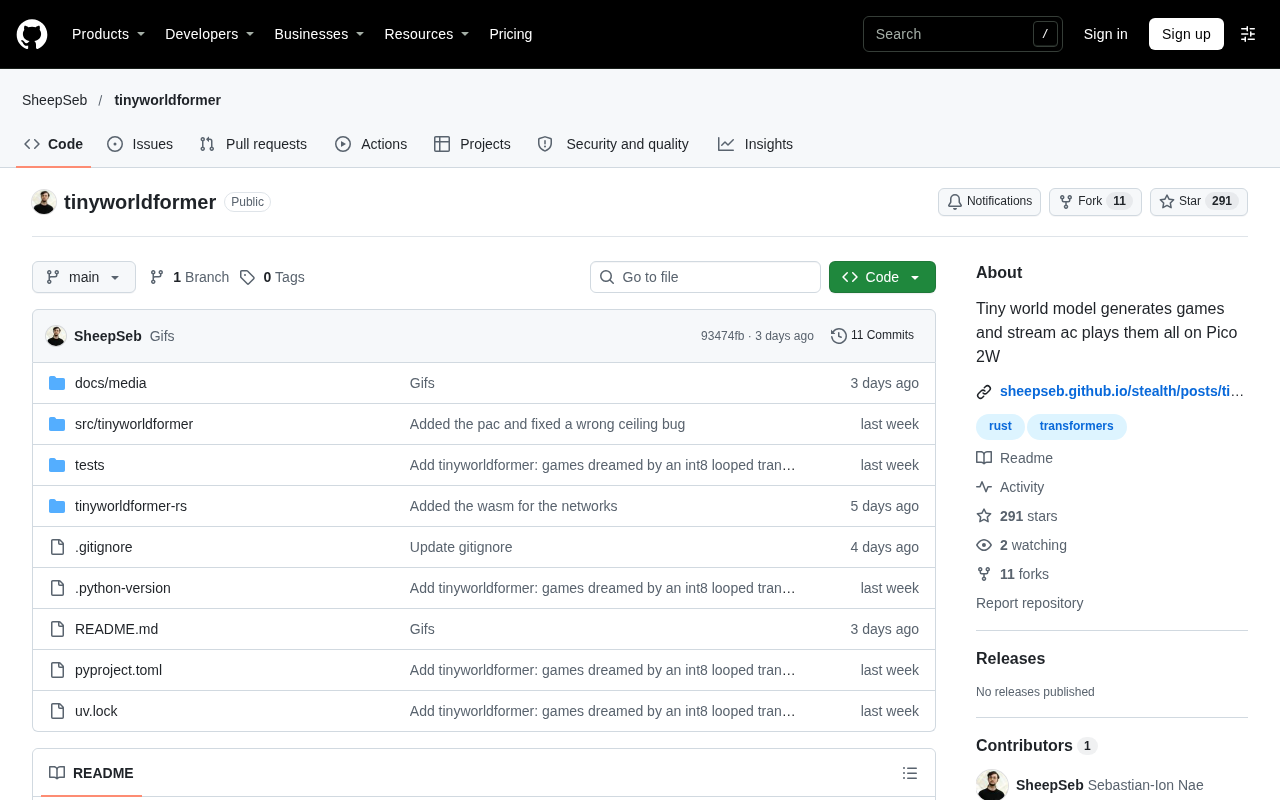
The core idea is not complicated: use a very small neural network model to learn the dynamics of a game environment, then generate the next frame or predict state changes in real time on resource-constrained hardware. The Pico 2 W is powered by the RP2350 microcontroller, whose memory and compute are far below those of a phone or a Raspberry Pi board, so the model must undergo aggressive compression and pruning.
Why a World Model Can Fit on a Microcontroller
Traditional world models (such as those used for autonomous driving or robot planning) often contain millions or even billions of parameters and rely on floating-point operations and external memory. tinyworldformer takes the opposite approach: keep only the minimal state representation the game requires, replace floating-point with fixed-point or quantized arithmetic, and compress the number of layers and channels to extremely low levels.
This "good enough" engineering philosophy lets the model run within KB-level memory. According to the project repository, it can run the game in real time on the Pico 2 W, meaning inference latency is kept within an acceptable frame-rate range. For a microcontroller, that is no small achievement in itself.
World model refers to a class of generative models that learn environment dynamics: given the current state (or observation) and an action, they predict the next state, reward, or observation frame, allowing an agent to "imagine" and plan without interacting with the real environment. Typical examples include the Dreamer series and GAIA-1 for autonomous driving, which usually have huge parameter counts and rely on GPU inference. The key difference of tinyworldformer is that it does not aim for general-purpose environment modeling; instead, it performs end-to-end fitting for a single game, compressing the state space into a very small discrete set. As a result, the model can degrade into a small state-transition table or a shallow network — the fundamental reason it can fit within KB-level memory.
Quantization and pruning are the two main lines of model compression. Quantization maps originally 32-bit floating-point weights and activations to 8-bit or even 4-bit integers, using per-layer or per-channel scaling factors to preserve accuracy; at inference, integer multiply-add replaces floating-point operations, which is especially critical for microcontrollers that lack an FPU or have a weak one. Pruning removes weights or entire channels that contribute little to the output, producing sparse structures that reduce computation. Combined, the two can shrink model size by one to two orders of magnitude at the cost of lower generation quality; tinyworldformer makes exactly this "accuracy for resources" trade-off to compress the model into a range the RP2350 can handle, and the actual results need to be assessed through frame rate and visual coherence.
Open-Source Implementation and HN Community Feedback
tinyworldformer is released as open source on GitHub, so developers can directly inspect the model architecture, training scripts, and deployment code. The Hacker News discussion centered on several directions: first, the practical boundaries of such a tiny world model; second, whether it can scale to more complex games or sensor data; third, the impact of quantization and pruning on generation quality.
Although 18 comments is not many, the discussion quality is relatively high. Some commenters noted that such projects are more like "proofs of concept" and still far from productization; others argued that it reveals a viable path for AI inference on future edge devices — not stuffing all large models into the device, but customizing tiny models for specific tasks.
The Real Significance of Tiny World Models
Between cloud AI and on-device AI, microcontroller AI is an often-overlooked tier. Its advantages are extremely low power consumption, instant response, and offline operation, making it suitable for toys, sensor nodes, wearables, and similar scenarios. tinyworldformer proves that world models do not necessarily require massive compute — at least in simple game environments, it can be done.
Of course, the limitations are obvious: model capacity dictates that it can only handle very limited scenarios, its generalization ability is weak, and the training data is highly specific. But as an open-source exploration, it provides a reproducible starting point for subsequent research on tiny world models.
RP2350 is a dual-core Cortex-M33 microcontroller released by the Raspberry Pi Foundation in 2024, clocked at 150MHz, with 520KB of built-in SRAM and optional 2MB or 4MB of on-chip flash (the Pico 2 W board carries 4MB). It has no dedicated matrix acceleration unit and limited floating-point capability, making it suitable for fixed-point inference. By comparison, a phone SoC typically has several GB of memory and tens of TOPS of NPU compute — a difference of three to four orders of magnitude. The Pico 2 W also includes a wireless module that can be used for remote model updates or data backhaul. Understanding this hardware baseline is necessary to judge just how much compression "running a world model on a microcontroller" actually entails, and why the project can only handle simple game environments.
Engineering Trade-offs Worth Noting
From an engineering perspective, the most instructive aspect of this project is its trade-off strategy: finding a balance among memory, compute, and model expressiveness. It does not pursue high-resolution visuals, nor does it try to simulate complex physics; instead, it focuses on the most essential state transitions in the game loop. This "task-oriented minimalism" offers a useful reference for developers who want to deploy AI on edge devices.
The project's popularity on HN also shows that the community remains curious about "small and beautiful" AI hardware experiments. As microcontroller compute gradually improves, such projects may move from toys to practical use.
Related articles
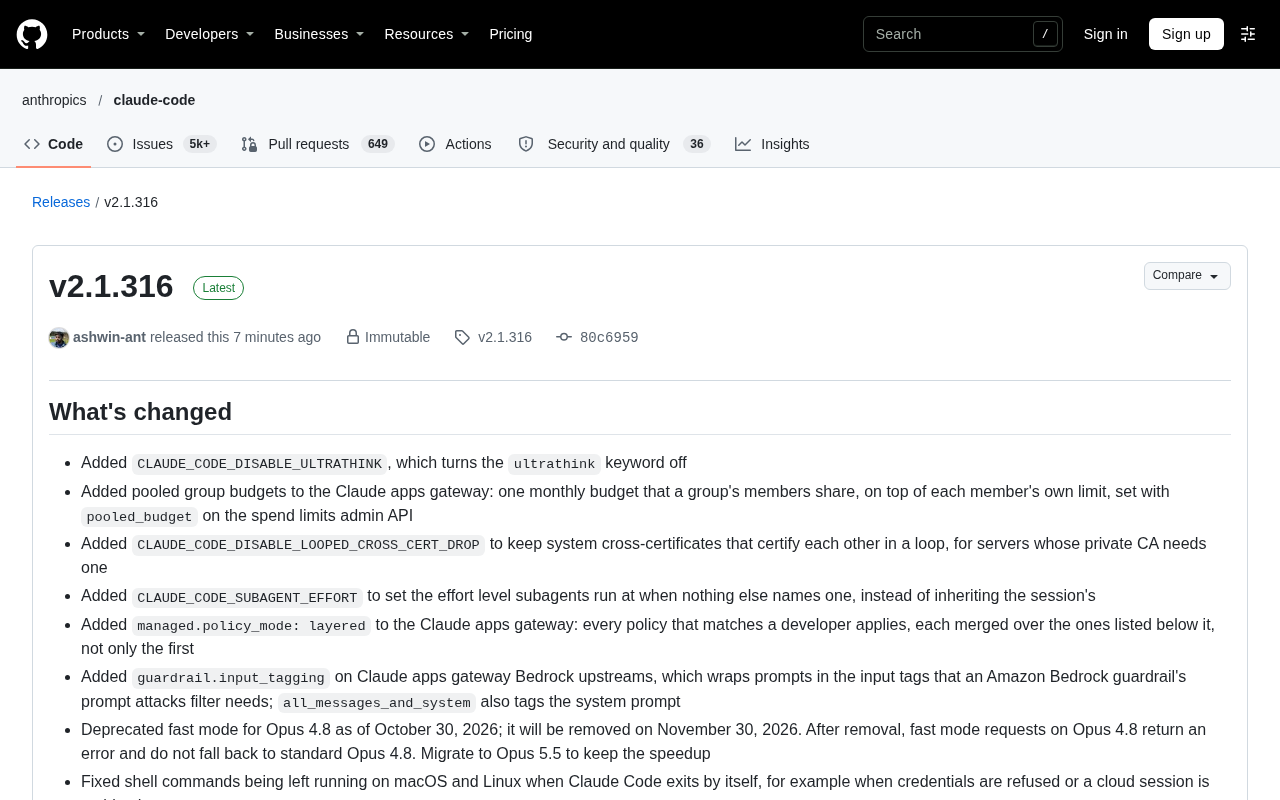
Claude Code v2.1.316 Update Analysis: Enterprise Gateway and Multiple Stability Fixes
Claude Code v2.1.316 released: new enterprise gateway pooled group budgets, layered policy mode, subagent effort control, dozens of Shell, network, and session recovery fixes, and Opus 4.8 fast mode deprecated.

17th-Century British Floods and Doomsday Panic: A New Perspective on Weather History
Based on a Hacker News discussion of '17th-Century British Floods and Foreboding,' this piece explores how extreme weather was given divine and political significance, and what weather history teaches us about contemporary climate communication.

Salesforce Acquires Rune for $375M: AI Logistics Tech Bolsters Defense Business
Salesforce reportedly acquires defense tech startup Rune for $375M. Rune's AI logistics tech will strengthen Salesforce's Missionforce defense platform, continuing its M&A spree.